Arsenault Jason, Gholizadeh Shervin, Niibori Yosuke, Pacey Laura K, Halder Sebok K, Koxhioni Enea, Konno Ayumu, Hirai Hirokazu, Hampson David R
1 Department of Pharmaceutical Sciences, Leslie Dan Faculty of Pharmacy, University of Toronto, Toronto, Ontario, Canada.
2 Department of Neurophysiology and Neural Repair, Gunma University Graduate School of Medicine, Maebashi, Japan.
Hum Gene Ther. 2016 Dec;27(12):982-996. doi: 10.1089/hum.2016.090. Epub 2016 Sep 7.
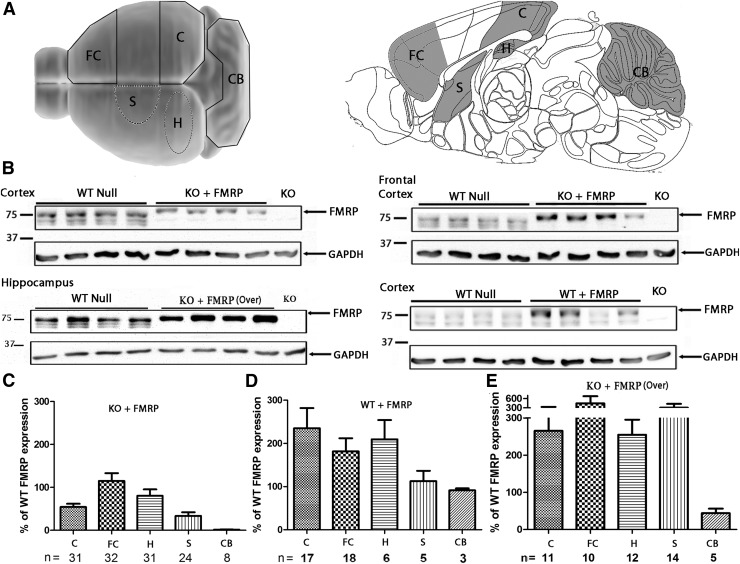
Fragile X mental retardation protein (FMRP) is absent or highly reduced in Fragile X Syndrome, a genetic disorder causing cognitive impairment and autistic behaviors. Previous proof-of-principle studies have demonstrated that restoring FMRP in the brain using viral vectors can improve pathological abnormalities in mouse models of fragile X. However, unlike small molecule drugs where the dose can readily be adjusted during treatment, viral vector-based biological therapeutic drugs present challenges in terms of achieving optimal dosing and expression levels. The objective of this study was to investigate the consequences of expressing varying levels of FMRP selectively in neurons of Fmr1 knockout and wild-type (WT) mice. A wide range of neuronal FMRP transgene levels was achieved in individual mice after intra-cerebroventricular administration of adeno-associated viral vectors coding for FMRP. In all treated knockout mice, prominent FMRP transgene expression was observed in forebrain structures, whereas lower levels were present in more caudal regions of the brain. Reduced levels of the synaptic protein PSD-95, elevated levels of the transcriptional modulator MeCP2, and abnormal motor activity, anxiety, and acoustic startle responses in Fmr1 knockout mice were fully or partially rescued after expression of FMRP at about 35-115% of WT expression, depending on the brain region examined. In the WT mouse, moderate FMRP over-expression of up to about twofold had little or no effect on PSD-95 and MeCP2 levels or on behavioral endophenotypes. In contrast, excessive over-expression in the Fmr1 knockout mouse forebrain (approximately 2.5-6-fold over WT) induced pathological motor hyperactivity and suppressed the startle response relative to WT mice. These results delineate a range of FMRP expression levels in the central nervous system that confer phenotypic improvement in fragile X mice. Collectively, these findings are pertinent to the development of long-term curative gene therapy strategies for treating Fragile X Syndrome and other neurodevelopmental disorders.
脆性X智力低下蛋白(FMRP)在脆性X综合征中缺失或高度减少,这是一种导致认知障碍和自闭症行为的遗传性疾病。先前的原理验证研究表明,使用病毒载体在大脑中恢复FMRP可以改善脆性X小鼠模型中的病理异常。然而,与小分子药物不同,小分子药物在治疗过程中剂量可以很容易地调整,基于病毒载体的生物治疗药物在实现最佳剂量和表达水平方面存在挑战。本研究的目的是研究在Fmr1基因敲除和野生型(WT)小鼠的神经元中选择性表达不同水平FMRP的后果。在脑室内注射编码FMRP的腺相关病毒载体后,在个体小鼠中实现了广泛的神经元FMRP转基因水平。在所有接受治疗的基因敲除小鼠中,在前脑结构中观察到显著的FMRP转基因表达,而在大脑更靠后的区域中表达水平较低。在Fmr1基因敲除小鼠中,突触蛋白PSD-95水平降低、转录调节因子MeCP2水平升高以及异常的运动活动、焦虑和听觉惊吓反应,在表达约为野生型表达水平的35%-115%的FMRP后,根据所检查的脑区,这些症状得到了完全或部分缓解。在野生型小鼠中,适度的FMRP过表达高达约两倍,对PSD-95和MeCP2水平或行为内表型几乎没有影响。相比之下,Fmr1基因敲除小鼠前脑中过度的过表达(比野生型高约2.5-6倍)诱导了病理性运动亢进,并相对于野生型小鼠抑制了惊吓反应。这些结果描绘了中枢神经系统中一系列FMRP表达水平,这些水平可使脆性X小鼠的表型得到改善。总的来说,这些发现与治疗脆性X综合征和其他神经发育障碍的长期治愈性基因治疗策略的开发相关。