Couce María L, Vitoria Isidro, Aldámiz-Echevarría Luís, Fernández-Marmiesse Ana, Roca Iria, Llarena Marta, Sánchez-Pintos Paula, Leis Rosaura, Hermida Alvaro
Unit of Diagnosis and Treatment of Congenital Metabolic Diseases. S. Neonatology, Department of Pediatrics, Hospital Clínico Universitario de Santiago, CIBERER, Health Research Institute of Santiago de Compostela (IDIS), Travesía da Choupana s/n, 15706, Santiago de Compostela, A Coruña, Spain.
Unit of Metabolopathies, Hospital Universitario La Fe, Bulevar sur s/n, 46021, Valencia, Spain.
Orphanet J Rare Dis. 2016 Sep 9;11(1):123. doi: 10.1186/s13023-016-0508-x.
The mainstay of treating patients with phenylketonuria (PKU) is based on a Phe-restricted diet, restrictive in natural protein combined with Phe-free L-amino acid supplements and low protein foods. This PKU diet seems to reduce atherogenesis and confer protection against cardiovascular diseases but the results from the few published studies have been inconclusive. The aim of our study was to evaluate the relationship between the lipid profile and several treatment-related risk factors in patients with hyperphenylalaninaemia (HPA) in order to optimize their monitoring.
We conducted a cross-sectional multicentre study. A total of 141 patients with HPA were classified according to age, phenotype, type of treatment and dietary adherence. Annual median blood phenylalanine (Phe) levels, Phe tolerance, anthropometric measurements, blood pressure (BP) and biochemical parameters [(triglycerides, total cholesterol (TC), high-density lipoprotein cholesterol (HDL-C), low density lipoprotein-cholesterol (LDL-C), apolipoprotein A (ApoA), apolipoprotein B (ApoB), vitamin B12, total homocysteine (tHcy), Methionine (Met), high sensitivity C-Reactive Protein (hsCRP)] were collected for each patient.
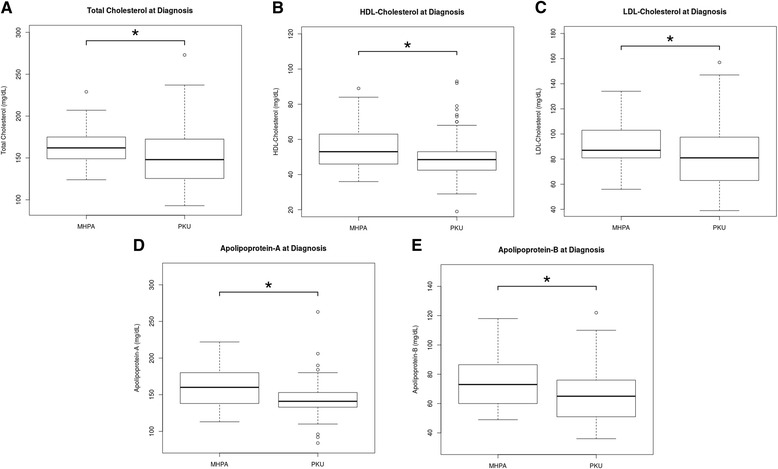
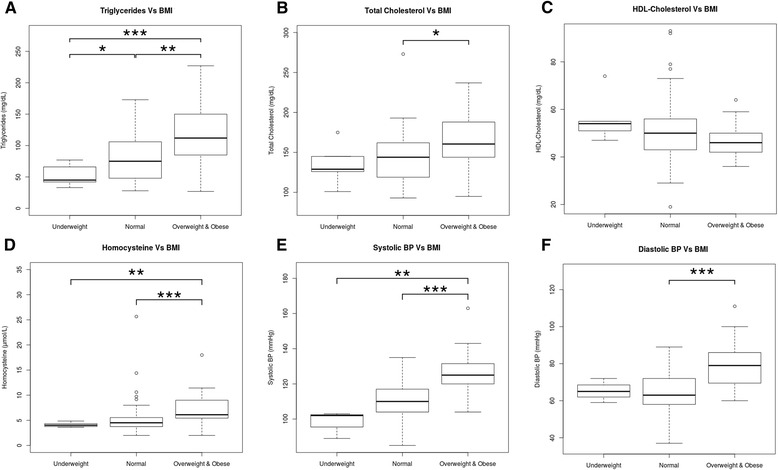
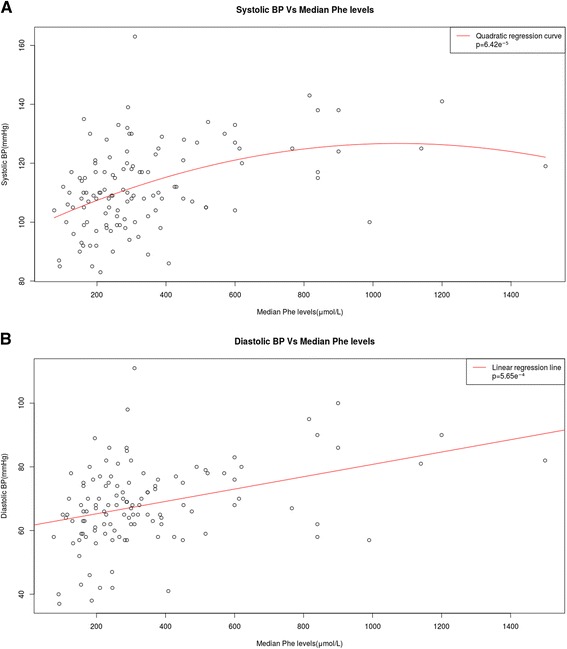
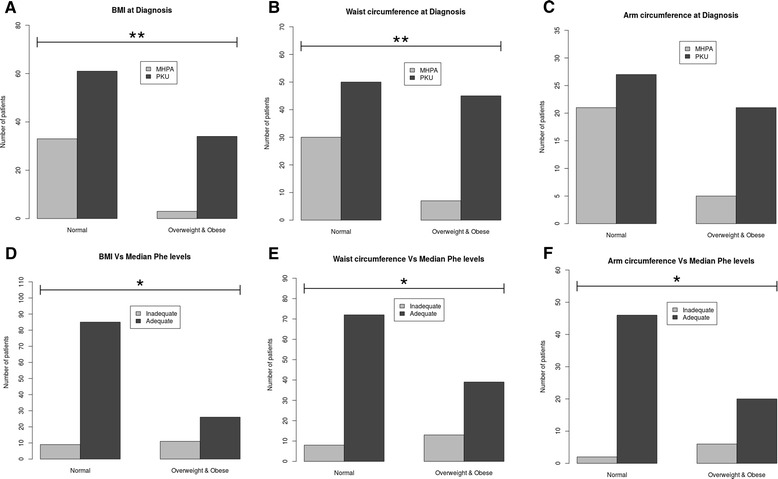
Plasma TC levels were lower in patients with PKU than in the mild-HPA group (150 ± 31 vs. 164 ± 22 mg/dL), and there was a weak inverse correlation between plasma TC and Phe levels. HDL-C, LDL-C, ApoA and ApoB levels were lower in the PKU group than in mild-HPA. Patients with PKU had higher systolic BP than the mild-HPA group and there was found a quadratic correlation between median Phe levels and systolic BP (p = 6.42e(-5)) and a linear correlation between median Phe levels and diastolic BP (p = 5.65e(-4)). In overweight or obese PKU patients (24.11 %), biochemical parameters such as TC, triglycerides, LDL-C, tHcy, hsCRP and BP were higher. By contrast, HDL-C was lower in these patients.
Our data show a direct correlation between lipid profile parameters and good adherence to the diet in PKU patients. However, lipid profile in overweight or obese patients displayed an atherogenic profile, in addition to higher hsCRP concentrations and BP. Our study contributes to a better understanding of the relationship between phenotype and treatment in patients with HPA, which could be useful in improving follow-up strategies and clinical outcome.
Research Ethics Committee of Santiago-Lugo 2015/393. Registered 22 September 2015, retrospectively registered.
治疗苯丙酮尿症(PKU)患者的主要方法是采用低苯丙氨酸饮食,即限制天然蛋白质摄入,同时补充无苯丙氨酸的L-氨基酸和低蛋白食物。这种PKU饮食似乎能减少动脉粥样硬化的发生,并预防心血管疾病,但少数已发表研究的结果尚无定论。我们研究的目的是评估高苯丙氨酸血症(HPA)患者的血脂谱与几种治疗相关风险因素之间的关系,以优化对他们的监测。
我们进行了一项横断面多中心研究。根据年龄、表型、治疗类型和饮食依从性对总共141例HPA患者进行分类。收集每位患者的年度血苯丙氨酸(Phe)水平中位数、Phe耐受性、人体测量数据、血压(BP)和生化参数[甘油三酯、总胆固醇(TC)、高密度脂蛋白胆固醇(HDL-C)、低密度脂蛋白胆固醇(LDL-C)、载脂蛋白A(ApoA)、载脂蛋白B(ApoB)、维生素B12、总同型半胱氨酸(tHcy)、蛋氨酸(Met)、高敏C反应蛋白(hsCRP)]。
PKU患者的血浆TC水平低于轻度HPA组(150±31 vs. 164±22mg/dL),血浆TC与Phe水平之间存在微弱的负相关。PKU组的HDL-C、LDL-C、ApoA和ApoB水平低于轻度HPA组。PKU患者的收缩压高于轻度HPA组,且发现Phe水平中位数与收缩压之间存在二次相关性(p = 6.42e(-5)),Phe水平中位数与舒张压之间存在线性相关性(p = 5.65e(-4))。在超重或肥胖的PKU患者中(24.11%),TC、甘油三酯、LDL-C、tHcy、hsCRP和BP等生化参数较高。相比之下,这些患者的HDL-C较低。
我们的数据表明PKU患者的血脂谱参数与良好的饮食依从性之间存在直接相关性。然而,超重或肥胖患者的血脂谱呈现动脉粥样硬化特征,此外hsCRP浓度和血压也较高。我们的研究有助于更好地理解HPA患者的表型与治疗之间的关系,这可能有助于改善随访策略和临床结局。
圣地亚哥 - 卢戈研究伦理委员会2015/393。于2015年9月22日注册,追溯注册。