Cui Xiaoyan, Nichols Shane M, Arteaga Oriol, Freudenthal John, Paula Froilanny, Shtukenberg Alexander G, Kahr Bart
Department of Chemistry and Molecular Design Institute, New York University , 100 Washington Square East, New York, New York 10003, United States.
Departament de Física Aplicada, Institute of Nanoscience and Nanotechnology (IN2UB), Universitat de Barcelona , C/Martí i Franqués 1, 08028 Barcelona, Catalonia, Spain.
J Am Chem Soc. 2016 Sep 21;138(37):12211-8. doi: 10.1021/jacs.6b06278. Epub 2016 Sep 12.
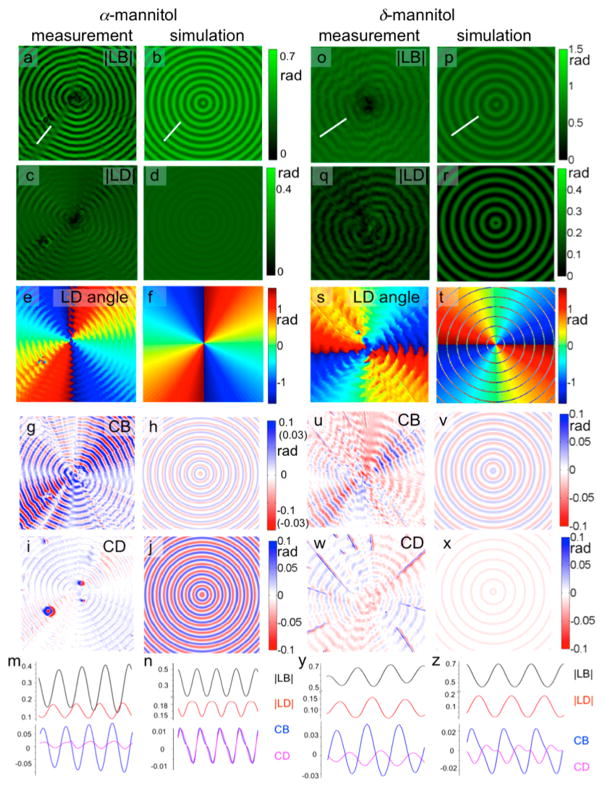
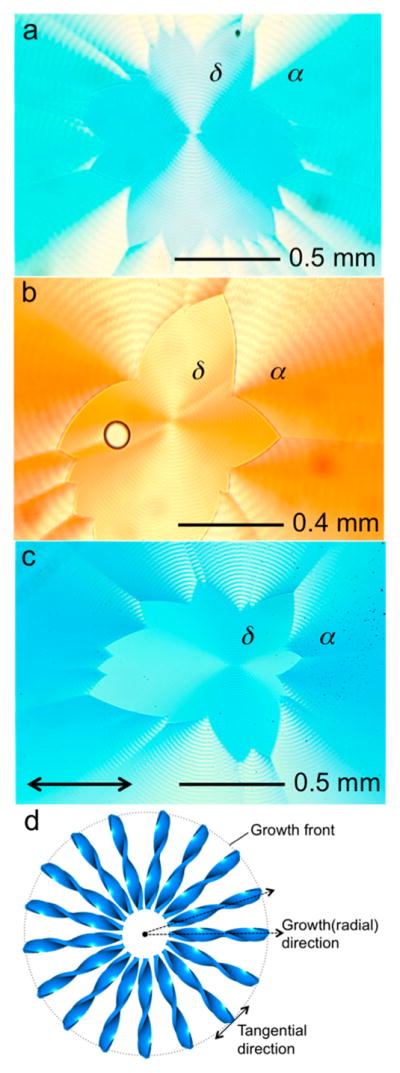
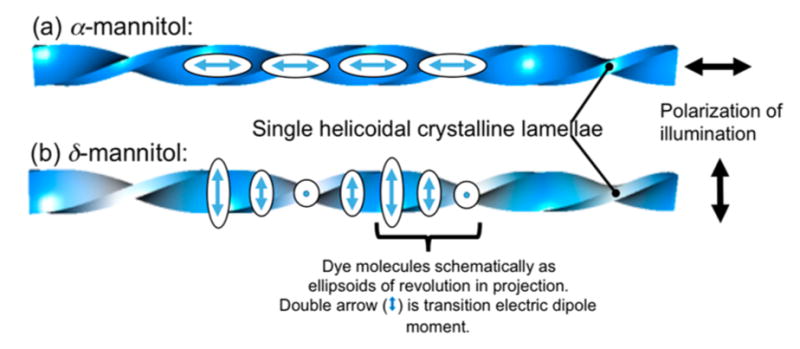
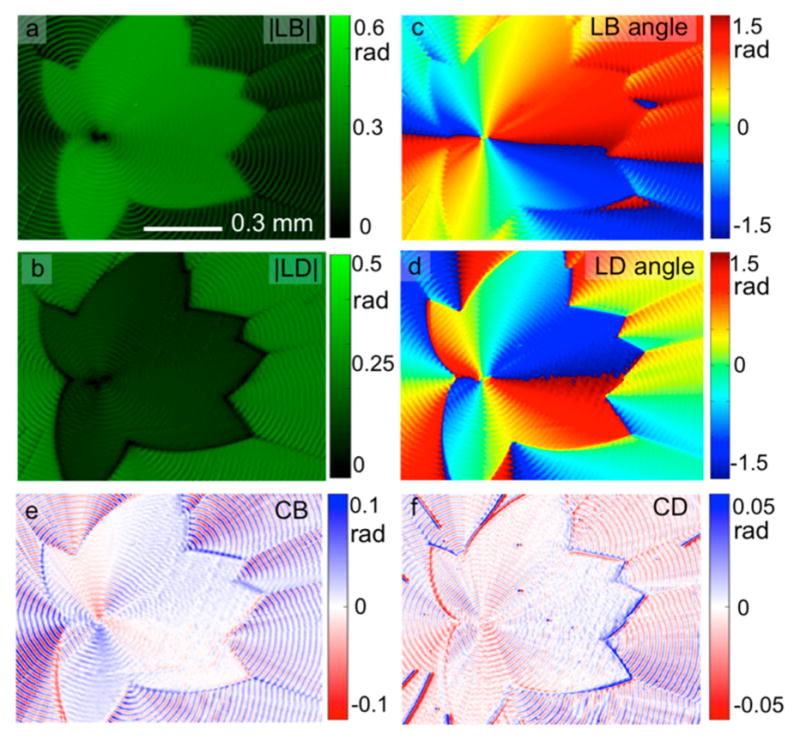
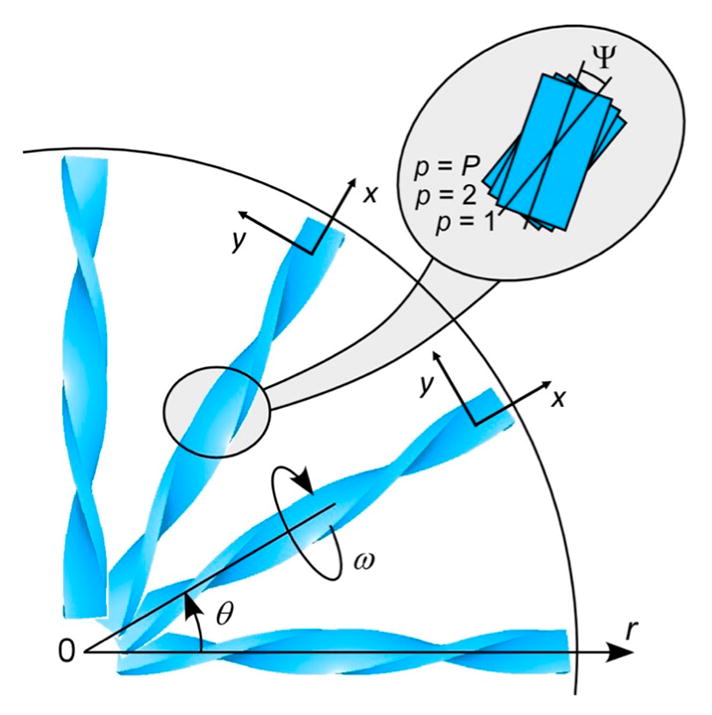
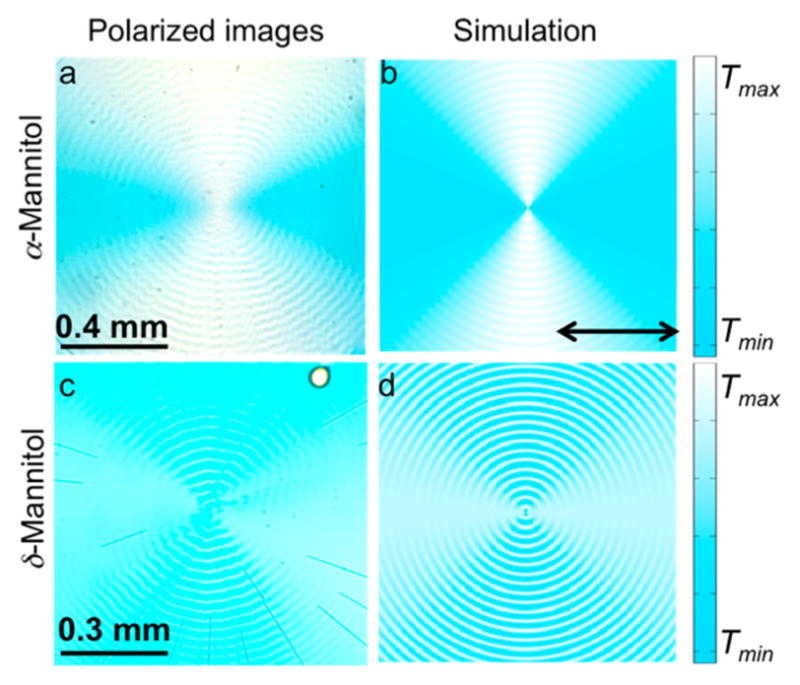
Accounting for the interactions of light with heterogeneous, anisotropic, absorbing, optically active media is part of the characterization of complex, transparent materials. Stained biological structures in thin tissue sections share many of these features, but systematic optical analyses beyond the employ of the simple petrographic microscopes have not be established. Here, this accounting is made for polycrystalline, spherulitic bundles of twisted d-mannitol lamellae grown from melts containing light-absorbing molecules. It has long been known that a significant percentage of molecular crystals readily grow as helicoidal ribbons with mesoscale pitches, but a general appreciation of the commonality of these non-classical crystal forms has been lost. Helicoidal crystal twisting was typically assayed by analyzing refractivity modulation in the petrographic microscope. However, by growing twisted crystals from melts in the presence of dissolved, light-absorbing molecules, crystal twisting can be assayed by analyzing the dichroism, both linear and circular. The term "helicoidal dichroism" is used here to describe the optical consequences of anisotropic absorbers precessing around radii of twisted crystalline fibrils or lamellae. d-Mannitol twists in two polymorphic forms, α and δ. The two polymorphs, when grown from supercooled melts in the presence of a variety of histochemical stains and textile dyes, are strongly dichroic in linearly polarized white light. The bis-azo dye Chicago sky blue is modeled because it is most absorbing when parallel and perpendicular to the radial axes in the respective spherulitic polymorphs. Optical properties were measured using Mueller matrix imaging polarimetry and simulated by taking into account the microstructure of the lamellae. The optical analysis of the dyed, patterned polycrystals clarifies aspects of the mesostructure that can be difficult to extract from bundles of tightly packed fibrils.
考虑光与非均匀、各向异性、吸收性、光学活性介质的相互作用是复杂透明材料表征的一部分。薄组织切片中染色的生物结构具有许多这些特征,但除了使用简单的偏光显微镜之外,尚未建立系统的光学分析方法。在此,对从含有光吸收分子的熔体中生长出的扭曲d-甘露糖醇薄片的多晶球晶束进行了这种分析。长期以来,人们一直知道相当比例的分子晶体很容易生长成具有中尺度螺距的螺旋带,但对这些非经典晶体形式的共性缺乏普遍认识。螺旋晶体扭曲通常通过分析偏光显微镜中的折射率调制来测定。然而,通过在溶解有光吸收分子的熔体中生长扭曲晶体,可以通过分析线性和圆二色性来测定晶体扭曲。这里使用“螺旋二色性”一词来描述各向异性吸收体围绕扭曲晶体原纤维或薄片半径进动的光学后果。d-甘露糖醇以两种多晶型形式扭曲,即α型和δ型。当在各种组织化学染色剂和纺织染料存在下从过冷熔体中生长时,这两种多晶型在线偏振白光中具有强烈的二色性。以双偶氮染料芝加哥天蓝为例进行建模,因为它在各自球晶多晶型中与径向轴平行和垂直时吸收最强。使用穆勒矩阵成像偏振测量法测量光学性质,并通过考虑薄片的微观结构进行模拟。对染色的图案化多晶体的光学分析阐明了介观结构的一些方面,这些方面可能很难从紧密堆积的原纤维束中提取出来。