Matin Mohammed Mahbubul, Nath Amit R, Saad Omar, Bhuiyan Mohammad M H, Kadir Farkaad A, Abd Hamid Sharifah Bee, Alhadi Abeer A, Ali Md Eaqub, Yehye Wageeh A
Organic Research Laboratory, Department of Chemistry, University of Chittagong, Chittagong 4331, Bangladesh.
Nanotechnology & Catalysis Research Centre (NANOCAT), University of Malaya, Block 3A, Institute of Postgraduate Studies Building, Kuala Lumpur 50603, Malaysia.
Int J Mol Sci. 2016 Aug 27;17(9):1412. doi: 10.3390/ijms17091412.
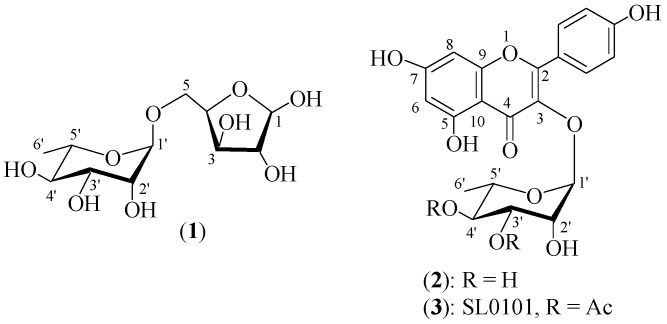
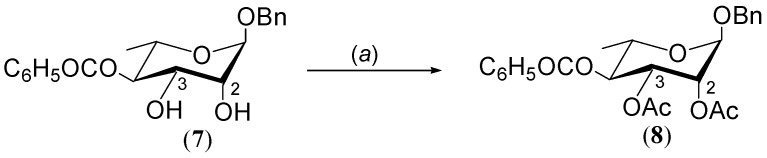
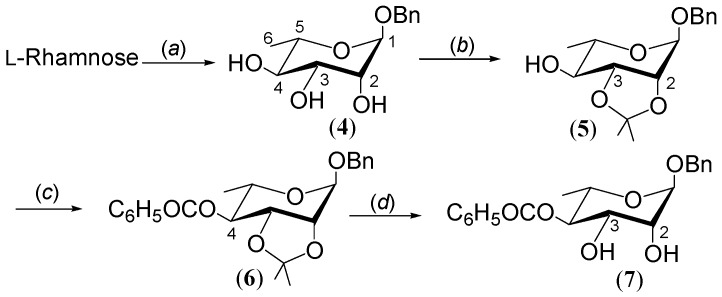
Benzyl α-l-rhamnopyranoside 4, obtained by both conventional and microwave assisted glycosidation techniques, was subjected to 2,3-O-isopropylidene protection to yield compound 5 which on benzoylation and subsequent deprotection of isopropylidene group gave the desired 4-O-benzoylrhamnopyranoside 7 in reasonable yield. Di-O-acetyl derivative of benzoate 7 was prepared to get newer rhamnopyranoside. The structure activity relationship (SAR) of the designed compounds was performed along with the prediction of activity spectra for substances (PASS) training set. Experimental studies based on antimicrobial activities verified the predictions obtained by the PASS software. Protected rhamnopyranosides 5 and 6 exhibited slight distortion from regular ¹C₄ conformation, probably due to the fusion of pyranose and isopropylidene ring. Synthesized rhamnopyranosides 4-8 were employed as test chemicals for in vitro antimicrobial evaluation against eight human pathogenic bacteria and two fungi. Antimicrobial and SAR study showed that the rhamnopyranosides were prone against fungal organisms as compared to that of the bacterial pathogens. Interestingly, PASS prediction of the rhamnopyranoside derivatives 4-8 were 0.49 < Pa < 0.60 (where Pa is probability 'to be active') as antibacterial and 0.65 < Pa < 0.73 as antifungal activities, which showed significant agreement with experimental data, suggesting rhamnopyranoside derivatives 4-8 were more active against pathogenic fungi as compared to human pathogenic bacteria thus, there is a more than 50% chance that the rhamnopyranoside derivative structures 4-8 have not been reported with antimicrobial activity, making it a possible valuable lead compound.
通过常规和微波辅助糖苷化技术获得的苄基α-L-鼠李吡喃糖苷4,进行2,3-O-异亚丙基保护以生成化合物5,化合物5经苯甲酰化以及随后的异亚丙基脱保护,以合理的产率得到所需的4-O-苯甲酰基鼠李吡喃糖苷7。制备苯甲酸酯7的二-O-乙酰基衍生物以得到新型鼠李吡喃糖苷。对设计的化合物进行了结构活性关系(SAR)研究以及物质活性谱预测(PASS)训练集分析。基于抗菌活性的实验研究验证了PASS软件获得的预测结果。受保护的鼠李吡喃糖苷5和6与规则的¹C₄构象略有偏差,这可能是由于吡喃糖环和异亚丙基环的稠合所致。合成的鼠李吡喃糖苷4-8用作测试化学品,用于对八种人类致病细菌和两种真菌进行体外抗菌评估。抗菌和SAR研究表明,与细菌病原体相比,鼠李吡喃糖苷对真菌生物体更敏感。有趣的是,鼠李吡喃糖苷衍生物4-8的PASS预测结果为:作为抗菌剂时0.49 < Pa < 0.60(其中Pa是“具有活性”的概率),作为抗真菌剂时0.65 < Pa < 0.73,这与实验数据显示出显著一致性,表明与人类致病细菌相比,鼠李吡喃糖苷衍生物4-8对致病真菌更具活性,因此,鼠李吡喃糖苷衍生物结构4-8具有抗菌活性的报道可能性超过50%,使其成为一种可能有价值的先导化合物。