Bousie E, van Blokland D, Lammers H J W, van Zanten A R H
Department of Intensive Care Medicine, Care Division, Gelderse Vallei Hospital, Ede, The Netherlands.
Department of Clinical Pharmacy, Gelderse Vallei Hospital, Ede, The Netherlands.
Eur J Clin Nutr. 2016 Dec;70(12):1443-1450. doi: 10.1038/ejcn.2016.167. Epub 2016 Sep 14.
BACKGROUND/OBJECTIVES: Overfeeding in critically ill patients is associated with many complications. Propofol, dextrose infusion and citrate dialysis provide non-nutritional calories (NNCs), potentially causing overfeeding. The relevance of NNCs for total caloric intake has not been systematically studied.
SUBJECTS/METHODS: We retrospectively studied adult mechanically ventilated intensive care unit (ICU) patients receiving enteral nutrition with or without supplemental parenteral nutrition. Primary outcome was the proportion of NNCs (from dextrose, propofol and trisodium citrate) to the total energy intake during the first 7 days after ICU admission. In addition, NNC intake groups were compared.
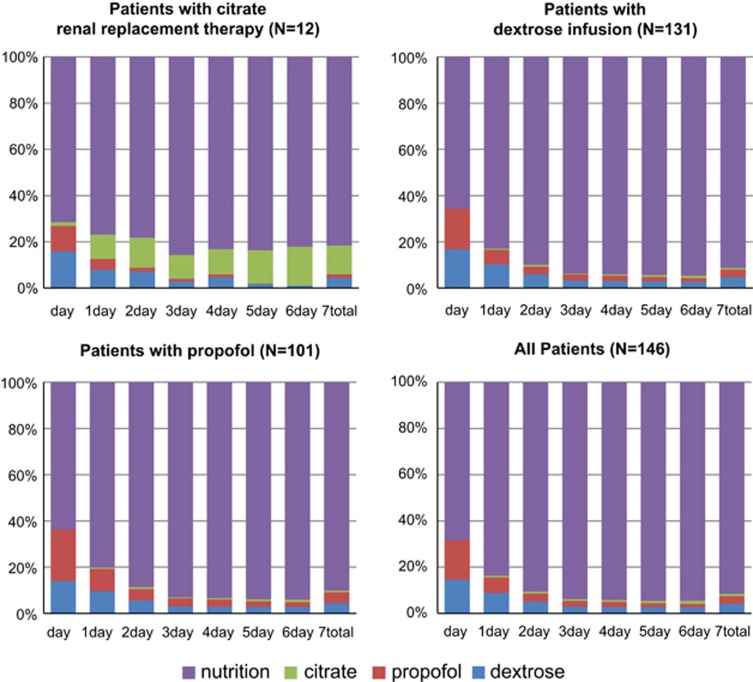
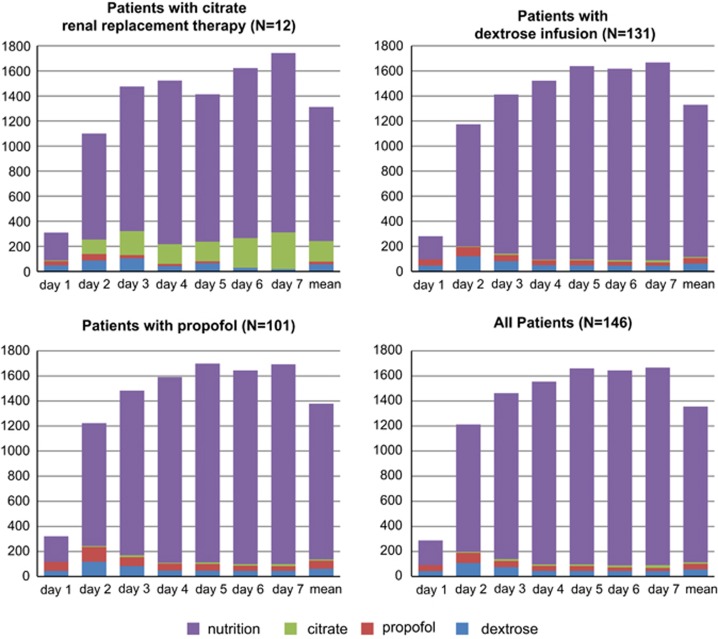
In total, we identified 146 patients: 142 patients with NNC median value of 580 kcal (interquartile range 310-1043 kcal) over 7 days and 4 patients without NNC intake. The mean proportion of NNCs was larger during the first days after ICU admission (30.7-36.1%), because of the start-up phase of the nutrition. In the 'propofol' group and the 'dextrose' group this proportion levelled off at 6% on day 4. A more stable proportion of 18% was found during the first 7 days of ICU admission in the 'citrate' group.
The mean proportion of NNCs in patients who receive dextrose and/or propofol is low (6%); however, in individual patients it may comprise one-third of the total daily calories. Patients receiving trisodium citrate have higher mean non-nutritional intakes (18%). As NNC intake can be marked in individual patients, close monitoring is warranted when administering high-dose propofol or trisodium citrate anticoagulation to prevent overfeeding.
背景/目的:危重症患者营养过剩与多种并发症相关。丙泊酚、葡萄糖输注和枸橼酸盐透析可提供非营养性热量(NNCs),可能导致营养过剩。NNCs对总热量摄入的相关性尚未得到系统研究。
对象/方法:我们回顾性研究了接受肠内营养加或不加肠外营养补充的成年机械通气重症监护病房(ICU)患者。主要结局是ICU入院后前7天NNCs(来自葡萄糖、丙泊酚和枸橼酸钠)占总能量摄入的比例。此外,对NNC摄入量组进行了比较。
我们共纳入146例患者:142例患者7天内NNC中位数为580千卡(四分位间距310 - 1043千卡),4例患者无NNC摄入。由于营养启动阶段,ICU入院后最初几天NNCs的平均比例较大(30.7 - 36.1%)。在“丙泊酚”组和“葡萄糖”组,该比例在第4天稳定在6%。“枸橼酸盐”组在ICU入院的前7天发现比例更稳定,为18%。
接受葡萄糖和/或丙泊酚的患者中NNCs的平均比例较低(6%);然而,在个别患者中,它可能占每日总热量的三分之一。接受枸橼酸钠的患者平均非营养性摄入量较高(18%)。由于个别患者的NNC摄入量可能较高,在给予大剂量丙泊酚或枸橼酸钠抗凝治疗时,有必要密切监测以防止营养过剩。