Department of Medicine, Division of Nephrology, University of California, Irvine, CA, USA.
Department of Neurology, University of California, San Diego, CA, USA.
Transl Stroke Res. 2017 Feb;8(1):67-76. doi: 10.1007/s12975-016-0499-x. Epub 2016 Sep 14.
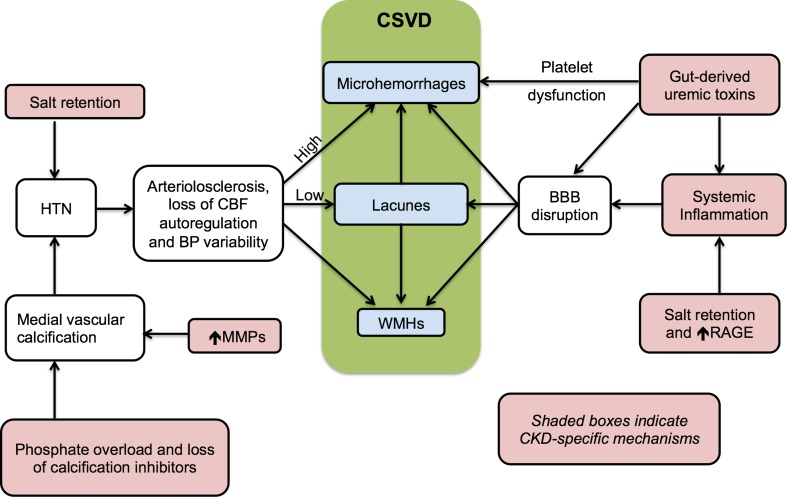
Chronic kidney disease (CKD) is an independent risk factor for the development of cerebrovascular disease, particularly small vessel disease which can manifest in a variety of phenotypes ranging from lacunes to microbleeds. Small vessel disease likely contributes to cognitive dysfunction in the CKD population. Non-traditional risk factors for vascular injury in uremia include loss of calcification inhibitors, hyperphosphatemia, increased blood pressure variability, elastinolysis, platelet dysfunction, and chronic inflammation. In this review, we discuss the putative pathways by which these mechanisms may promote cerebrovascular disease and thus increase risk of future stroke in CKD patients.
慢性肾脏病(CKD)是脑血管疾病发展的独立危险因素,特别是小血管疾病,其可表现出从腔隙到微出血等多种表型。小血管疾病可能导致 CKD 人群的认知功能障碍。尿毒症血管损伤的非传统危险因素包括钙抑制剂丢失、高磷血症、血压变异性增加、弹性蛋白溶解、血小板功能障碍和慢性炎症。在这篇综述中,我们讨论了这些机制可能促进脑血管疾病并因此增加 CKD 患者未来中风风险的推测途径。