Liu Fang, Wang Hong-Mei, Wang Tiansheng, Zhang Ya-Mei, Zhu Xi
Department of Pharmacy, Peking University Third Hospital, Beijing, 100191, China.
Department of Pharmacy, Yanqing Teaching Hospital of Capital Medical University/Yanqing County Hospital, Beijing, 102100, China.
BMC Infect Dis. 2016 Sep 15;16:488. doi: 10.1186/s12879-016-1823-5.
Thymosin α1 (Tα1) as immunomodulatory treatment is supposed to be beneficial for the sepsis patients by regulating T cell subsets and inflammatory mediators. However, limited by the small sample size and the poor study design, the persuasive power of the single clinical studies is weak. This meta-analysis aimed to investigate the impact of Tα1 on the sepsis patients.
We searched for the Cochrane Central Register of Controlled Trials, MEDLINE, EMBASE, CBM, VIP, CNKI, WANFANG, Igaku Chuo Zasshi (ICHUSHI) and Korean literature databases reporting the effects of Tα1 on outcomes in sepsis patients.
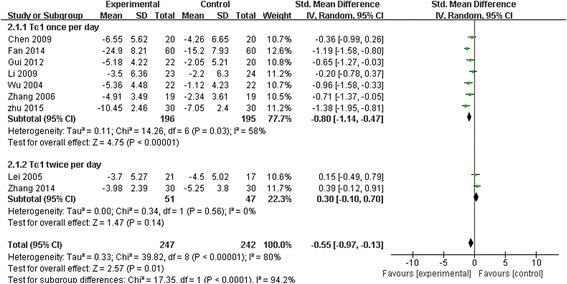
Among 444 related articles, 19 randomized controlled trials (RCTs) met our inclusion criteria. Mortality events were reported in 10 RCTs included 530 patients, and the meta-analysis showed significant decrease in Tα1 group compared with control group (RR 0.59, 95 % CI 0.45 to 0.77, p = 0.0001). The subgroup analysis showed no difference between the two dosages (RR 0.59, 95 % CI 0.43 to 0.81; RR 0.59, 95 % CI 0.35 to 0.98, respectively). In 9 RCTs, with a total of 489 patients, Tα1 administered once per day decrease APACHE II score significantly (SMD -0.80, 95 % CI -1.14 to -0.47, p < 0.0001) while Tα1 twice per day showed no effect (SMD 0.30, 95 % CI-0.10 to 0.70, p = 0.14). However, the length of ICU stay, the incidence of multiple organ failure (MOF) and duration of mechanical ventilation were not significantly affected by Tα1 treatment (SMD -0.52, 95 % CI -1.06 to 0.11, p = 0.06; SMD -0.49, 95 % CI -1.09 to 0.11, p = 0.11; SMD -0.37, 95 % CI -0.90 to 0.17, p = 0.17, respectively). As to the immunological indicators, the level of HLA-DR were increased by Tα1 (SMD 1.23, 95 % CI 0.28 to 2.18, p = 0.01) according to the pooled analysis of 8 studies involving 721 patients. Lymphocyte subsets CD3, CD4 and cytokines IL-6, IL-10 and TNF-α were also beneficially affected by Tα1 treatment.
Tα1 may be beneficial to sepsis patients in reducing mortality and modulating inflammation reactions. However, the quality of evidence supporting the effectiveness is low considering the small sample sizes and inadequate adherence to standardized reporting guidelines for RCTs among the included studies.
胸腺素α1(Tα1)作为免疫调节治疗手段,被认为可通过调节T细胞亚群和炎症介质对脓毒症患者有益。然而,受样本量小和研究设计欠佳的限制,单个临床研究的说服力较弱。本荟萃分析旨在探究Tα1对脓毒症患者的影响。
我们检索了Cochrane对照试验中心注册库、MEDLINE、EMBASE、中国生物医学文献数据库、维普资讯、中国知网、万方数据库、《医学中央杂志》以及韩国文献数据库,以查找报告Tα1对脓毒症患者预后影响的文献。
在444篇相关文章中,19项随机对照试验(RCT)符合我们的纳入标准。10项RCT报告了死亡事件,共纳入530例患者,荟萃分析显示Tα1组与对照组相比死亡率显著降低(风险比[RR]0.59,95%置信区间[CI]0.45至0.77,p = 0.0001)。亚组分析显示两种剂量之间无差异(RR分别为0.59,95%CI 0.43至0.81;RR 0.59,95%CI 0.35至0.98)。在9项RCT中,共489例患者,每天给药1次的Tα1显著降低急性生理与慢性健康状况评分系统II(APACHE II)评分(标准化均数差[SMD] -0.80,95%CI -1.14至-0.47,p < 0.0001),而每天给药2次的Tα1则无效果(SMD 0.30,95%CI -0.10至0.70,p = 0.14)。然而,Tα1治疗对重症监护病房(ICU)住院时间、多器官功能衰竭(MOF)发生率及机械通气时间无显著影响(SMD分别为-0.52,95%CI -1.06至0.11,p = 0.06;SMD -0.49,95%CI -1.09至0.11,p = 0.11;SMD -0.37,95%CI -0.90至0.17,p = 0.17)。关于免疫指标,根据对涉及721例患者的8项研究的汇总分析,Tα1可提高人类白细胞抗原-DR(HLA-DR)水平(SMD 1.23,95%CI 0.28至2.18,p = 0.01)。Tα1治疗对淋巴细胞亚群CD3、CD4以及细胞因子白细胞介素-6(IL-6)、白细胞介素-10(IL-10)和肿瘤坏死因子-α(TNF-α)也有有益影响。
Tα1可能对脓毒症患者有益,可降低死亡率并调节炎症反应。然而,鉴于纳入研究中样本量小且未充分遵循RCT标准化报告指南,支持其有效性的证据质量较低。