Kanemasa Hikaru, Fukai Ryoko, Sakai Yasunari, Torio Michiko, Miyake Noriko, Lee Sooyoung, Ono Hiroaki, Akamine Satoshi, Nishiyama Kei, Sanefuji Masafumi, Ishizaki Yoshito, Torisu Hiroyuki, Saitsu Hirotomo, Matsumoto Naomichi, Hara Toshiro
Department of Pediatrics, Graduate School of Medical Sciences, Kyushu University, 3-1-1 Maidashi, Higashi-ku, Fukuoka, 812-8582, Japan.
Department of Human Genetics, Yokohama City University School of Medicine, Yokohama, Japan.
BMC Neurol. 2016 Sep 15;16:174. doi: 10.1186/s12883-016-0680-6.
Alternating hemiplegia of childhood (AHC) is a rare neurological disorder that manifests recurrent attacks of hemiplegia, oculogyric, and choreoathetotic involuntary movements. De novo mutations in ATP1A3 cause three types of neurological diseases: AHC; rapid-onset dystonia-Parkinsonism (RDP); and cerebellar ataxia, areflexia, pes cavus, optic atrophy, and sensorineural hearing loss (CAPOS) syndromes. It remains to be determined whether or not a rare mutation in ATP1A3 may cause atypical phenotypes.
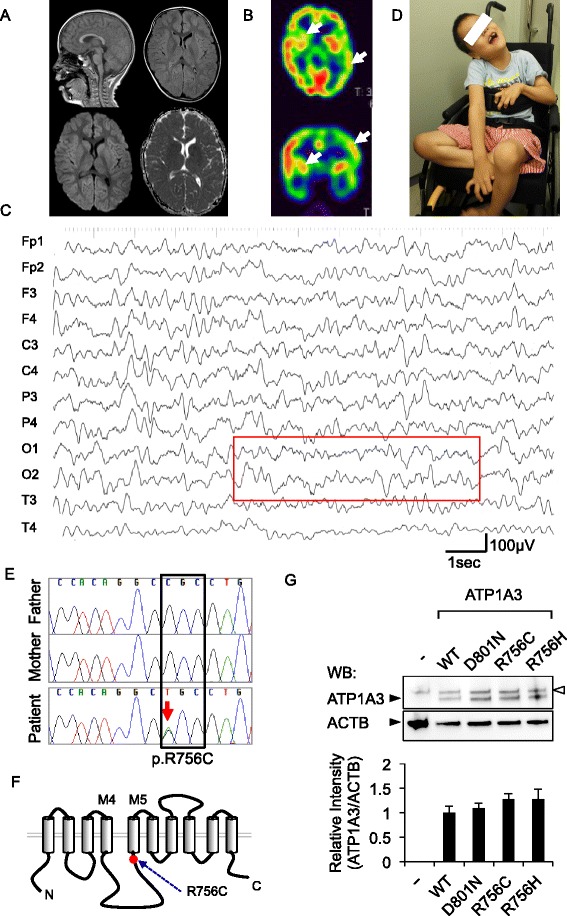
A 7-year-old boy presented with recurrent symptoms of generalized paralysis since 1 year and 5 months of age. Hypotonia, dystonia, and choreoathetosis persisted with exacerbation under febrile conditions, but no cerebellar ataxia had ever evolved in 6 years. Whole-exome sequencing (WES) was performed to determine his genetic background, and mutations were validated by the Sanger method. Crude protein extracts were prepared from the cultured cells, and expression of the wild-type or mutant ATP1A3 proteins were analyzed by Western blotting. WES identified a de novo pathogenic mutation in ATP1A3 (c.2266C > T:p.R756C) for this patient. A literature overview of two reported cases with p.R756C and p.R756H mutations showed both overlapping and distinct phenotypes when compared with those of the present case. The expression of the mutant form (R756C) of ATP1A3 did not differ markedly from that of the wild-type and D801N proteins.
This study confirmed that p.R756C mutation of ATP1A3 cause atypical forms of AHC-associated disorders. The wide spectra of neurological phenotypes in AHC are linked to as-yet-unknown deficits in the functions of mutant ATP1A3.
儿童交替性偏瘫(AHC)是一种罕见的神经系统疾病,表现为偏瘫、动眼危象和舞蹈手足徐动症等反复发作为特征。ATP1A3基因的新发突变会导致三种神经系统疾病:AHC;快速进展性肌张力障碍-帕金森综合征(RDP);以及小脑共济失调、无反射、高弓足、视神经萎缩和感觉神经性听力丧失(CAPOS)综合征。ATP1A3基因的罕见突变是否会导致非典型表型仍有待确定。
一名7岁男孩自1岁5个月起出现反复的全身麻痹症状。肌张力减退、肌张力障碍和舞蹈手足徐动症在发热情况下持续存在并加重,但6年来从未出现过小脑共济失调。进行全外显子测序(WES)以确定其遗传背景,并通过桑格法验证突变。从培养细胞中制备粗蛋白提取物,并通过蛋白质印迹法分析野生型或突变型ATP1A3蛋白的表达。WES确定该患者的ATP1A3基因存在新发致病突变(c.2266C>T:p.R756C)。对两例报告的携带p.R756C和p.R756H突变病例的文献综述显示,与本病例相比,其表型既有重叠又有不同。ATP1A3突变形式(R756C)的表达与野生型和D801N蛋白的表达没有明显差异。
本研究证实,ATP1A3基因的p.R756C突变会导致AHC相关疾病的非典型形式。AHC中广泛的神经表型与突变型ATP1A3功能中尚未明确的缺陷有关。