Kume Aiko, Anh Dang Trinh Minh, Shichiri Mototada, Ishida Noriko, Suzuki Hiroshi
Research Unit for Functional Genomics, National Research Center for Protozoan Diseases, Obihiro University of Agriculture and Veterinary Medicine, Obihiro City, Hokkaido, Japan.
The United Graduate School of Veterinary Sciences, Gifu University, Gifu City, Japan.
Malar J. 2016 Sep 15;15:472. doi: 10.1186/s12936-016-1532-y.
Artemisinin-based combination therapy (ACT) has been adopted as national policy for the first-line treatment in large number of malaria-endemic regions. However, artemisinin-resistant parasites have emerged and are spreading, with slow-cleaning parasites being reported in patients treated with ACT. It means that more parasites are exposed to the partner drug alone and the risk of developing resistant parasites against the partner drug is increasing. Therefore, the development of a new method to enhance the effect of artemisinin is required. In this study, the potential effect of probucol as a combination drug of dihydroartemisinin (DHA), an artemisinin derivative, was examined.
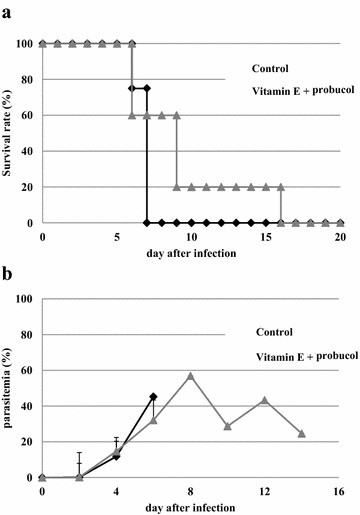
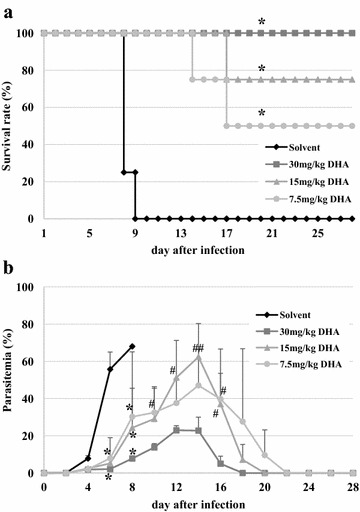
C57BL/6 J mice infected with Plasmodium yoelii XL-17 were treated with probucol and/or DHA. The mice were fed with a probucol mixed diet from 2 weeks before infection and through infection period. DHA was injected to mice three to 5 days post infection once a day. In addition, 0.5 % (w/w) probucol was mixed with vitamin E supplemented diet (800 mg/kg) and fed to mice infected with P. yoelii XL-17 to examine the mechanisms of probucol on murine malaria. Furthermore, 8-OHdG, a biomarker of oxidized DNA, was detected in infected red blood cells (iRBC) taken from infected mice by immunofluorescent staining.
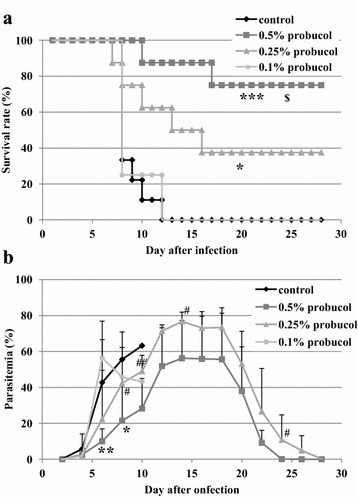
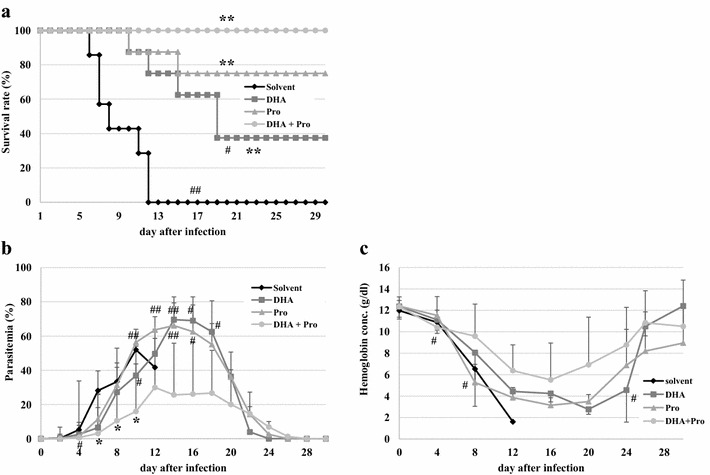
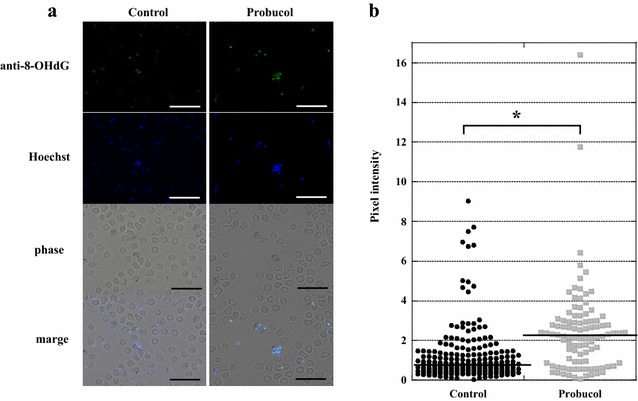
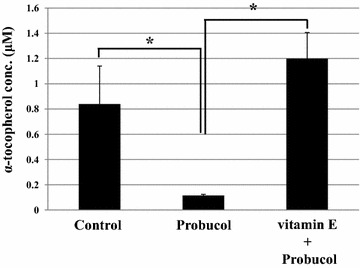
With dose-dependent manner, both probucol and DHA decreased parasitaemia and increased survival rate of mice infected with P. yoelii XL-17. A significantly larger amount of 8-OHdG was detected in iRBC taking from probucol-treated mice than control mice. In addition, a large amount of vitamin E supplementation eliminated the effect of probucol against P. yoelii XL-17 infection and lowered the effect of probucol on host plasma vitamin E concentration. The effective doses for probucol and DHA were 0.5 % and 30 mg/kg, respectively, in each single treatment. While the combination treatment of 0.25 % probucol and 7.5 mg/kg DHA was effective in all mice from P. yoelii XL-17 infection.
This study demonstrated that probucol has some impact on malaria by oxidative stress through the induction of host plasma vitamin E deficiency. Moreover, the effective dose of DHA on malaria was decreased by prophylactic treatment of probucol. This finding indicates that probucol might be a candidate for a prophylactic treatment drug to enhance the effect of DHA.
以青蒿素为基础的联合疗法(ACT)已被大量疟疾流行地区采纳为一线治疗的国家政策。然而,对青蒿素耐药的疟原虫已经出现并正在传播,接受ACT治疗的患者中出现了清除缓慢的疟原虫。这意味着更多的疟原虫仅暴露于联合用药中的另一种药物,对该联合用药中另一种药物产生耐药疟原虫的风险正在增加。因此,需要开发一种新方法来增强青蒿素的疗效。在本研究中,考察了普罗布考作为青蒿素衍生物双氢青蒿素(DHA)联合用药的潜在效果。
用普罗布考和/或DHA治疗感染约氏疟原虫XL-17的C57BL/6 J小鼠。从感染前2周开始直至感染期,给小鼠喂食含普罗布考的混合饲料。感染后3至5天,每天给小鼠注射一次DHA。此外,将0.5%(w/w)普罗布考与补充维生素E的饲料(800 mg/kg)混合,喂给感染约氏疟原虫XL-17的小鼠,以研究普罗布考对鼠疟的作用机制。此外,通过免疫荧光染色在从感染小鼠采集的感染红细胞(iRBC)中检测氧化DNA的生物标志物8-羟基脱氧鸟苷(8-OHdG)。
普罗布考和DHA均以剂量依赖方式降低了感染约氏疟原虫XL-17小鼠的疟原虫血症并提高了存活率。与对照小鼠相比,在接受普罗布考治疗的小鼠的iRBC中检测到显著更多的8-OHdG。此外,大量补充维生素E消除了普罗布考对约氏疟原虫XL-17感染的作用,并降低了普罗布考对宿主血浆维生素E浓度的影响。在每次单一治疗中,普罗布考和DHA的有效剂量分别为0.5%和30 mg/kg。而0.25%普罗布考和7.5 mg/kg DHA的联合治疗对所有感染约氏疟原虫XL-17的小鼠均有效。
本研究表明,普罗布考通过诱导宿主血浆维生素E缺乏,通过氧化应激对疟疾产生一定影响。此外,普罗布考的预防性治疗降低了DHA对疟疾的有效剂量。这一发现表明,普罗布考可能是一种增强DHA疗效的预防性治疗药物候选物。