Shafi Syed, Afrin Farhat, Islamuddin Mohammad, Chouhan Garima, Ali Intzar, Naaz Faatima, Sharma Kalicharan, Zaman Mohammad S
Medicinal Chemistry Lab, Department of Chemistry, Faculty of Science, Hamdard University New Delhi, India.
Department of Medical Laboratories Technology, Faculty of Applied Medical Sciences, Taibah UniversityMedina, Saudi Arabia; Parasite Immunology Lab, Department of Biotechnology, Faculty of Science, Hamdard UniversityNew Delhi, India.
Front Microbiol. 2016 Sep 1;7:1379. doi: 10.3389/fmicb.2016.01379. eCollection 2016.
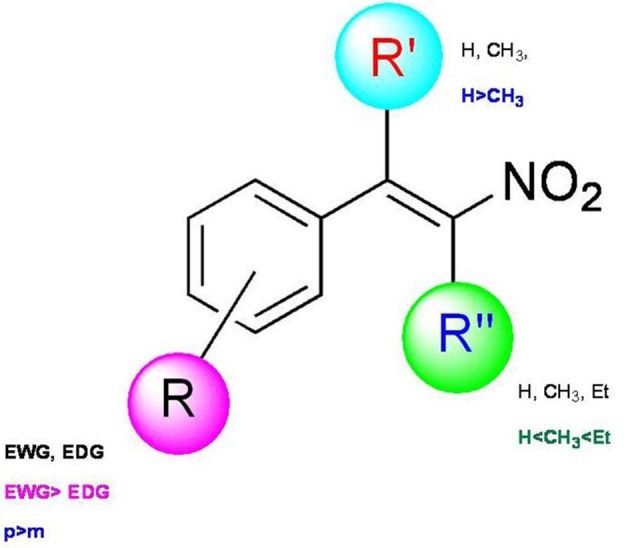
Development of new therapeutic approach to treat leishmaniasis has become a priority. In the present study, the antileishmanial effect of β-nitrostyrenes was investigated against in vitro promastigotes and amastigotes. A series of β-nitrostyrenes have been synthesized by using Henry reaction and were evaluated for their antimicrobial activities by broth microdilution assay and in vitro antileishmanial activities against Leishmania donovani promastigotes by following standard guidelines. The most active compounds were futher evaluated for their in vitro antileishmanial activities against intracellular amastigotes. Among the tested β-nitrostyrenes, compounds 7, 8, 9, 12, and 17 exhibited potential activities (MICs range, 0.25-8 μg/mL) against clinically significant human pathogenic fungi. However, the microbactericidal concentrations (MBCs) and the microfungicidal concentrations (MFCs) were found to be either similar or only two-fold greater than the MICs. Anti-leishmanial results demonstrated that compounds 9, 12, 14, and 18 were found to be most active among the tested samples and exhibited 50% inhibitory concentration (IC50) by 23.40 ± 0.71, 37.83 ± 3.74, 40.50 ± 1.47, 55.66 ± 2.84 nM against L. donovani promastigotes and 30.5 ± 3.42, 21.46 ± 0.96, 26.43 ± 2.71, and 61.63 ± 8.02 nM respectively against intracellular L. donovani promastigotes amastigotes respectively which are comparable with standard AmB (19.60 ± 1.71 nM against promastigotes and 27.83 ± 3.26 nM against amastigotes). Compounds 9, 12, 14, and 18 were found to have potent in vitro leishmanicidal activity against L. donovani and found to be non-toxic against mammalian macrophages even at a concentration of 25 μM. Nitric oxide (NO) estimation studies reveals that these compounds are moderately inducing NO levels.
开发治疗利什曼病的新治疗方法已成为当务之急。在本研究中,研究了β-硝基苯乙烯对体外前鞭毛体和无鞭毛体的抗利什曼原虫作用。通过亨利反应合成了一系列β-硝基苯乙烯,并按照标准指南通过肉汤微量稀释法评估了它们的抗菌活性以及对杜氏利什曼原虫前鞭毛体的体外抗利什曼原虫活性。对活性最高的化合物进一步评估了它们对细胞内无鞭毛体的体外抗利什曼原虫活性。在测试的β-硝基苯乙烯中,化合物7、8、9、12和17对临床上重要的人类致病真菌表现出潜在活性(MIC范围为0.25-8μg/mL)。然而,发现最低杀菌浓度(MBC)和最低杀真菌浓度(MFC)与MIC相似或仅比MIC高两倍。抗利什曼原虫结果表明,化合物9、12、14和18在所测试的样品中活性最高,对杜氏利什曼原虫前鞭毛体的50%抑制浓度(IC50)分别为23.40±0.71、37.83±3.74、40.50±1.47、55.66±2.84 nM,对细胞内杜氏利什曼原虫无鞭毛体的IC50分别为30.5±3.42、21.46±0.96、26.43±2.71和61.63±8.02 nM,与标准两性霉素B相当(对前鞭毛体为19.60±1.71 nM,对无鞭毛体为27.83±3.26 nM)。发现化合物9、12、14和18对杜氏利什曼原虫具有强大的体外杀利什曼原虫活性,并发现即使在25μM的浓度下对哺乳动物巨噬细胞也无毒。一氧化氮(NO)评估研究表明,这些化合物适度诱导NO水平。