Piniewska Danuta, Sanak Marek, Wojtas Marta, Polanska Nina
Present address: Department of Forensic Medicine, Jagiellonian University Medical College, Grzegorzecka Str. 16, 31-531, Krakow, Poland.
Department of Internal Medicine, Jagiellonian University Medical College, Krakow, Poland.
Int J Legal Med. 2017 May;131(3):643-650. doi: 10.1007/s00414-016-1448-7. Epub 2016 Sep 18.
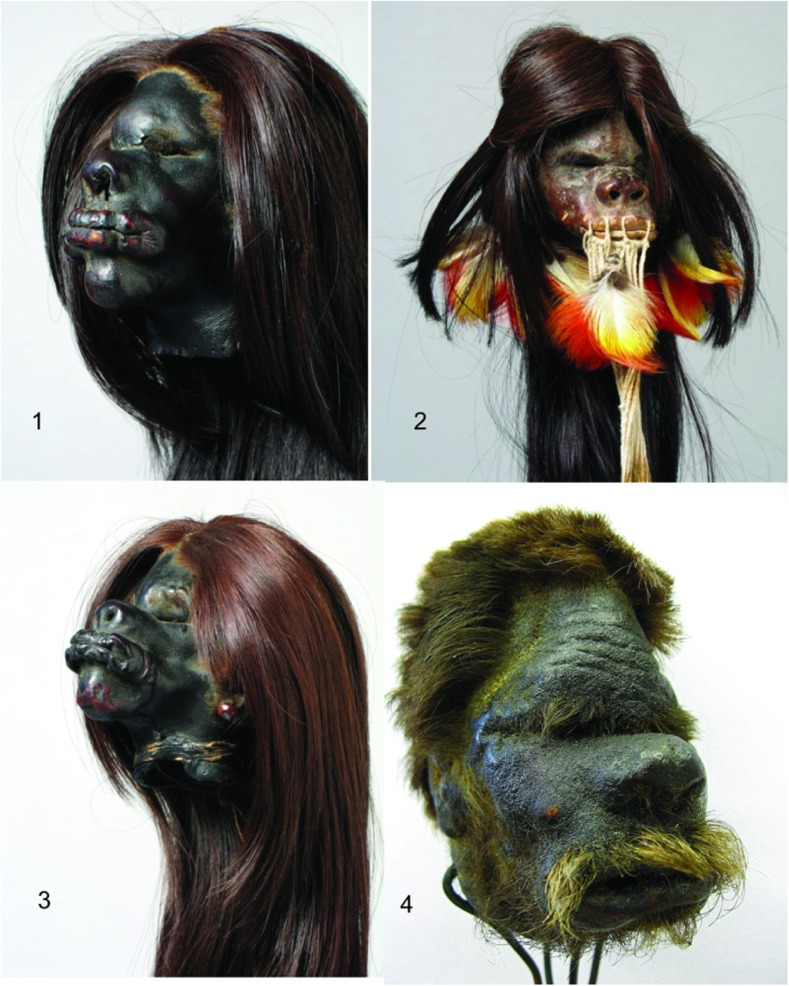
Advances in forensic identification using molecular genetics are helpful in resolving some historical mysteries. The aim of this study was to confirm the authenticity of shrunken-head artifacts exhibited by two Polish museums. Shrunken heads, known as tsantsas, were headhunting trophies of South American Indians (Jivaroan). A special preparation preserved their hair and facial appearance. However, it was quite common to offer counterfeit shrunken heads of sloths or monkeys to collectors of curiosities. We sampled small skin specimens of four shrunken-head skin from the museum collection from Warsaw and Krakow, Poland. Following genomic DNA isolation, highly polymorphic short tandem repeats were genotyped using a commercial chemistry and DNA sequencing analyzer. Haplogroups of human Y chromosome were identified. We obtained an informative genetic profile of genomic short tandem repeats from all the samples of shrunken heads. Moreover, amplification of amelogenin loci allowed for sex determination. All four studied shrunken heads were of human origin. In two ones, a shared Y-chromosome haplogroup Q characteristic for Indigenous Americans was detected. Another artifact was counterfeited because Y-chromosome haplogroup I2 was found, characteristic for the Southeastern European origin. Commercial genetic methods of identification can be applied successfully in studies on the origin and authenticity of some unusual collection items.
利用分子遗传学进行法医鉴定的进展有助于解开一些历史谜团。本研究的目的是确认两家波兰博物馆展出的缩头制品的真伪。缩头,即所谓的“扎恩扎”,是南美印第安人(希瓦罗人)的猎头战利品。一种特殊的处理方法保留了它们的头发和面部外观。然而,向古玩收藏家提供树懒或猴子的伪造缩头是相当常见的。我们从波兰华沙和克拉科夫博物馆收藏的四个缩头皮肤中采集了小皮肤样本。在分离基因组DNA后,使用商业化学试剂和DNA测序分析仪对高度多态性的短串联重复序列进行基因分型。鉴定了人类Y染色体的单倍群。我们从所有缩头样本中获得了基因组短串联重复序列的信息性遗传图谱。此外,牙釉蛋白基因座的扩增可用于性别鉴定。所有四个研究的缩头都是人类起源的。在其中两个中,检测到了美洲原住民特有的共享Y染色体单倍群Q。另一件制品是伪造的,因为发现了Y染色体单倍群I2,这是东南欧起源的特征。商业遗传鉴定方法可以成功应用于一些不寻常收藏物品的起源和真伪研究。