Sahare P, Ayala M, Vazquez-Duhalt R, Pal U, Loni A, Canham L T, Osorio I, Agarwal V
Centro de Investigacion en Ingenieria y Ciencias Aplicadas, Universidad Autónoma del Estado de México, Av. Univ. 1001, Col. Chamilpa, Cuernavaca, Morelos, 62209, Mexico.
Instituto de Biotecnología, Universidad Nacional Autónoma de México, Av. Universidad 2001, Chamilpa, Cuernavaca, 62210, Morelos, Mexico.
Nanoscale Res Lett. 2016 Dec;11(1):417. doi: 10.1186/s11671-016-1605-4. Epub 2016 Sep 20.
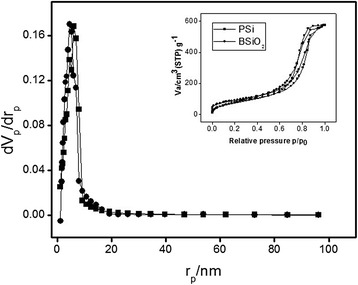
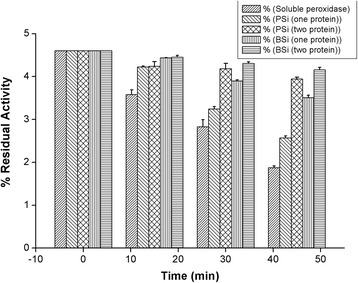
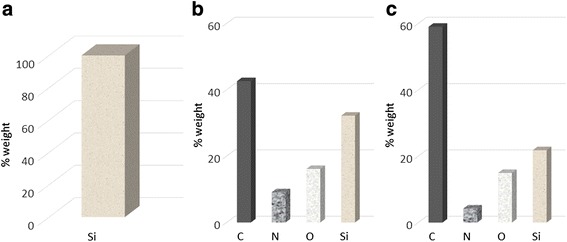
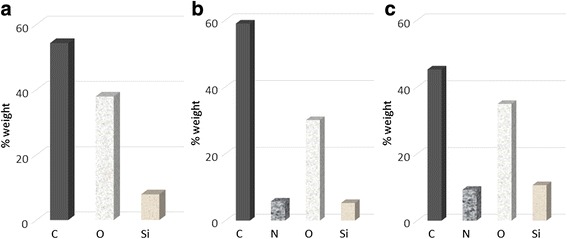
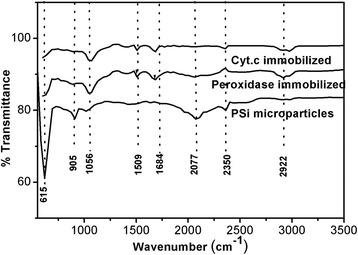
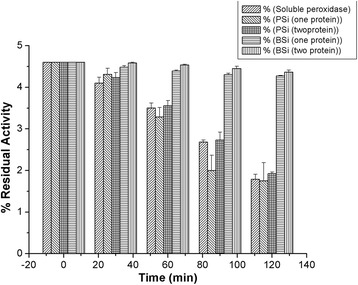
The study of the stability enhancement of a peroxidase immobilized onto mesoporous silicon/silica microparticles is presented. Peroxidases tend to get inactivated in the presence of hydrogen peroxide, their essential co-substrate, following an auto-inactivation mechanism. In order to minimize this inactivation, a second protein was co-immobilized to act as an electron acceptor and thus increase the stability against self-oxidation of peroxidase. Two heme proteins were immobilized into the microparticles: a fungal commercial peroxidase and cytochrome c from equine heart. Two types of biocatalysts were prepared: one with only covalently immobilized peroxidase (one-protein system) and another based on covalent co-immobilization of peroxidase and cytochrome c (two-protein system), both immobilized by using carbodiimide chemistry. The amount of immobilized protein was estimated spectrophotometrically, and the characterization of the biocatalyst support matrix was performed using Brunauer-Emmett-Teller (BET), scanning electron microscopy with energy-dispersive X-ray spectroscopy (SEM-EDX), and Fourier transform infrared (FTIR) analyses. Stability studies show that co-immobilization with the two-protein system enhances the oxidative stability of peroxidase almost four times with respect to the one-protein system. Thermal stability analysis shows that the immobilization of peroxidase in derivatized porous silicon microparticles does not protect the protein from thermal denaturation, whereas biogenic silica microparticles confer significant thermal stabilization.
本文介绍了固定在介孔硅/二氧化硅微粒上的过氧化物酶稳定性增强的研究。过氧化物酶在其必需的共底物过氧化氢存在下,往往会通过自动失活机制而失活。为了尽量减少这种失活,共固定了第二种蛋白质作为电子受体,从而提高过氧化物酶抗自氧化的稳定性。将两种血红素蛋白固定到微粒中:一种是真菌商业过氧化物酶,另一种是马心细胞色素c。制备了两种类型的生物催化剂:一种是仅共价固定过氧化物酶的(单蛋白体系),另一种是基于过氧化物酶和细胞色素c共价共固定的(双蛋白体系),两者均采用碳二亚胺化学方法固定。通过分光光度法估算固定化蛋白的量,并使用布鲁诺尔-埃米特-泰勒(BET)法、带能谱仪的扫描电子显微镜(SEM-EDX)和傅里叶变换红外(FTIR)分析对生物催化剂载体基质进行表征。稳定性研究表明,与单蛋白体系相比,双蛋白体系的共固定使过氧化物酶的氧化稳定性提高了近四倍。热稳定性分析表明,将过氧化物酶固定在衍生化多孔硅微粒中并不能保护蛋白质免受热变性,而生物源二氧化硅微粒则具有显著的热稳定作用。