
脊柱内固定中棒材塑形对棒-螺钉系统强度的力学影响。
The Mechanical Effect of Rod Contouring on Rod-Screw System Strength in Spine Fixation.
作者信息
Acar Nihat, Karakasli Ahmet, Karaarslan Ahmet A, Ozcanhan Mehmet Hilal, Ertem Fatih, Erduran Mehmet
机构信息
Department of Orthopaedics and Traumatology, Ilyas Cokay Catalca Hospital, Catalca, Istanbul, Turkey.
Department of Orthopaedics and Traumatology, Faculty of Medicine, Dokuz Eylul University, Balcova, Izmir, Turkey.
出版信息
J Korean Neurosurg Soc. 2016 Sep;59(5):425-9. doi: 10.3340/jkns.2016.59.5.425. Epub 2016 Sep 8.
OBJECTIVE
Rod-screw fixation systems are widely used for spinal instrumentation. Although many biomechanical studies on rod-screw systems have been carried out, but the effects of rod contouring on the construct strength is still not very well defined in the literature. This work examines the mechanical impact of straight, 20° kyphotic, and 20° lordotic rod contouring on rod-screw fixation systems, by forming a corpectomy model.
METHODS
The corpectomy groups were prepared using ultra-high molecular weight polyethylene samples. Non-destructive loads were applied during flexion/extension and torsion testing. Spine-loading conditions were simulated by load subjections of 100 N with a velocity of 5 mm min(-1), to ensure 8.4-Nm moment. For torsional loading, the corpectomy models were subjected to rotational displacement of 0.5° s(-1) to an end point of 5.0°, in a torsion testing machine.
RESULTS
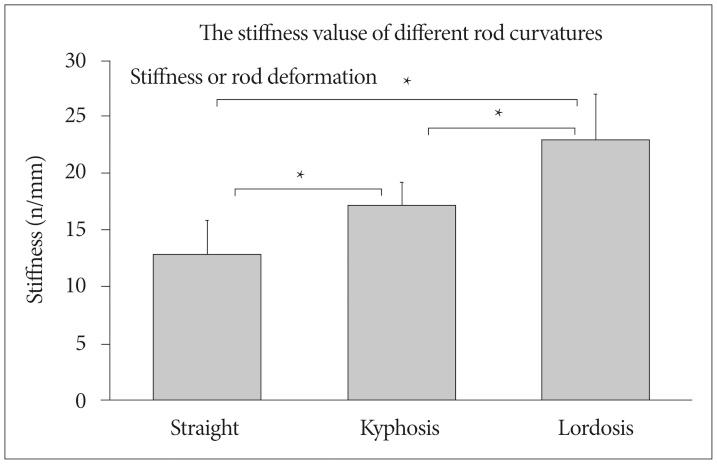
Under both flexion and extension loading conditions the stiffness values for the lordotic rod-screw system were the highest. Under torsional loading conditions, the lordotic rod-screw system exhibited the highest torsional rigidity.
CONCLUSION
We concluded that the lordotic rod-screw system was the most rigid among the systems tested and the risk of rod and screw failure is much higher in the kyphotic rod-screw systems. Further biomechanical studies should be attempted to compare between different rod kyphotic angles to minimize the kyphotic rod failure rate and to offer a more stable and rigid rod-screw construct models for surgical application in the kyphotic vertebrae.
目的
椎弓根螺钉固定系统广泛应用于脊柱内固定。尽管已经对椎弓根螺钉系统进行了许多生物力学研究,但文献中对于棒材塑形对结构强度的影响仍未明确界定。本研究通过构建椎体切除模型,探讨直形、20°后凸和20°前凸棒材塑形对椎弓根螺钉固定系统的力学影响。
方法
使用超高分子量聚乙烯样本制备椎体切除组。在屈伸和扭转测试过程中施加无损载荷。通过以5 mm min⁻¹的速度施加100 N的载荷来模拟脊柱加载条件,以确保产生8.4 N·m的力矩。对于扭转加载,在扭转试验机中,将椎体切除模型以0.5° s⁻¹的旋转位移加载至5.0°的终点。
结果
在屈伸加载条件下,前凸椎弓根螺钉系统的刚度值最高。在扭转加载条件下,前凸椎弓根螺钉系统表现出最高的扭转刚度。
结论
我们得出结论,在前凸椎弓根螺钉系统是测试系统中最坚固的,而后凸椎弓根螺钉系统中棒材和螺钉失效的风险要高得多。应进一步进行生物力学研究,以比较不同的棒材后凸角度,以尽量减少后凸棒材的失败率,并为后凸椎体的手术应用提供更稳定、坚固的椎弓根螺钉结构模型。




 Zotero 插件