Le Wei, Zhou Weidong, Li Chao, Wu Denglong, Zhang Jinfu, Bian Cuidong
Department of Urology, Tongji Hospital, Tongji University School of Medicine, 389 Xincun Road, Shanghai, 200065 China.
Department of Reproduction and Andrology, Tongji Hospital, Tongji University School of Medicine, 389 Xincun Road, Shanghai, 200065 China.
Springerplus. 2016 Aug 30;5(1):1457. doi: 10.1186/s40064-016-3137-x. eCollection 2016.
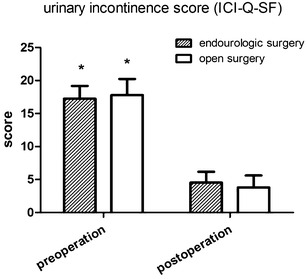
The aim of this study was to explore the clinical effect of endoscopic minimal invasive surgery on posterior urethral stricture with false passage. Twenty-one patients suffering from posterior urethral stricture with false passage were involved in the study. All the patients received pre-operative urethrography and flexible cystoscopy to make sure that the distance between the blind end of the proximal normal urethra and the distal urethra was <1 cm. Ten patients received open operation and eleven patients underwent endoscopic minimally-invasive surgery. All the patients in both groups had their catheters removed 4 weeks after operations, and improvements in urination and incontinence were observed. Urethrography was performed and urine flow rate was measured 1 month after catheter removal. In the open-operation group, nine patients showed unobstructed urinary tracts in the urethrography, and one, after his catheter removal, experienced dysuresia, which was improved after urethral dilatation. In the minimally-invasive operation group, nine patients showed patent urinary tracts in the urethrography, and two experienced post-operation dysuresia, of whom, open-operation treatment and urethral dilatation were performed respectively. In the minimally-invasive operation group, the average urine flow rate was significantly increased. Patients in both groups obtained obvious improvement in post-operation urinary incontinence, and there was no statistically significant difference between the two groups in urine flow rate and index for urinary incontinence. Endoscopic minimally-invasive operation had similar effects to open operation in treatment of posterior urethra stricture with <1 cm in length and false passage.
本研究旨在探讨内镜微创手术治疗后尿道狭窄伴假道的临床效果。21例后尿道狭窄伴假道患者纳入本研究。所有患者术前行尿道造影和软性膀胱镜检查,以确保近端正常尿道盲端与远端尿道之间的距离<1 cm。10例患者接受开放手术,11例患者接受内镜微创手术。两组患者术后4周均拔除导尿管,并观察排尿和尿失禁情况改善。拔管后1个月行尿道造影并测量尿流率。开放手术组中,9例患者尿道造影显示尿路通畅,1例拔管后出现排尿困难,经尿道扩张后改善。微创手术组中,9例患者尿道造影显示尿路通畅,2例出现术后排尿困难,分别行开放手术治疗和尿道扩张。微创手术组平均尿流率显著增加。两组患者术后尿失禁均有明显改善,两组尿流率和尿失禁指标差异无统计学意义。内镜微创手术治疗长度<1 cm的后尿道狭窄伴假道与开放手术效果相似。