Drdácký Miloš, Lesák Jaroslav, Rescic Silvia, Slížková Zuzana, Tiano Piero, Valach Jaroslav
Institute of Theoretical and Applied Mechanics of the Academy of Sciences of the Czech Republic, Prosecká 76, 19000 Praha 9, Czech Republic.
CNR, Institute for the Conservation and Valorization of Cultural Heritage (ICVBC), Via Madonna del Piano 10, 5019 Sesto Fiorentino, Florence Italy.
Mater Struct. 2012;45(4):505-520. doi: 10.1617/s11527-011-9778-x. Epub 2011 Sep 9.
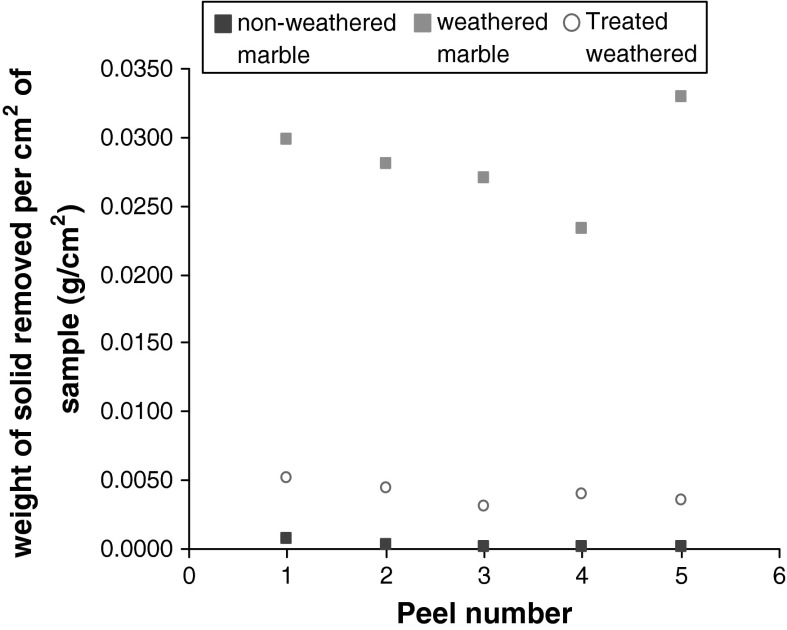
A peeling test known as the "Scotch Tape test" has been used for more than 40 years in conservation practice for assessing the consolidation efficiency of degraded stone. However, the method has not been supported by any standard or reliably verified recommendations for its application. Its applicability is overestimated, and its unrestricted use without adequate knowledge and sufficient understanding can lead to non-comparable, non-reproducible and, in many cases, incorrect and severely biased results and assessments. This paper presents the results of a recent study focused on establishing limits for application, reliable procedures and a "standard" protocol for testing the cohesion characteristics of brittle and quasi-brittle materials, mainly mortars and stones. The main application strategy exploits repeated peeling in the same place on a surface in order to eliminate the effect of the natural decrease in the detached material from the subsurface layers, which might be incorrectly interpreted as a consolidation effect. There is a discussion of factors influencing the performance of the peeling test method, and examples of peeling measurements on various natural and artificial stones are presented.
一种名为“透明胶带测试”的剥离测试在文物保护实践中用于评估风化石材的加固效果已有40多年。然而,该方法尚未得到任何关于其应用的标准或可靠验证的建议的支持。其适用性被高估,在缺乏足够知识和充分理解的情况下无限制使用可能导致不可比、不可重复,且在许多情况下结果和评估不正确且存在严重偏差。本文介绍了最近一项研究的结果,该研究专注于确定脆性和准脆性材料(主要是灰浆和石材)粘结特性测试的应用限制、可靠程序和“标准”方案。主要应用策略是在表面的同一位置反复剥离,以消除从次表层分离的材料自然减少的影响,这种影响可能被错误地解释为加固效果。文中讨论了影响剥离测试方法性能的因素,并给出了对各种天然和人造石材进行剥离测量的示例。