Chen Ming-Shuo, Kim Hyosung, Jagot-Lacoussiere Léonard, Maurel Patrice
Department of Biological Sciences, Rutgers, The State University of New Jersey, Newark, New Jersey.
Glia. 2016 Dec;64(12):2247-2262. doi: 10.1002/glia.23072. Epub 2016 Sep 23.
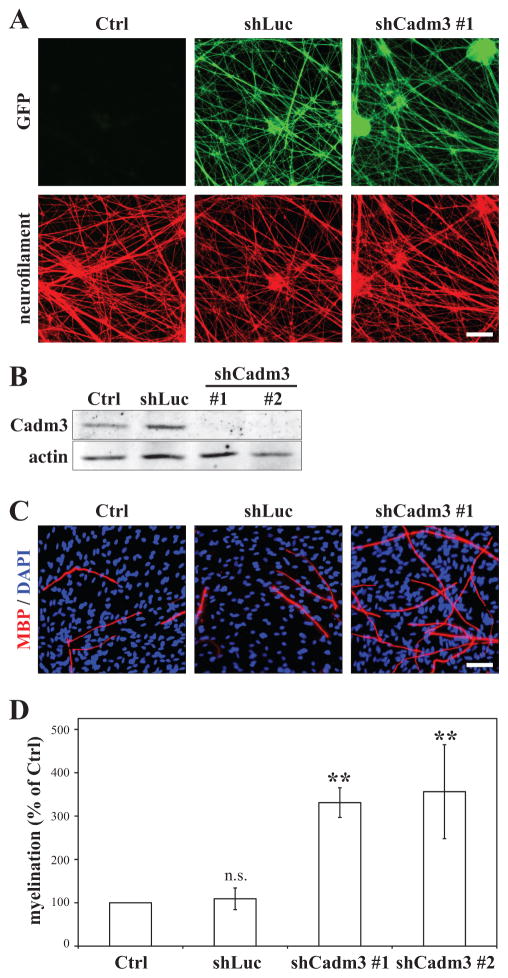
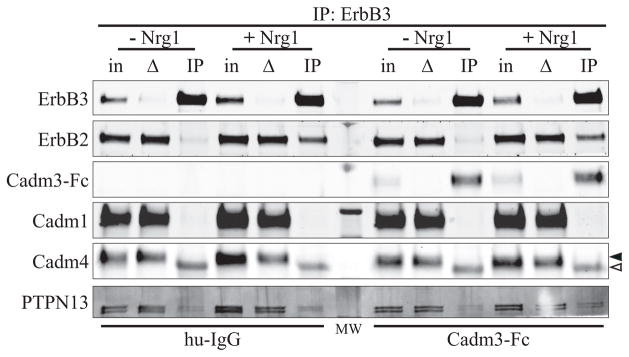
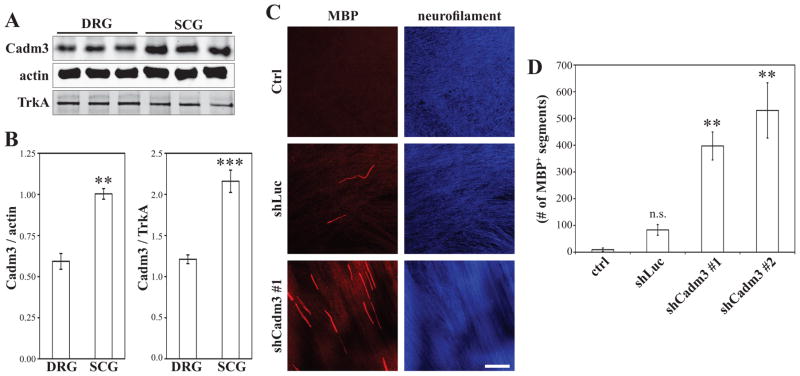
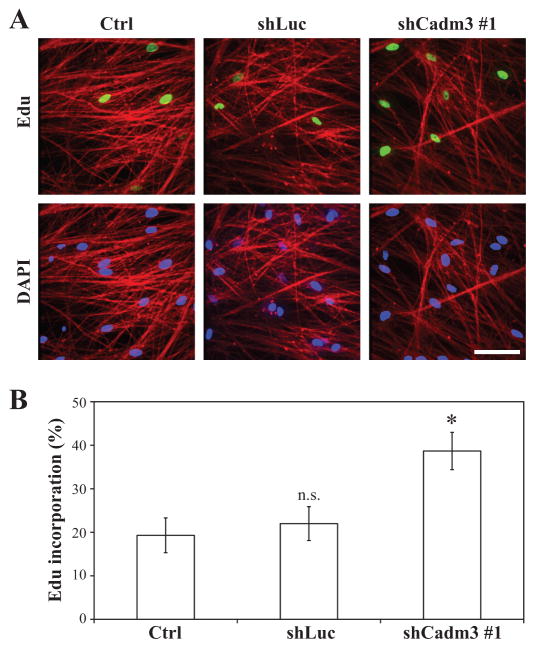
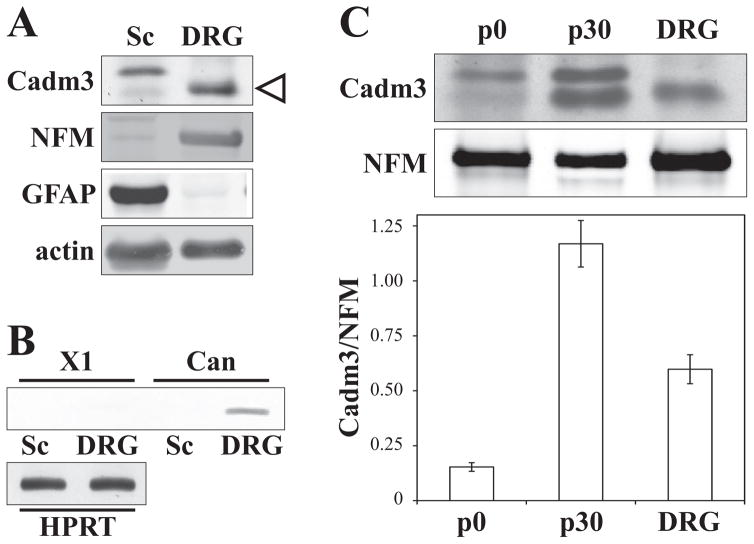
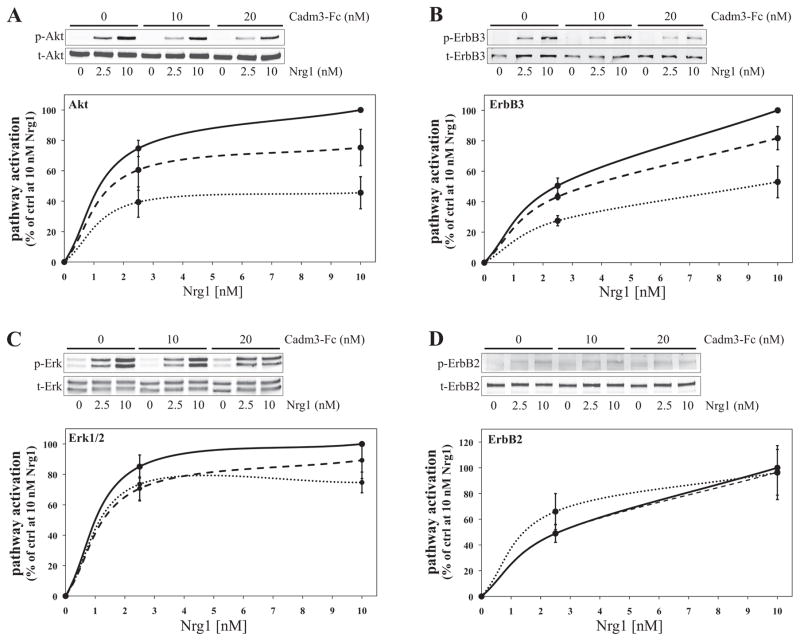
Axo-glial interactions are critical for myelination and the domain organization of myelinated fibers. Cell adhesion molecules belonging to the Cadm family, and in particular Cadm3 (axonal) and its heterophilic binding partner Cadm4 (Schwann cell), mediate these interactions along the internode. Using targeted shRNA-mediated knockdown, we show that the removal of axonal Cadm3 promotes Schwann cell myelination in the in vitro DRG neuron/Schwann cell myelinating system. Conversely, over-expressing Cadm3 on the surface of DRG neuron axons results in an almost complete inability by Schwann cells to form myelin segments. Axons of superior cervical ganglion (SCG) neurons, which do not normally support the formation of myelin segments by Schwann cells, express higher levels of Cadm3 compared to DRG neurons. Knocking down Cadm3 in SCG neurons promotes myelination. Finally, the extracellular domain of Cadm3 interferes in a dose-dependent manner with the activation of ErbB3 and of the pro-myelinating PI3K/Akt pathway, but does not interfere with the activation of the Mek/Erk1/2 pathway. While not in direct contradiction, these in vitro results shed lights on the apparent lack of phenotype that was reported from in vivo studies of Cadm3 mice. Our results suggest that Cadm3 may act as a negative regulator of PNS myelination, potentially through the selective regulation of the signaling cascades activated in Schwann cells by axonal contact, and in particular by type III Nrg-1. Further analyses of peripheral nerves in the Cadm mice will be needed to determine the exact role of axonal Cadm3 in PNS myelination. GLIA 2016;64:2247-2262.
轴突-神经胶质细胞相互作用对于髓鞘形成和有髓纤维的区域组织至关重要。属于Cadm家族的细胞粘附分子,特别是Cadm3(轴突)及其异嗜性结合伴侣Cadm4(施万细胞),介导节间的这些相互作用。使用靶向shRNA介导的敲低,我们表明在体外背根神经节神经元/施万细胞髓鞘形成系统中去除轴突Cadm3可促进施万细胞髓鞘形成。相反,在背根神经节神经元轴突表面过表达Cadm3会导致施万细胞几乎完全无法形成髓鞘节段。与背根神经节神经元相比,通常不支持施万细胞形成髓鞘节段的颈上神经节(SCG)神经元的轴突表达更高水平的Cadm3。在SCG神经元中敲低Cadm3可促进髓鞘形成。最后,Cadm3的细胞外结构域以剂量依赖性方式干扰ErbB3和促髓鞘形成的PI3K/Akt途径的激活,但不干扰Mek/Erk1/2途径的激活。虽然并非直接矛盾,但这些体外结果揭示了Cadm3小鼠体内研究报告中明显缺乏表型的原因。我们的结果表明,Cadm3可能作为周围神经系统髓鞘形成的负调节因子,可能是通过选择性调节轴突接触在施万细胞中激活的信号级联反应,特别是通过III型神经调节蛋白-1。需要进一步分析Cadm小鼠的外周神经,以确定轴突Cadm3在周围神经系统髓鞘形成中的确切作用。《胶质细胞》2016年;64:2247 - 2262。