Lindberg Maren Falch, Miaskowski Christine, RustøEn Tone, Rosseland Leiv Arne, Cooper Bruce A, Lerdal Anners
a Department of Surgery , Lovisenberg Diakonale Hospital , Oslo.
b Department of Nursing Science, Institute of Health and Society, Faculty of Medicine , University of Oslo , Oslo , Norway.
Acta Orthop. 2016 Dec;87(6):600-606. doi: 10.1080/17453674.2016.1237440. Epub 2016 Sep 23.
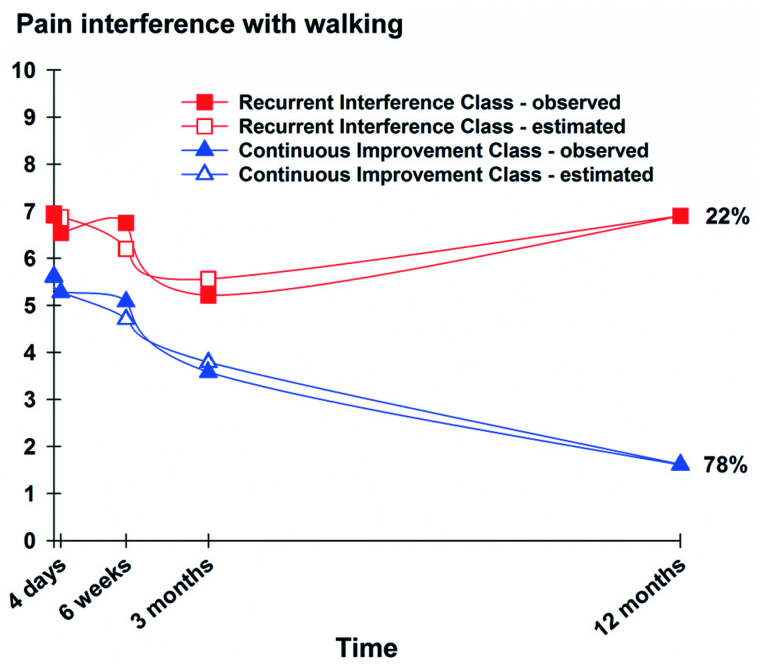
Background and purpose - Functional limitations after total knee arthroplasty (TKA) are common. In this longitudinal study, we wanted to identify subgroups of patients with distinct trajectories of pain-related interference with walking during the first year after TKA and to determine which demographic, clinical, symptom-related, and psychological characteristics were associated with being part of this subgroup. Patients and methods - Patients scheduled for primary TKA for osteoarthritis (n = 202) completed questionnaires that evaluated perception of pain, fatigue, anxiety, depression, and illness on the day before surgery. Clinical characteristics were obtained from the medical records. Interference of pain with walking was assessed preoperatively, on postoperative day 4, and at 6 weeks, 3 months, and 12 months after TKA. Results - Using growth mixture modeling, 2 subgroups of patients were identified with distinct trajectories of pain-related interference with walking over time. Patients in the Continuous Improvement class (n = 157, 78%) had lower preoperative interference scores and reported a gradual decline in pain-related interference with walking over the first 12 months after TKA. Patients in the Recurrent Interference class (n = 45, 22%) reported a high degree of preoperative pain-related interference with walking, initial improvement during the first 3 months after TKA, and then a gradual increase-returning to preoperative levels at 12 months. Patients in the Recurrent Interference class had higher preoperative pain, fatigue, and depression scores, and poorer perception of illness than the Continuous Improvement class. Interpretation - 1 in 5 patients did not improve in pain-related interference with walking at 12 months after TKA. Future studies should test the efficacy of interventions designed to modify preoperative characteristics.
背景与目的——全膝关节置换术(TKA)后功能受限很常见。在这项纵向研究中,我们希望识别出TKA术后第一年疼痛对行走干扰轨迹不同的患者亚组,并确定哪些人口统计学、临床、症状相关和心理特征与该亚组的组成有关。
患者与方法——计划因骨关节炎接受初次TKA的患者(n = 202)在手术前一天完成了评估疼痛、疲劳、焦虑、抑郁和疾病认知的问卷。临床特征从病历中获取。在术前、术后第4天以及TKA术后6周、3个月和12个月评估疼痛对行走的干扰。
结果——使用生长混合模型,识别出了2个患者亚组,其疼痛对行走的干扰随时间有不同轨迹。持续改善组(n = 157,78%)术前干扰得分较低,且报告在TKA术后的前12个月疼痛对行走的干扰逐渐下降。反复干扰组(n = 45,22%)报告术前疼痛对行走的干扰程度较高,在TKA术后的前3个月有初始改善,然后逐渐增加——在12个月时恢复到术前水平。反复干扰组患者的术前疼痛、疲劳和抑郁得分高于持续改善组,且疾病认知较差。
解读——五分之一的患者在TKA术后12个月时疼痛对行走的干扰没有改善。未来的研究应测试旨在改变术前特征的干预措施的疗效。