Wang Aidong, Cui Ming, Qu Hong, Di Jiabo, Wang Zaozao, Xing Jiadi, Wu Fan, Wu Wei, Wang Xicheng, Shen Lin, Jiang Beihai, Su Xiangqian
Key laboratory of Carcinogenesis and Translational Research (Ministry of Education), Department of Gastrointestinal Surgery IV, Peking University Cancer Hospital & Institute, Beijing 100142, China.
Center for Bioinformatics, State Key Laboratory of Protein and Plant Gene Research, College of Life Sciences, Peking University, Beijing, 100871, China.
Oncotarget. 2016 Nov 15;7(46):75293-75306. doi: 10.18632/oncotarget.12167.
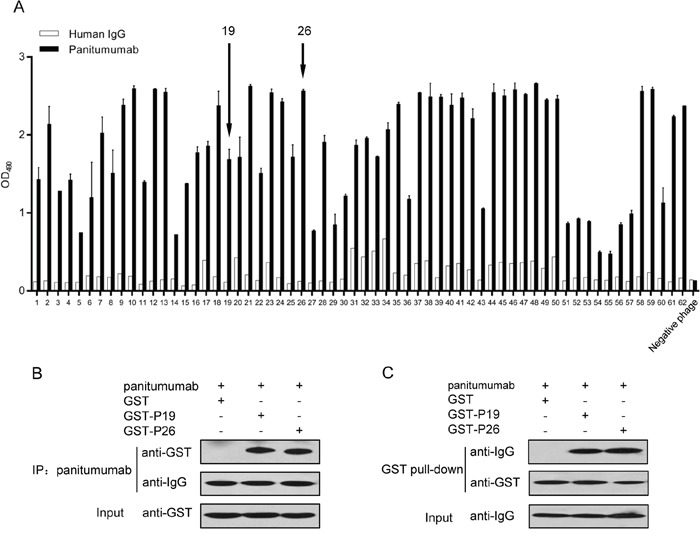
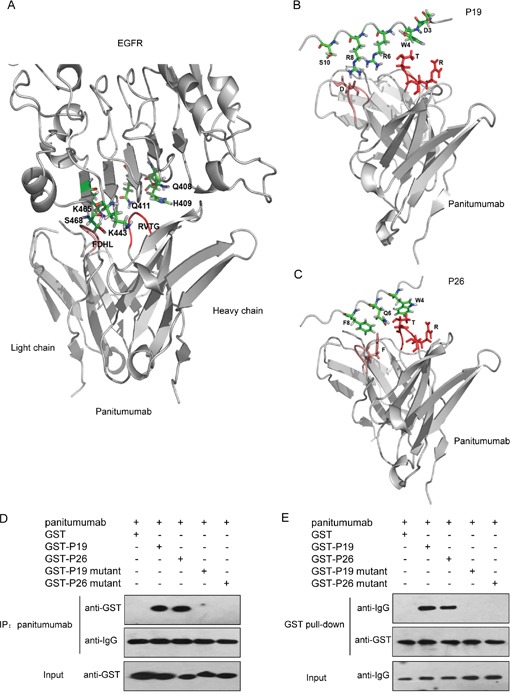
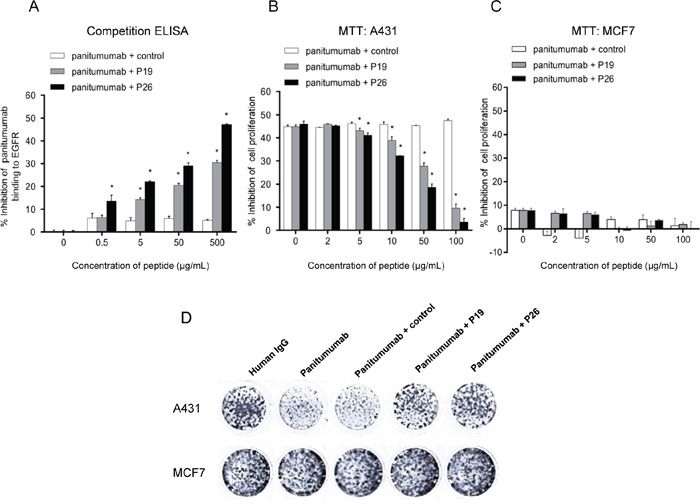
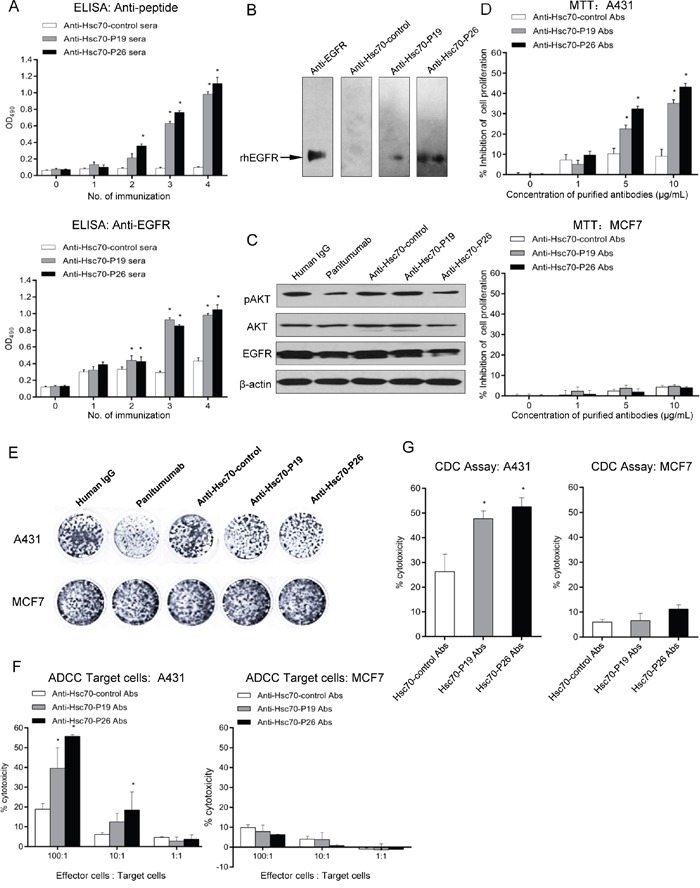
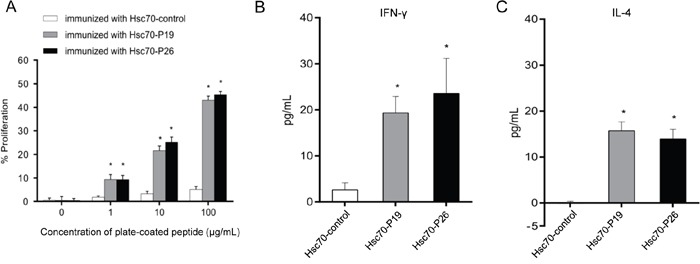
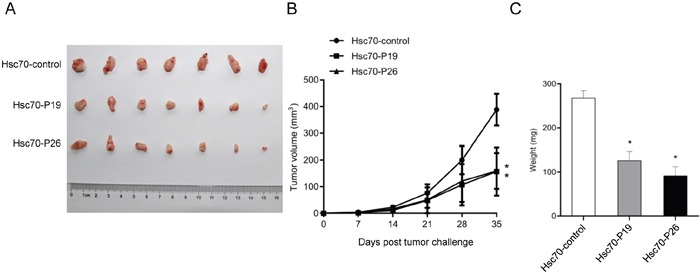
The epidermal growth factor receptor (EGFR) is overexpressed in several epithelial tumors. Anti-EGFR humanized monoclonal antibodies, cetuximab and panitumumab, in combination with chemotherapy have improved the prognosis for patients with wild-type RAS tumors. To identify mimotopes of EGFR and develop mimotope-based EGFR vaccines, we screened a phage display peptide library with panitumumab. Two EGFR mimotopes P19 and P26, which could be recognized by panitumumab specifically, were isolated. To enhance the immune responses, we generated recombinant proteins of P19 or P26 fused to a heat-shock cognate protein 70 (Hsc70), and evaluated the efficacy of Hsc70-P19 and Hsc70-P26 as vaccines in vivo. Immunization with Hsc70-P19 or Hsc70-P26 fusion protein stimulated the immune system to produce specific antibodies against peptides as well as EGFR. Moreover, antibodies elicited against mimotopes could induce antibody-dependent cellular cytotoxicity (ADCC), complement-dependent cytotoxicity (CDC), and inhibit the proliferation of EGFR-overexpressing A431 cells. Treatment with Hsc70-P19 and Hsc70-P26 significantly reduced tumor growth in BALB/c transplantable lung cancer models. Although there was no sequence homology between the phage-derived peptides and EGFR by alignments, both peptides mimic the conformational structure of EGFR binding to panitumumab. In conclusion, the mimotopes we identified from phage display peptide library could be promising candidate vaccines for active anti-EGFR immunotherapy against cancers.
表皮生长因子受体(EGFR)在多种上皮肿瘤中过表达。抗EGFR人源化单克隆抗体西妥昔单抗和帕尼单抗与化疗联合使用,改善了野生型RAS肿瘤患者的预后。为了鉴定EGFR的模拟表位并开发基于模拟表位的EGFR疫苗,我们用帕尼单抗筛选了一个噬菌体展示肽库。分离出了两个能被帕尼单抗特异性识别的EGFR模拟表位P19和P26。为了增强免疫反应,我们构建了与热休克同源蛋白70(Hsc70)融合的P19或P26重组蛋白,并在体内评估了Hsc70-P19和Hsc70-P26作为疫苗的效果。用Hsc70-P19或Hsc70-P26融合蛋白免疫刺激免疫系统产生针对肽以及EGFR的特异性抗体。此外,针对模拟表位产生的抗体可诱导抗体依赖性细胞毒性(ADCC)、补体依赖性细胞毒性(CDC),并抑制EGFR过表达的A431细胞的增殖。在BALB/c移植性肺癌模型中,用Hsc70-P19和Hsc70-P26治疗可显著降低肿瘤生长。虽然通过比对噬菌体衍生肽与EGFR之间没有序列同源性,但这两种肽都模拟了EGFR与帕尼单抗结合的构象结构。总之,我们从噬菌体展示肽库中鉴定出的模拟表位可能是用于癌症主动抗EGFR免疫治疗的有前景的候选疫苗。