Dong Ke, Gao Zhao-Wei, Zhang Hui-Zhong
Department of Clinical Diagnosis, Tangdu Hospital, Fourth Military Medical University, Xi'an, China.
Immunol Res. 2016 Dec;64(5-6):1133-1141. doi: 10.1007/s12026-016-8870-2.
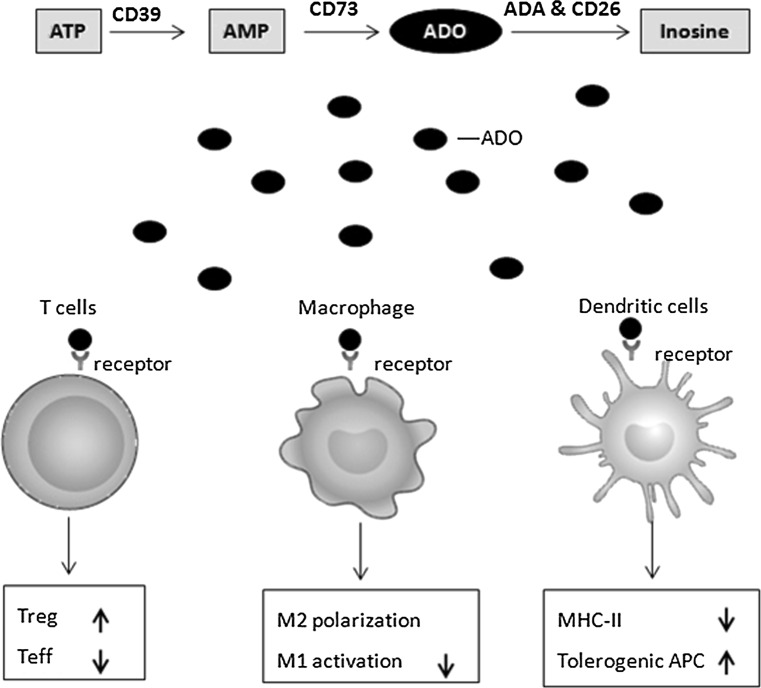
Autoimmune diseases are characterized by the abnormal immune response against self-tissue, which are caused by the failure of nature immune homeostasis. Nature immune homeostasis represents the normal state of appropriate immune response to nonself-antigen and unresponsiveness to self-antigens. In normal situation, immune homeostasis is regulated by immunosuppressive signal and immunostimulating signal together. Accumulating data have demonstrated that the adenosinergic pathway played key roles in immune suppression and shield body from an excessive inflammatory response. The deficiency of adenosinergic pathway results in the imbalance between the pro- and anti-inflammatory activities. Thus, researchers pay much attention to the role of adenosinergic pathway in autoimmune diseases development. To date, accumulating data have suggested an important role of adenosinergic pathway-related molecules (i.e., CD39, CD73, ADA, adenosine receptors, etc.) in many types of human autoimmune diseases. More importantly, these findings have presented potential value of adenosinergic pathway analysis to be used for autoimmune diseases diagnosis, monitoring and treatment. In this review, we will provide a comprehensive description of the role of adenosinergic pathway in human autoimmune diseases.
自身免疫性疾病的特征是针对自身组织的异常免疫反应,这是由天然免疫稳态失衡引起的。天然免疫稳态代表了对非自身抗原产生适当免疫反应以及对自身抗原无反应的正常状态。在正常情况下,免疫稳态由免疫抑制信号和免疫刺激信号共同调节。越来越多的数据表明,腺苷能途径在免疫抑制以及保护机体免受过度炎症反应方面发挥着关键作用。腺苷能途径的缺陷会导致促炎和抗炎活性之间的失衡。因此,研究人员非常关注腺苷能途径在自身免疫性疾病发展中的作用。迄今为止,越来越多的数据表明腺苷能途径相关分子(即CD39、CD73、ADA、腺苷受体等)在多种人类自身免疫性疾病中具有重要作用。更重要的是,这些发现显示了腺苷能途径分析在自身免疫性疾病诊断、监测和治疗方面的潜在价值。在本综述中,我们将全面描述腺苷能途径在人类自身免疫性疾病中的作用。