Anoop Gopinathan, Rani Janardhanan R, Lim Juhwan, Jang Myoung Soo, Suh Dong Wook, Kang Shinill, Jun Seong Chan, Yoo Jae Soo
School of Chemical Engineering and Materials Science, Chung-Ang University, Heukseok-Dong 221, Dongjak-gu, Seoul-06974, Republic of Korea.
School of Materials Science and Engineering, Gwangju Institute of Science and Technology, Gwangju-61005, Republic of Korea.
Sci Rep. 2016 Sep 27;6:33993. doi: 10.1038/srep33993.
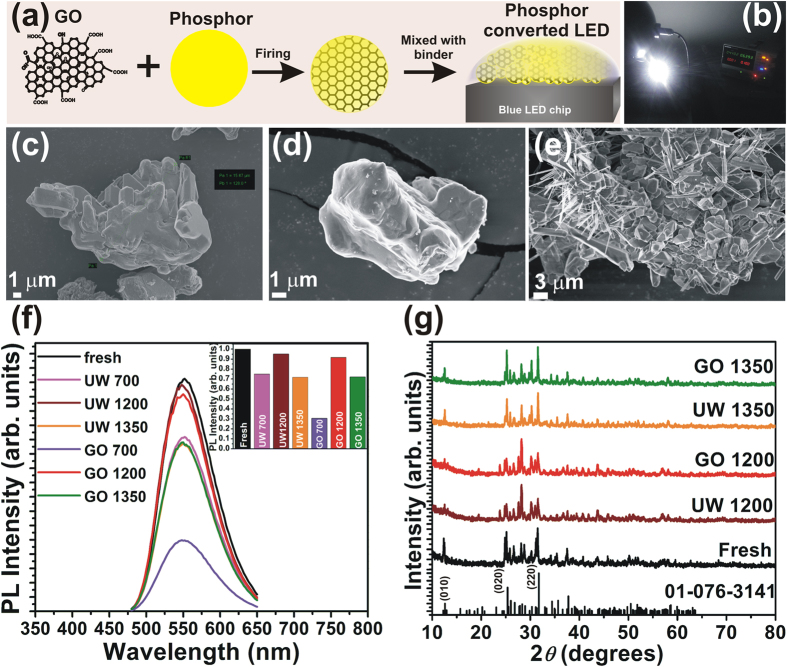
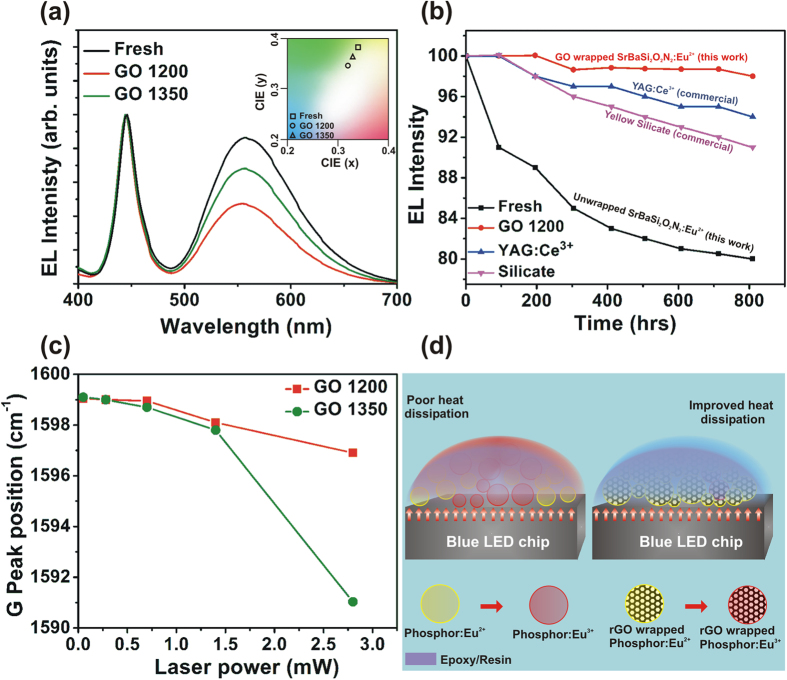
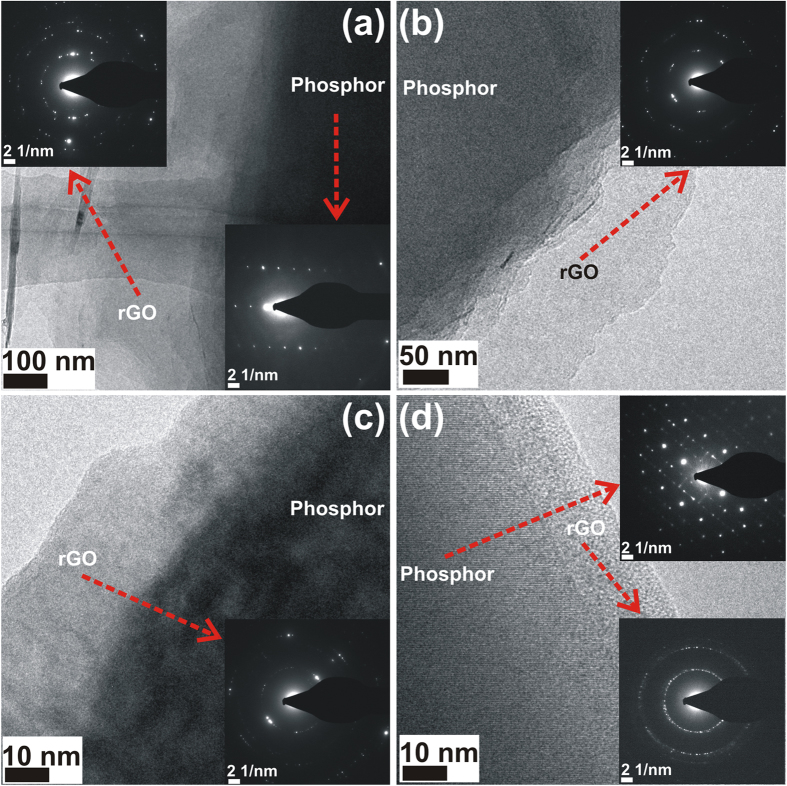
The long-term instability of the presently available best commercial phosphor-converted light-emitting diodes (pcLEDs) is the most serious obstacle for the realization of low-cost and energy-saving lighting applications. Emission from pcLEDs starts to degrade after approximately 200 h of operation because of thermal degradation of the phosphors. We propose a new strategy to overcome this thermal degradation problem of phosphors by wrapping the phosphor particles with reduced graphene oxide (rGO). Through the rGO wrapping, we have succeeded in controlling the thermal degradation of phosphors and improving the stability of fabricated pcLEDs. We have fabricated pcLEDs with long-term stability that maintain nearly 98% of their initial luminescence emission intensity even after 800 h of continuous operation at 85 °C and 85% relative humidity. The pcLEDs fabricated using SrBaSiON:Eu phosphor particles wrapped with reduced graphene oxide are thermally stable because of enhanced heat dissipation that prevents the ionization of Eu to Eu. We believe that this technique can be applied to other rare-earth doped phosphors for the realization of highly efficient and stable white LEDs.
目前市面上最好的商业化磷光转换发光二极管(pcLED)的长期不稳定性是实现低成本节能照明应用的最严重障碍。由于磷光体的热降解,pcLED在运行约200小时后发光开始退化。我们提出了一种新策略,通过用还原氧化石墨烯(rGO)包裹磷光体颗粒来克服磷光体的这种热降解问题。通过rGO包裹,我们成功地控制了磷光体的热降解,并提高了所制备的pcLED的稳定性。我们制备出了具有长期稳定性的pcLED,即使在85°C和85%相对湿度下连续运行800小时后,仍能保持其初始发光强度的近98%。使用包裹有还原氧化石墨烯的SrBaSiON:Eu磷光体颗粒制备的pcLED具有热稳定性,这是因为增强的散热防止了Eu离子化形成Eu。我们相信,这种技术可以应用于其他稀土掺杂磷光体,以实现高效稳定的白光LED。