Swallow Diane M A, Lawton Michael A, Grosset Katherine A, Malek Naveed, Klein Johannes, Baig Fahd, Ruffmann Claudio, Bajaj Nin P, Barker Roger A, Ben-Shlomo Yoav, Burn David J, Foltynie Thomas, Morris Huw R, Williams Nigel, Wood Nicholas W, Hu Michele T M, Grosset Donald G
Department of Neurology, Institute of Neurological Sciences, Glasgow, UK.
School of Social and Community Medicine, University of Bristol, Bristol, UK.
J Neurol Neurosurg Psychiatry. 2016 Nov;87(11):1183-1190. doi: 10.1136/jnnp-2016-313642. Epub 2016 Sep 26.
Cardiovascular disease (CVD) influences phenotypic variation in Parkinson's disease (PD), and is usually an indication for statin therapy. It is less clear whether cardiovascular risk factors influence PD phenotype, and if statins are prescribed appropriately.
To quantify vascular risk and statin use in recent-onset PD, and examine the relationship between vascular risk, PD severity and phenotype.
Cardiovascular risk was quantified using the QRISK2 calculator (high ≥20%, medium ≥10 and <20%, low risk <10%). Motor severity and phenotype were assessed using the Movement Disorder Society Unified PD Rating Scale (UPDRS) and cognition by the Montreal cognitive assessment.
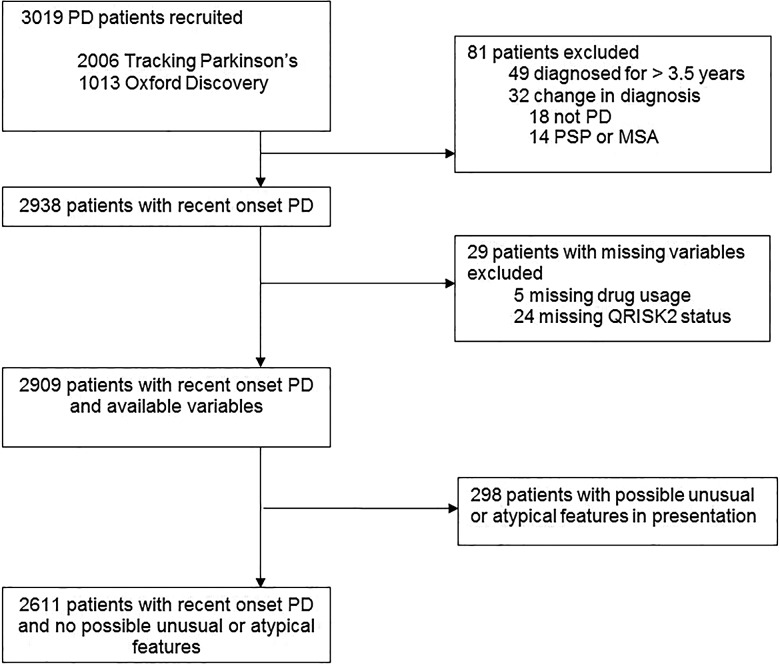
In 2909 individuals with recent-onset PD, the mean age was 67.5 years (SD 9.3), 63.5% were men and the mean disease duration was 1.3 years (SD 0.9). 33.8% of cases had high vascular risk, 28.7% medium risk, and 22.3% low risk, while 15.2% of cases had established CVD. Increasing vascular risk and CVD were associated with older age (p<0.001), worse motor score (p<0.001), more cognitive impairment (p<0.001) and worse motor phenotype (p=0.021). Statins were prescribed in 37.2% with high vascular risk, 15.1% with medium vascular risk and 6.5% with low vascular risk, which compared with statin usage in 75.3% of those with CVD.
Over 60% of recent-onset PD patients have high or medium cardiovascular risk (meriting statin usage), which is associated with a worse motor and cognitive phenotype. Statins are underused in these patients, compared with those with vascular disease, which is a missed opportunity for preventive treatment.
GN11NE062, NCT02881099.
心血管疾病(CVD)影响帕金森病(PD)的表型变异,通常是他汀类药物治疗的指征。心血管危险因素是否影响PD表型以及他汀类药物的处方是否恰当尚不清楚。
量化近期发病的PD患者的血管风险和他汀类药物的使用情况,并研究血管风险、PD严重程度和表型之间的关系。
使用QRISK2计算器对心血管风险进行量化(高风险≥20%,中风险≥10%且<20%,低风险<10%)。使用运动障碍协会统一PD评定量表(UPDRS)评估运动严重程度和表型,并通过蒙特利尔认知评估评估认知情况。
在2909例近期发病的PD患者中,平均年龄为67.5岁(标准差9.3),63.5%为男性,平均病程为1.3年(标准差0.9)。33.8%的病例有高血管风险,28.7%为中风险,22.3%为低风险,而15.2%的病例已患有CVD。血管风险增加和患有CVD与年龄较大(p<0.001)、运动评分较差(p<0.001)、认知障碍更多(p<0.001)以及运动表型较差(p=0.021)相关。高血管风险患者中37.2%使用了他汀类药物,中血管风险患者中15.1%使用了他汀类药物,低血管风险患者中6.5%使用了他汀类药物,而患有CVD的患者中75.3%使用了他汀类药物。
超过60%的近期发病的PD患者有高或中等心血管风险(值得使用他汀类药物),这与较差的运动和认知表型相关。与患有血管疾病的患者相比,这些患者中他汀类药物的使用不足,这是预防性治疗的一个错失的机会。
GN11NE062,NCT02881099。