Liu Li-Juan, Xie Shui-Xiang, Chen Ya-Tang, Xue Jing-Ling, Zhang Chuan-Jie, Zhu Fan
Li-Juan Liu, Ya-Tang Chen, Fan Zhu, Department of Medical Microbiology, School of Medicine, Wuhan University, Wuhan 430071, Hubei Province, China.
World J Gastroenterol. 2016 Sep 7;22(33):7486-99. doi: 10.3748/wjg.v22.i33.7486.
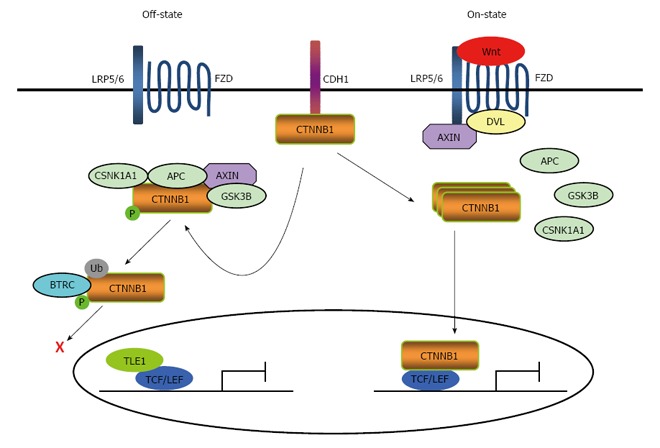
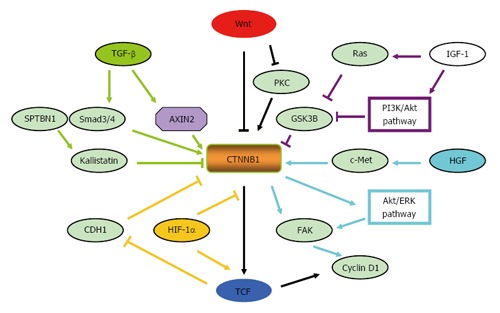
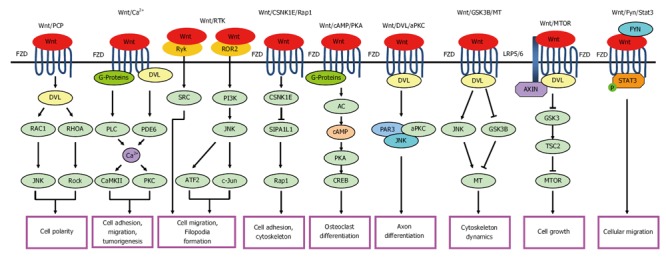
Hepatocellular carcinoma (HCC) is one of the most lethal malignancies in the world. Several signaling pathways, including the wingless/int-1 (Wnt) signaling pathway, have been shown to be commonly activated in HCC. The Wnt signaling pathway can be triggered via both catenin β1 (CTNNB1)-dependent (also known as "canonical") and CTNNB1-independent (often referred to as "non-canonical") pathways. Specifically, the canonical Wnt pathway is one of those most frequently reported in HCC. Aberrant regulation from three complexes (the cell-surface receptor complex, the cytoplasmic destruction complex and the nuclear CTNNB1/T-cell-specific transcription factor/lymphoid enhancer binding factor transcriptional complex) are all involved in HCC. Although the non-canonical Wnt pathway is rarely reported, two main non-canonical pathways, Wnt/planar cell polarity pathway and Wnt/Ca(2+) pathway, participate in the regulation of hepatocarcinogenesis. Interestingly, the canonical Wnt pathway is antagonized by non-canonical Wnt signaling in HCC. Moreover, other signaling cascades have also been demonstrated to regulate the Wnt pathway through crosstalk in HCC pathogenesis. This review provides a perspective on the emerging evidence that the aberrant regulation of Wnt signaling is a critical mechanism for the development of HCC. Furthermore, crosstalk between different signaling pathways might be conducive to the development of novel molecular targets of HCC.
肝细胞癌(HCC)是全球最致命的恶性肿瘤之一。包括无翅/整合1(Wnt)信号通路在内的多种信号通路已被证明在HCC中普遍被激活。Wnt信号通路可通过β-连环蛋白1(CTNNB1)依赖性(也称为“经典”)和CTNNB1非依赖性(通常称为“非经典”)途径触发。具体而言,经典Wnt途径是HCC中最常报道的途径之一。来自三种复合物(细胞表面受体复合物、细胞质破坏复合物和核CTNNB1/T细胞特异性转录因子/淋巴增强子结合因子转录复合物)的异常调节均参与了HCC的发生。虽然非经典Wnt途径报道较少,但两条主要的非经典途径,即Wnt/平面细胞极性途径和Wnt/Ca(2+)途径,参与了肝癌发生的调节。有趣的是,在HCC中,经典Wnt途径受到非经典Wnt信号的拮抗。此外,其他信号级联反应也已被证明在HCC发病机制中通过相互作用调节Wnt途径。本综述提供了一个观点,即Wnt信号的异常调节是HCC发生发展的关键机制。此外,不同信号通路之间的相互作用可能有助于开发HCC的新型分子靶点。