Shprits Yuri Y, Drozdov Alexander Y, Spasojevic Maria, Kellerman Adam C, Usanova Maria E, Engebretson Mark J, Agapitov Oleksiy V, Zhelavskaya Irina S, Raita Tero J, Spence Harlan E, Baker Daniel N, Zhu Hui, Aseev Nikita A
Helmholtz Centre Potsdam, GFZ, German Research Centre For Geosciences, Section 2.3, Building K 3, Room 012, Potsdam 14467, Germany.
Department of Earth, Planetary, and Space Sciences, University of California, Los Angeles, California 90095-1567, USA.
Nat Commun. 2016 Sep 28;7:12883. doi: 10.1038/ncomms12883.
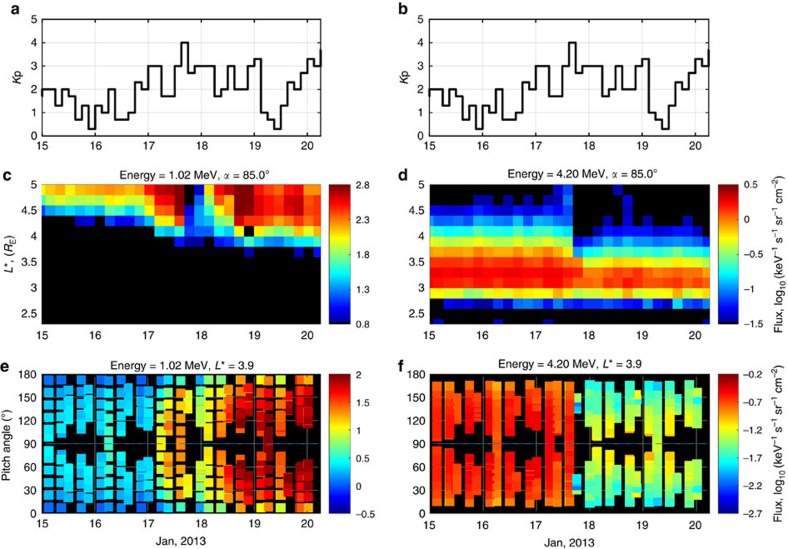
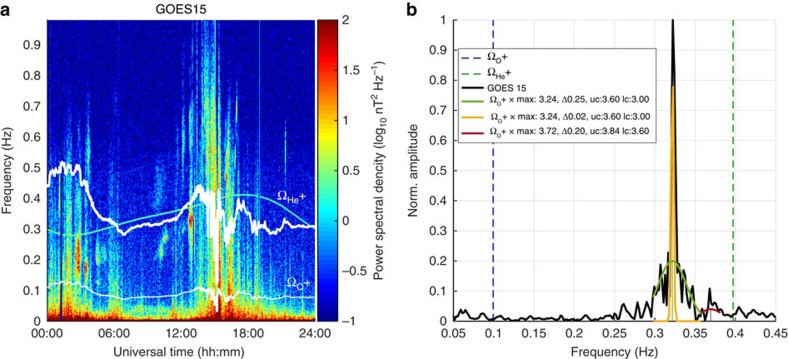
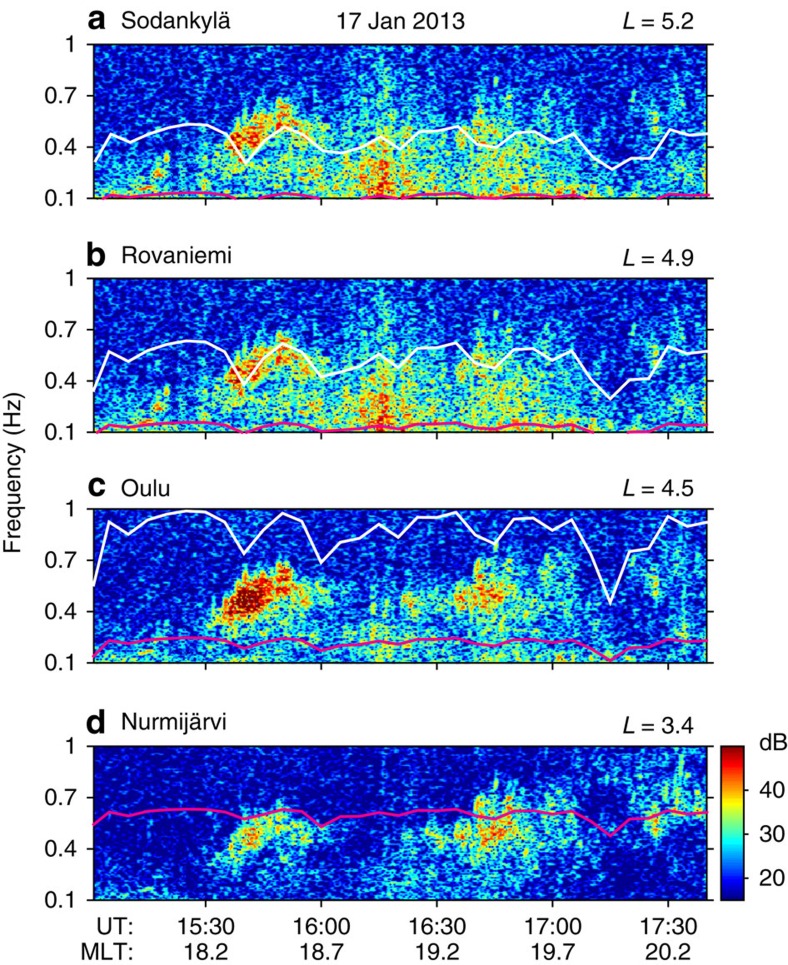
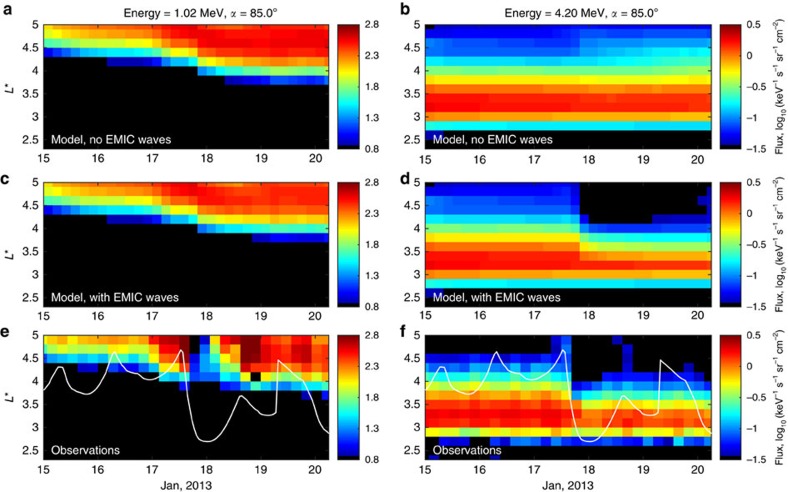
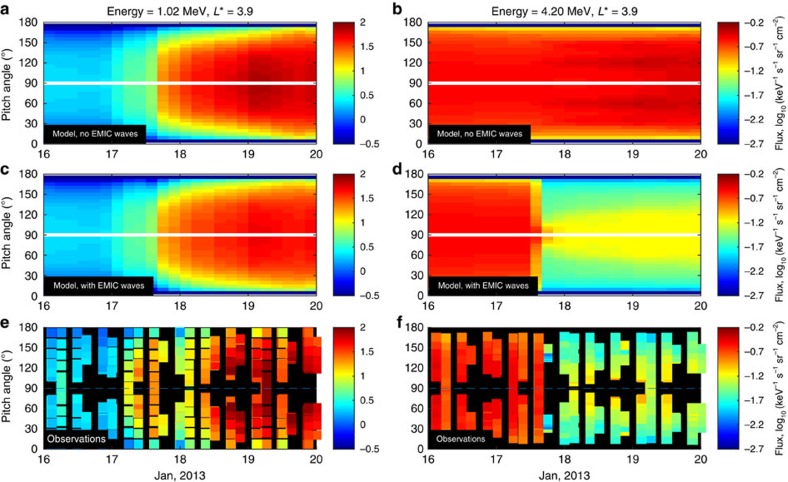
The dipole configuration of the Earth's magnetic field allows for the trapping of highly energetic particles, which form the radiation belts. Although significant advances have been made in understanding the acceleration mechanisms in the radiation belts, the loss processes remain poorly understood. Unique observations on 17 January 2013 provide detailed information throughout the belts on the energy spectrum and pitch angle (angle between the velocity of a particle and the magnetic field) distribution of electrons up to ultra-relativistic energies. Here we show that although relativistic electrons are enhanced, ultra-relativistic electrons become depleted and distributions of particles show very clear telltale signatures of electromagnetic ion cyclotron wave-induced loss. Comparisons between observations and modelling of the evolution of the electron flux and pitch angle show that electromagnetic ion cyclotron waves provide the dominant loss mechanism at ultra-relativistic energies and produce a profound dropout of the ultra-relativistic radiation belt fluxes.
地球磁场的偶极子构型使得高能粒子能够被捕获,这些粒子形成了辐射带。尽管在理解辐射带中的加速机制方面已经取得了重大进展,但损失过程仍知之甚少。2013年1月17日的独特观测提供了整个辐射带关于高达超相对论能量的电子能谱和俯仰角(粒子速度与磁场之间的夹角)分布的详细信息。我们在此表明,尽管相对论电子有所增强,但超相对论电子却减少了,并且粒子分布显示出非常明显的由电磁离子回旋波引起的损失特征。对电子通量和俯仰角演化的观测与模型之间的比较表明,电磁离子回旋波在超相对论能量下提供了主要的损失机制,并导致超相对论辐射带通量大幅下降。