McClendon T Brooke, Mainpal Rana, Amrit Francis R G, Krause Michael W, Ghazi Arjumand, Yanowitz Judith L
Molecular Genetics and Developmental Biology Graduate Program, University of Pittsburgh School of Medicine, Pennsylvania.
Magee-Womens Research Institute, Department of Obstetrics, Gynecology, and Reproductive Services University of Pittsburgh School of Medicine, Pennsylvania 15213.
G3 (Bethesda). 2016 Dec 7;6(12):3913-3925. doi: 10.1534/g3.116.035725.
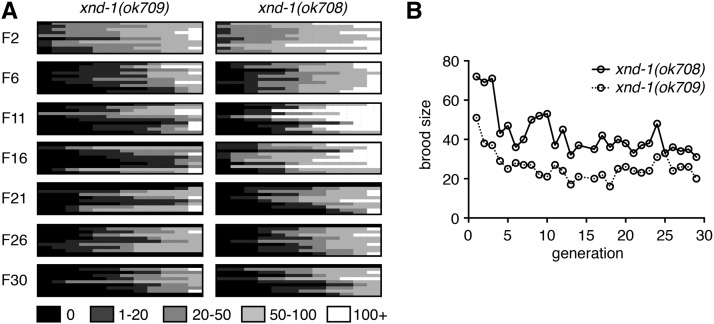
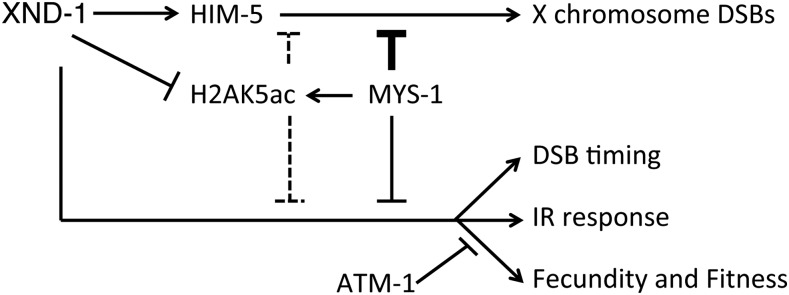
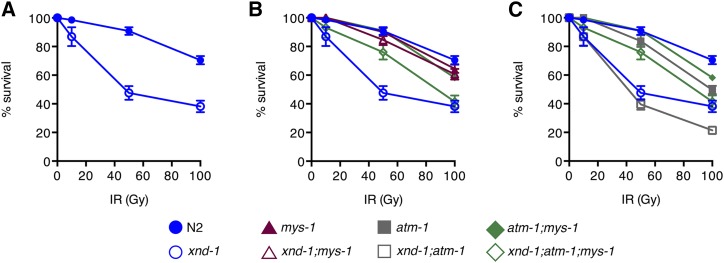
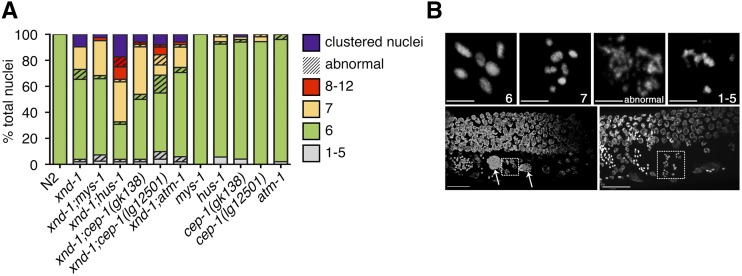
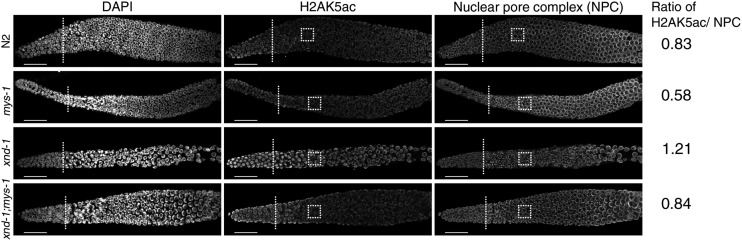
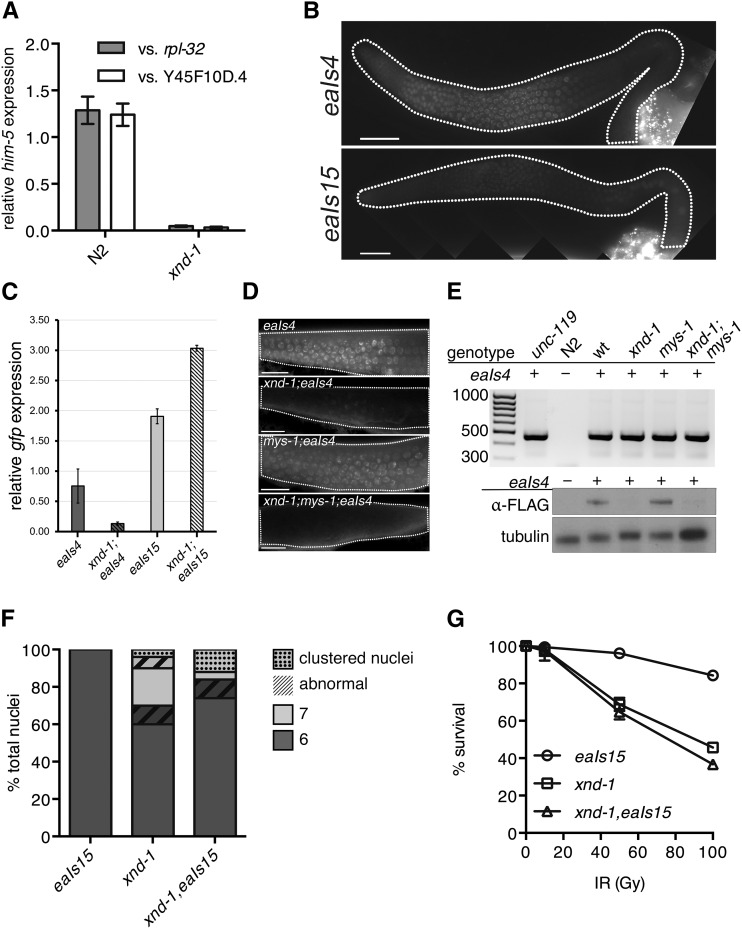
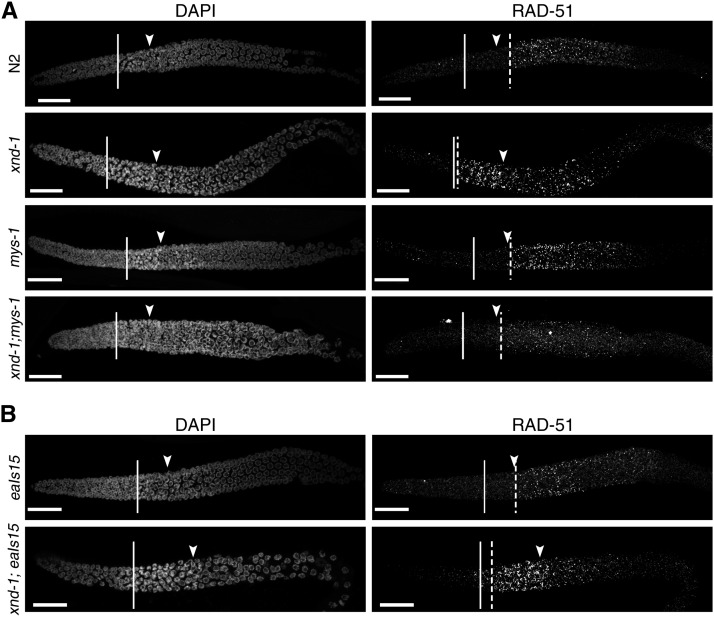
The germ line efficiently combats numerous genotoxic insults to ensure the high fidelity propagation of unaltered genomic information across generations. Yet, germ cells in most metazoans also intentionally create double-strand breaks (DSBs) to promote DNA exchange between parental chromosomes, a process known as crossing over. Homologous recombination is employed in the repair of both genotoxic lesions and programmed DSBs, and many of the core DNA repair proteins function in both processes. In addition, DNA repair efficiency and crossover (CO) distribution are both influenced by local and global differences in chromatin structure, yet the interplay between chromatin structure, genome integrity, and meiotic fidelity is still poorly understood. We have used the xnd-1 mutant of Caenorhabditis elegans to explore the relationship between genome integrity and crossover formation. Known for its role in ensuring X chromosome CO formation and germ line development, we show that xnd-1 also regulates genome stability. xnd-1 mutants exhibited a mortal germ line, high embryonic lethality, high incidence of males, and sensitivity to ionizing radiation. We discovered that a hypomorphic allele of mys-1 suppressed these genome instability phenotypes of xnd-1, but did not suppress the CO defects, suggesting it serves as a separation-of-function allele. mys-1 encodes a histone acetyltransferase, whose homolog Tip60 acetylates H2AK5, a histone mark associated with transcriptional activation that is increased in xnd-1 mutant germ lines, raising the possibility that thresholds of H2AK5ac may differentially influence distinct germ line repair events. We also show that xnd-1 regulated him-5 transcriptionally, independently of mys-1, and that ectopic expression of him-5 suppressed the CO defects of xnd-1 Our work provides xnd-1 as a model in which to study the link between chromatin factors, gene expression, and genome stability.
生殖系能有效抵御多种基因毒性损伤,以确保未改变的基因组信息在世代间高保真地传递。然而,大多数后生动物的生殖细胞也会有意制造双链断裂(DSB),以促进亲本染色体之间的DNA交换,这一过程称为交叉互换。同源重组用于修复基因毒性损伤和程序性DSB,许多核心DNA修复蛋白在这两个过程中都发挥作用。此外,DNA修复效率和交叉互换(CO)分布都受染色质结构局部和全局差异的影响,但染色质结构、基因组完整性和减数分裂保真度之间的相互作用仍知之甚少。我们利用秀丽隐杆线虫的xnd-1突变体来探究基因组完整性与交叉互换形成之间的关系。xnd-1以其在确保X染色体CO形成和生殖系发育中的作用而闻名,我们发现xnd-1也调节基因组稳定性。xnd-1突变体表现出致死性生殖系、高胚胎致死率、高雄性发生率以及对电离辐射敏感。我们发现mys-1的一个亚效等位基因抑制了xnd-1的这些基因组不稳定表型,但没有抑制CO缺陷,这表明它是一个功能分离等位基因。mys-1编码一种组蛋白乙酰转移酶,其同源物Tip60使H2AK5乙酰化,H2AK5是一种与转录激活相关的组蛋白标记,在xnd-1突变体生殖系中增加,这增加了H2AK5ac阈值可能差异影响不同生殖系修复事件的可能性。我们还表明,xnd-1独立于mys-1转录调节him-5,并且him-5的异位表达抑制了xnd-1的CO缺陷。我们的工作提供了xnd-1作为一个模型,用于研究染色质因子、基因表达和基因组稳定性之间的联系。