Xie Shao-Lin, Bian Wan-Ping, Wang Chao, Junaid Muhammad, Zou Ji-Xing, Pei De-Sheng
College of Marine Sciences, South China Agricultural University, Guangzhou, 510642, China.
Chongqing Institute of Green and Intelligent Technology, Chinese Academy of Sciences, Chongqing, 400714, China.
Sci Rep. 2016 Sep 29;6:34555. doi: 10.1038/srep34555.
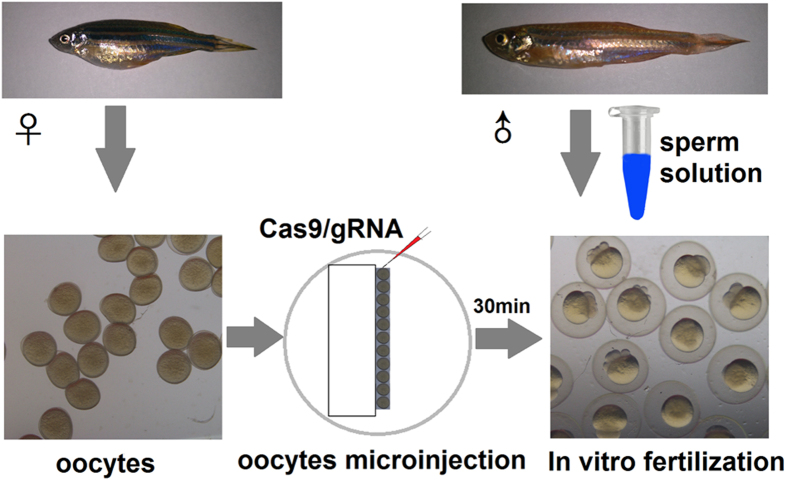
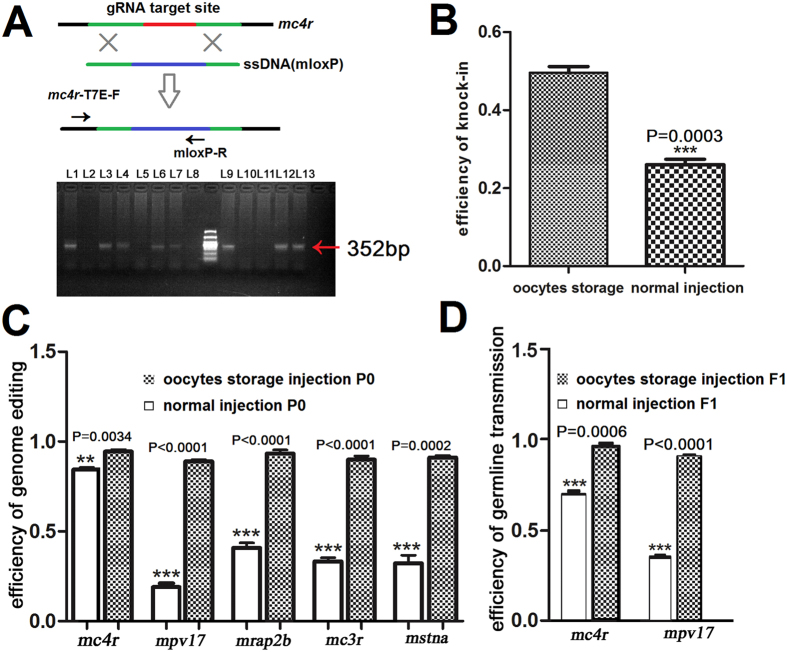
Contemporary improvements in the type II clustered regularly interspaced short palindromic repeats/CRISPR-associated protein 9 (CRISPR/Cas9) system offer a convenient way for genome editing in zebrafish. However, the low efficiencies of genome editing and germline transmission require a time-intensive and laborious screening work. Here, we reported a method based on in vitro oocyte storage by injecting oocytes in advance and incubating them in oocyte storage medium to significantly improve the efficiencies of genome editing and germline transmission by in vitro fertilization (IVF) in zebrafish. Compared to conventional methods, the prior micro-injection of zebrafish oocytes improved the efficiency of genome editing, especially for the sgRNAs with low targeting efficiency. Due to high throughputs, simplicity and flexible design, this novel strategy will provide an efficient alternative to increase the speed of generating heritable mutants in zebrafish by using CRISPR/Cas9 system.
II型成簇规律间隔短回文重复序列/CRISPR相关蛋白9(CRISPR/Cas9)系统的当代改进为斑马鱼的基因组编辑提供了一种便捷方法。然而,基因组编辑和种系传递的低效率需要耗时费力的筛选工作。在此,我们报告了一种基于体外卵母细胞储存的方法,即预先注射卵母细胞并将其置于卵母细胞储存培养基中孵育,以通过斑马鱼的体外受精(IVF)显著提高基因组编辑和种系传递的效率。与传统方法相比,预先对斑马鱼卵母细胞进行显微注射提高了基因组编辑效率,尤其是对于靶向效率低的sgRNA。由于高通量、简单性和灵活的设计,这种新策略将为利用CRISPR/Cas9系统提高斑马鱼中可遗传突变体的产生速度提供一种有效的替代方法。