Sheridan Robert P, Piras Patrick, Sherer Edward C, Roussel Christian, Pirkle William H, Welch Christopher J
Department of Structural Chemistry, Merck Research Laboratories, Rahway, NJ 07065, USA.
Aix Marseille Université, Centrale Marseille, CNRS, iSm2, 13397 Marseille CEDEX 20, France.
Molecules. 2016 Sep 29;21(10):1297. doi: 10.3390/molecules21101297.
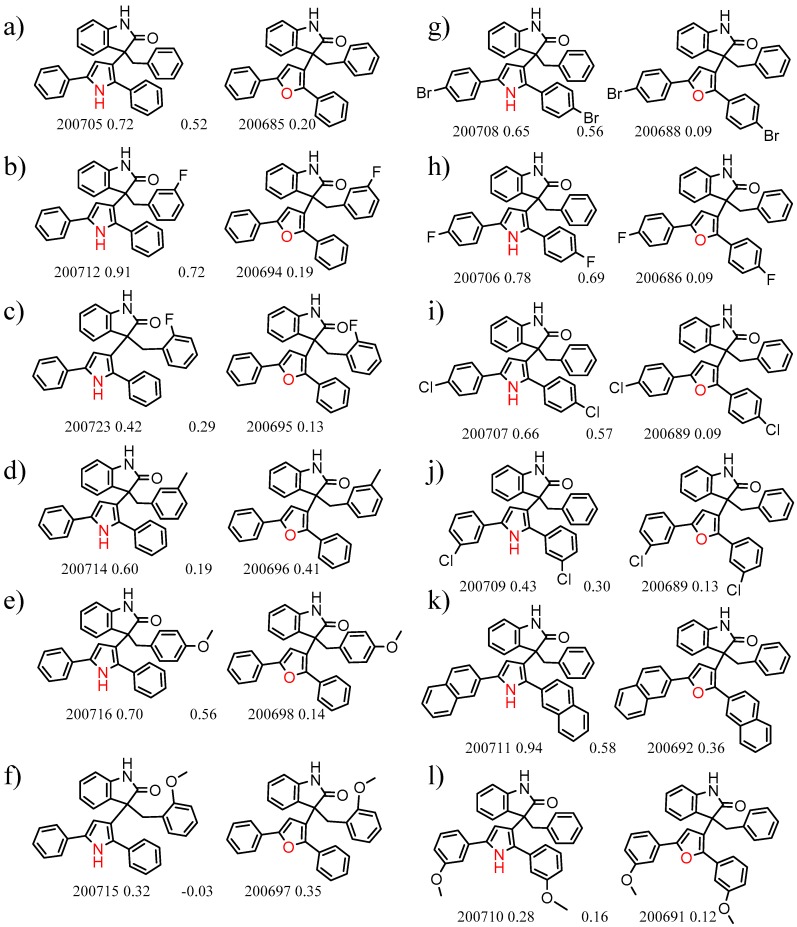
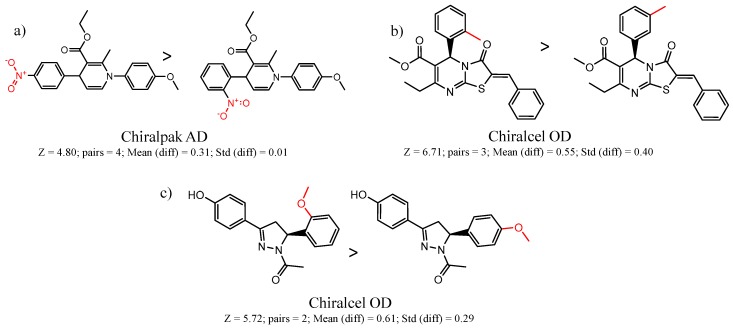
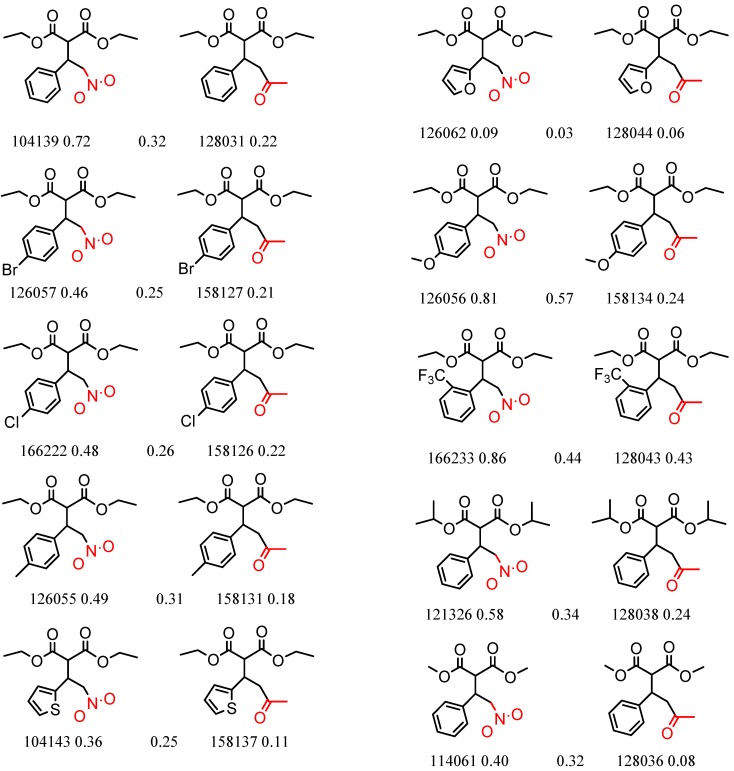
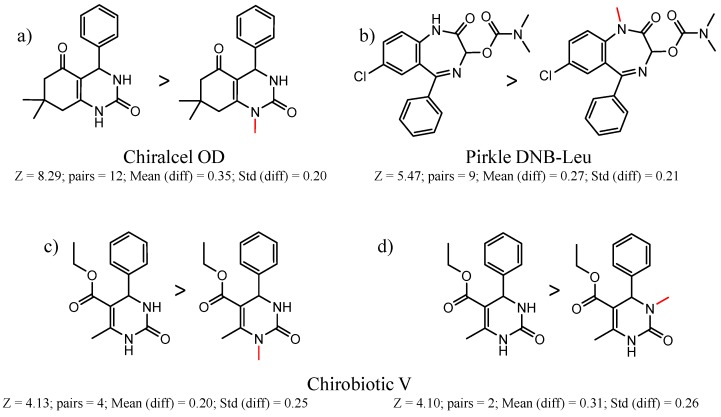
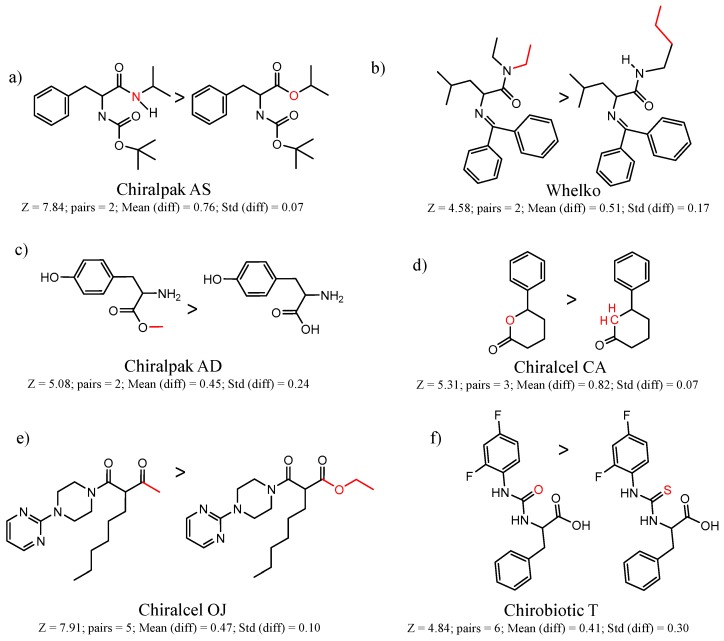
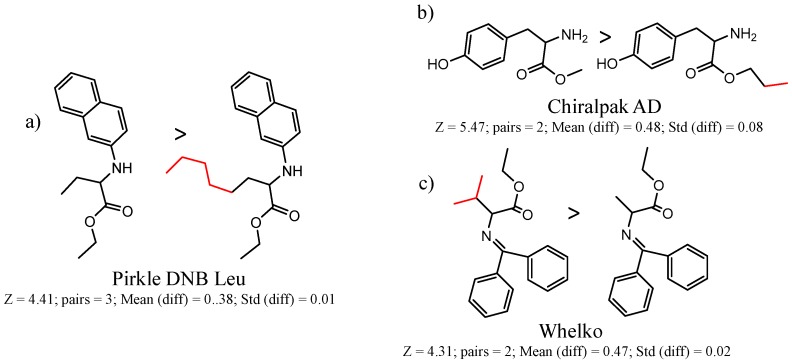
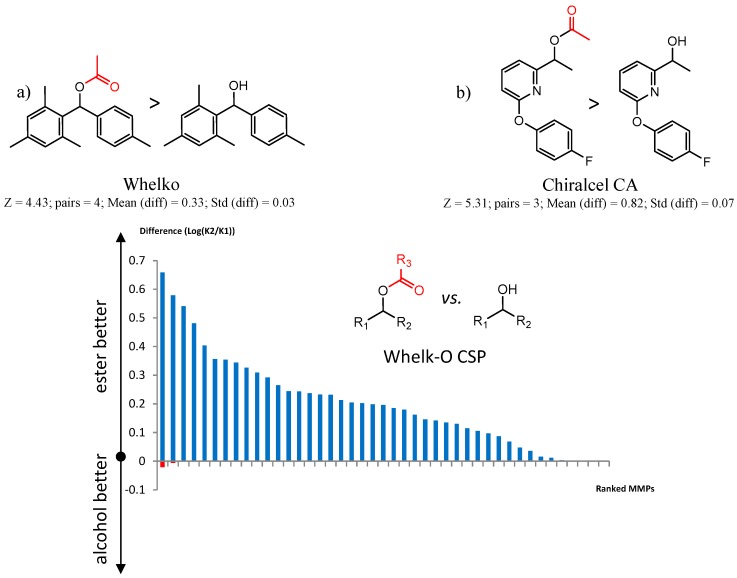
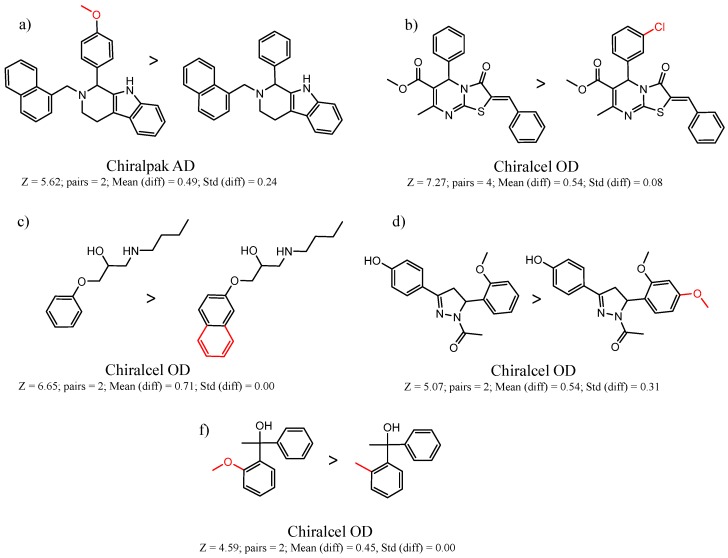
We apply matched molecular pair (MMP) analysis to data from ChirBase, which contains literature reports of chromatographic enantioseparations. For the 19 chiral stationary phases we examined, we were able to identify 289 sets of pairs where there is a statistically significant and consistent difference in enantioseparation due to a small chemical change. In many cases these changes highlight enantioselectivity differences between pairs or small families of closely related molecules that have for many years been used to probe the mechanisms of chromatographic chiral recognition; for example, the comparison of N-H vs. N-Me analytes to determine the criticality of an N-H hydrogen bond in chiral molecular recognition. In other cases, statistically significant MMPs surfaced by the analysis are less familiar or somewhat puzzling, sparking a need to generate and test hypotheses to more fully understand. Consequently, mining of appropriate datasets using MMP analysis provides an important new approach for studying and understanding the process of chromatographic enantioseparation.
我们将匹配分子对(MMP)分析应用于ChirBase中的数据,该数据库包含色谱对映体分离的文献报道。对于我们研究的19种手性固定相,我们能够识别出289组分子对,这些分子对由于微小的化学变化而在对映体分离方面存在统计学上显著且一致的差异。在许多情况下,这些变化突出了多年来用于探究色谱手性识别机制的分子对或密切相关分子的小家族之间的对映选择性差异;例如,比较N-H与N-Me分析物以确定N-H氢键在手性分子识别中的关键性。在其他情况下,分析揭示的具有统计学意义的MMP不太常见或有些令人费解,这引发了生成和检验假设以更全面理解的需求。因此,使用MMP分析挖掘合适的数据集为研究和理解色谱对映体分离过程提供了一种重要的新方法。