Goeders Nathalie, Chai Ray, Chen Bihe, Day Andrew, Salmond George P C
Department of Biochemistry, University of Cambridge, Cambridge CB2 1QW, UK.
Toxins (Basel). 2016 Sep 28;8(10):282. doi: 10.3390/toxins8100282.
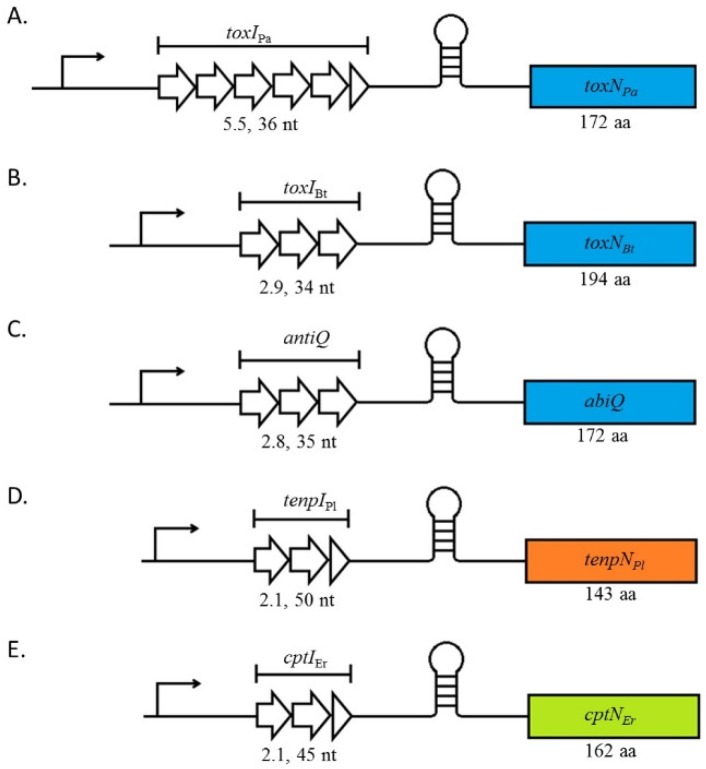
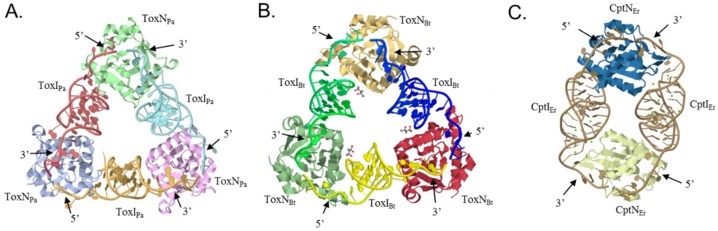
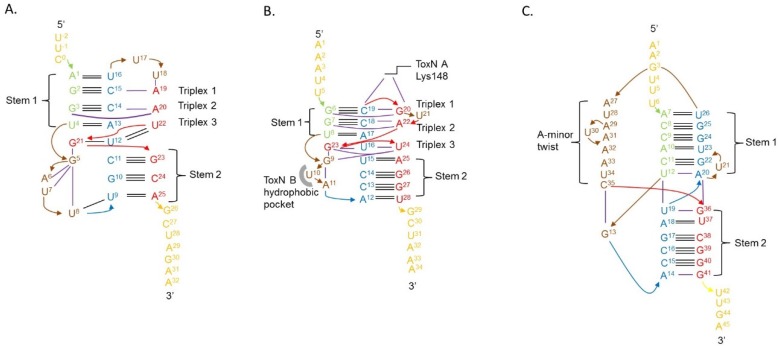
Toxin-antitoxin (TA) systems are small genetic modules that encode a toxin (that targets an essential cellular process) and an antitoxin that neutralises or suppresses the deleterious effect of the toxin. Based on the molecular nature of the toxin and antitoxin components, TA systems are categorised into different types. Type III TA systems, the focus of this review, are composed of a toxic endoribonuclease neutralised by a non-coding RNA antitoxin in a pseudoknotted configuration. Bioinformatic analysis shows that the Type III systems can be classified into subtypes. These TA systems were originally discovered through a phage resistance phenotype arising due to a process akin to an altruistic suicide; the phenomenon of abortive infection. Some Type III TA systems are bifunctional and can stabilise plasmids during vegetative growth and sporulation. Features particular to Type III systems are explored here, emphasising some of the characteristics of the RNA antitoxin and how these may affect the co-evolutionary relationship between toxins and cognate antitoxins in their quaternary structures. Finally, an updated analysis of the distribution and diversity of these systems are presented and discussed.
毒素-抗毒素(TA)系统是小型遗传模块,其编码一种毒素(作用于细胞必需过程)和一种能中和或抑制毒素有害作用的抗毒素。根据毒素和抗毒素成分的分子性质,TA系统可分为不同类型。III型TA系统是本综述的重点,它由一种毒性内切核糖核酸酶和一个呈假结构型的非编码RNA抗毒素组成,该抗毒素可中和毒性。生物信息学分析表明,III型系统可进一步分为不同亚型。这些TA系统最初是通过一种类似于利他性自杀的过程(即流产感染现象)所产生的噬菌体抗性表型发现的。一些III型TA系统具有双功能,可在营养生长和孢子形成过程中稳定质粒。本文探讨了III型系统的独特特征,重点介绍了RNA抗毒素的一些特性以及这些特性如何在四级结构中影响毒素与同源抗毒素之间的共同进化关系。最后,对这些系统的分布和多样性进行了更新分析并展开讨论。