Rittman Timothy, Rubinov Mikail, Vértes Petra E, Patel Ameera X, Ginestet Cedric E, Ghosh Boyd C P, Barker Roger A, Spillantini Maria Grazia, Bullmore Edward T, Rowe James B
Department of Clinical Neurosciences, University of Cambridge, Herchel Smith Building for Brain and Mind Sciences, Cambridge, UK; Department of Psychology, Behavioural and Clinical Neuroscience Institute, University of Cambridge, Cambridge, UK.
Department of Psychology, Behavioural and Clinical Neuroscience Institute, University of Cambridge, Cambridge, UK; Department of Psychiatry, Herchel Smith Building for Brain and Mind Sciences, Cambridge, UK; Churchill College, University of Cambridge, Cambridge, UK.
Neurobiol Aging. 2016 Dec;48:153-160. doi: 10.1016/j.neurobiolaging.2016.09.001. Epub 2016 Sep 9.
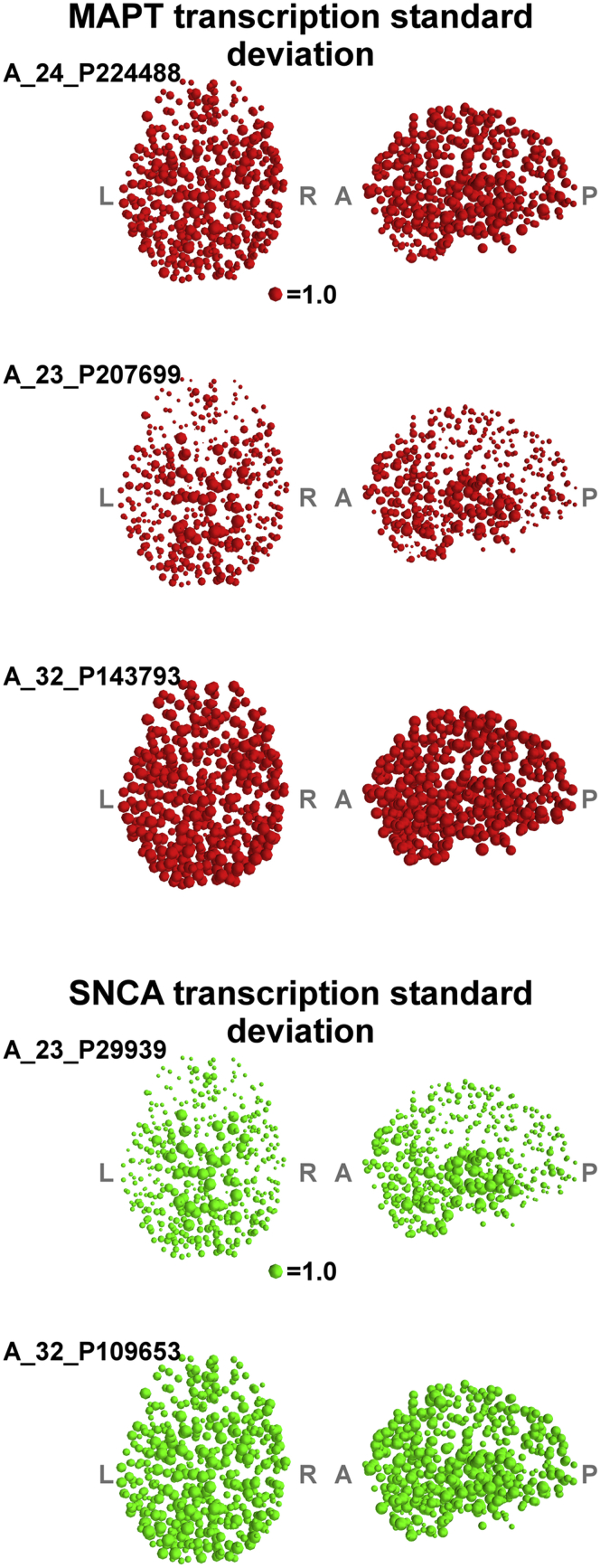
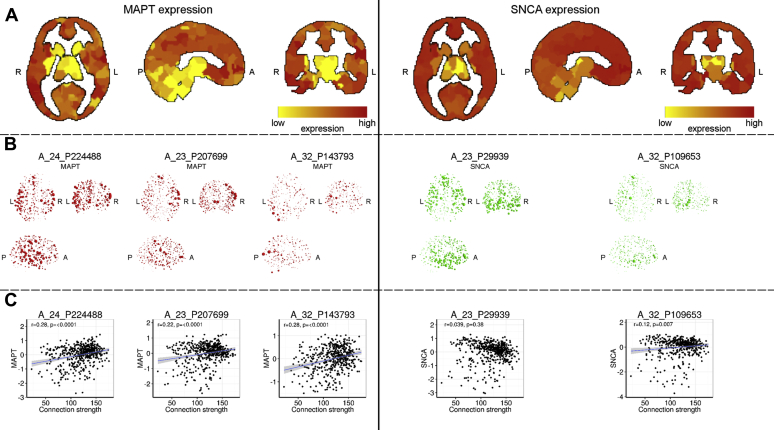
Abnormalities of tau protein are central to the pathogenesis of progressive supranuclear palsy, whereas haplotype variation of the tau gene MAPT influences the risk of Parkinson disease and Parkinson's disease dementia. We assessed whether regional MAPT expression might be associated with selective vulnerability of global brain networks to neurodegenerative pathology. Using task-free functional magnetic resonance imaging in progressive supranuclear palsy, Parkinson disease, and healthy subjects (n = 128), we examined functional brain networks and measured the connection strength between 471 gray matter regions. We obtained MAPT and SNCA microarray expression data in healthy subjects from the Allen brain atlas. Regional connectivity varied according to the normal expression of MAPT. The regional expression of MAPT correlated with the proportionate loss of regional connectivity in Parkinson's disease. Executive cognition was impaired in proportion to the loss of hub connectivity. These effects were not seen with SNCA, suggesting that alpha-synuclein pathology is not mediated through global network properties. The results establish a link between regional MAPT expression and selective vulnerability of functional brain networks to neurodegeneration.
tau蛋白异常是进行性核上性麻痹发病机制的核心,而tau基因MAPT的单倍型变异会影响帕金森病和帕金森病痴呆的风险。我们评估了区域MAPT表达是否可能与全脑网络对神经退行性病变的选择性易损性相关。在进行性核上性麻痹、帕金森病患者及健康受试者(n = 128)中使用静息态功能磁共振成像,我们检测了脑功能网络,并测量了471个灰质区域之间的连接强度。我们从艾伦脑图谱中获取了健康受试者的MAPT和SNCA基因芯片表达数据。区域连接性随MAPT的正常表达而变化。MAPT的区域表达与帕金森病中区域连接性的相应丧失相关。执行认知功能的损害程度与枢纽连接性的丧失程度成正比。这些效应在SNCA中未观察到,表明α-突触核蛋白病变不是通过全脑网络特性介导的。这些结果建立了区域MAPT表达与脑功能网络对神经退行性变的选择性易损性之间的联系。