Kamezaki Chihiro, Nakashima Ami, Yamada Asako, Uenishi Sachiko, Ishibashi Hiroshi, Shibuya Natsumi, Hama Susumu, Hosoi Shinzo, Yamashita Eiji, Kogure Kentaro
Kyoto Pharmaceutical University, 5 Misasagi-Nakauchi-cho, Yamashina-ku, Kyoto 607-8414, Japan.
Department of Pharmaceutical Health Chemistry, Institute of Biomedical Sciences, Tokushima University, Graduate School, 1 Shomachi, Tokushima 770-8505, Japan.
J Clin Biochem Nutr. 2016 Sep;59(2):100-106. doi: 10.3164/jcbn.15-153. Epub 2016 Sep 1.
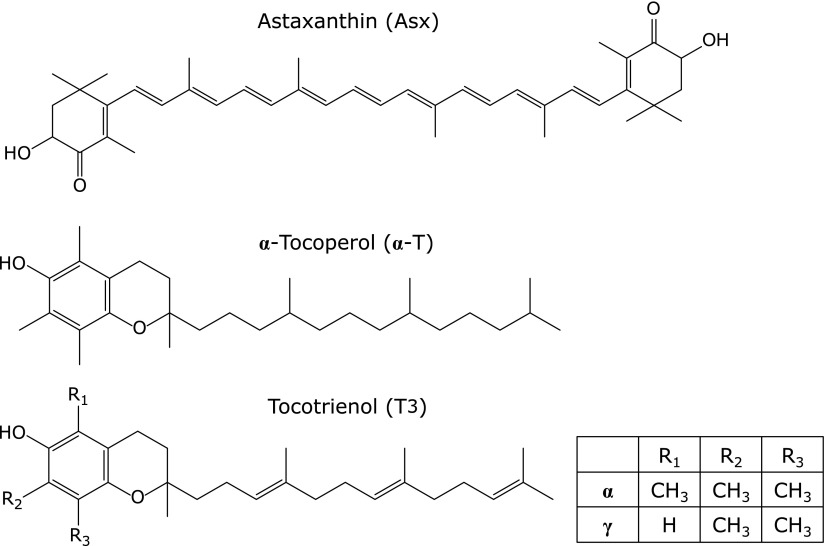
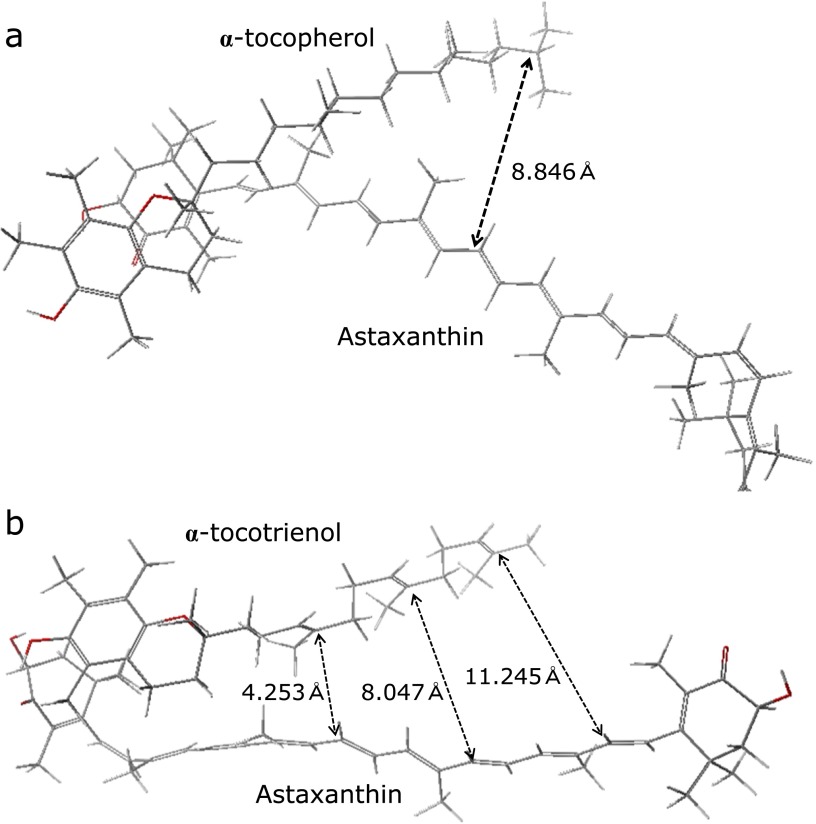
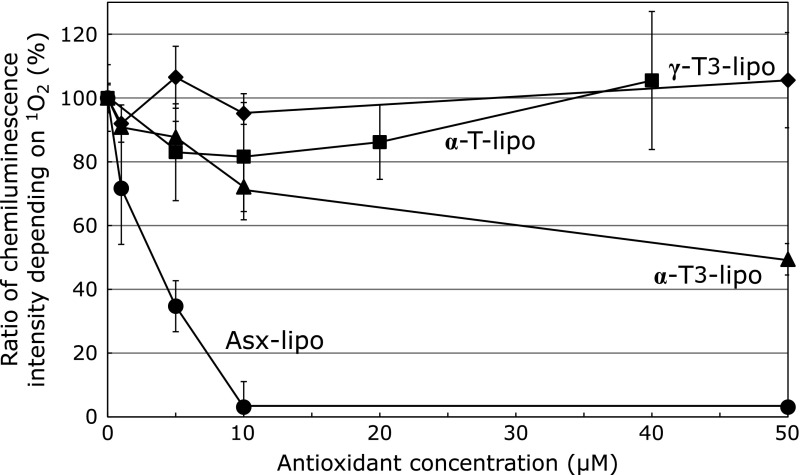
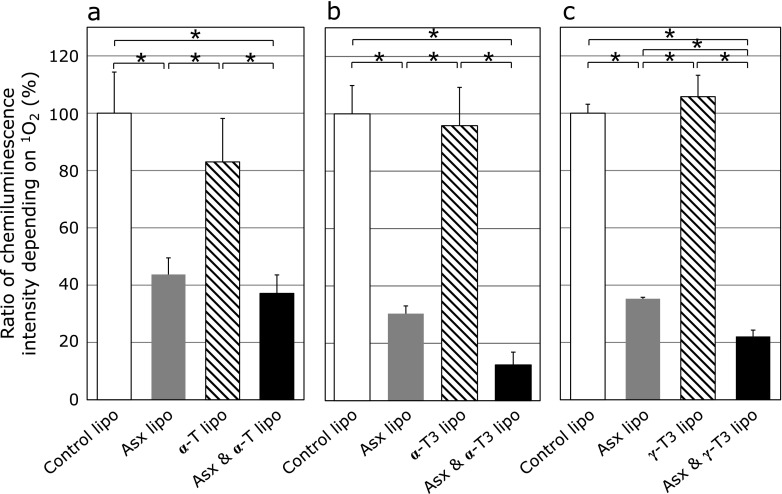
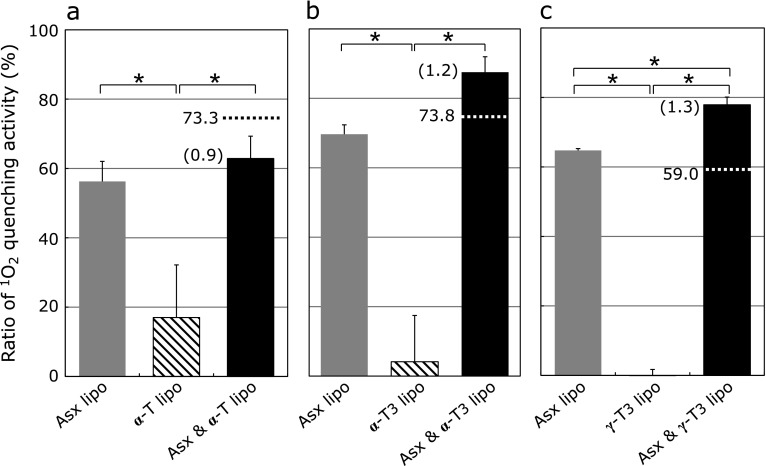
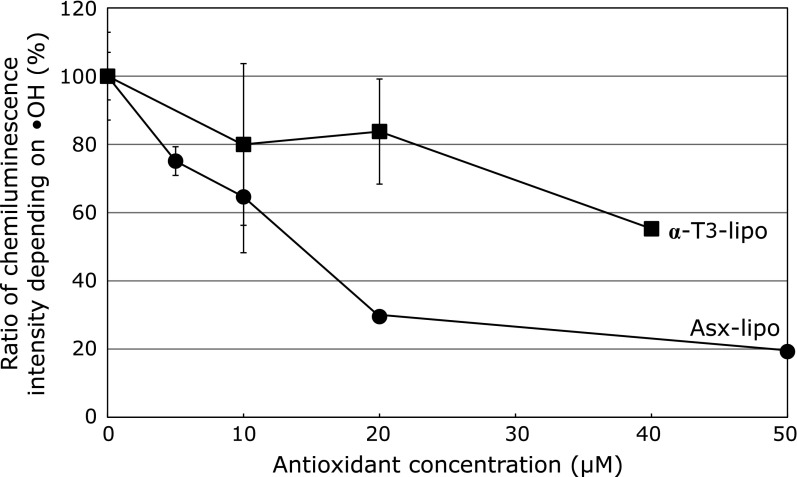
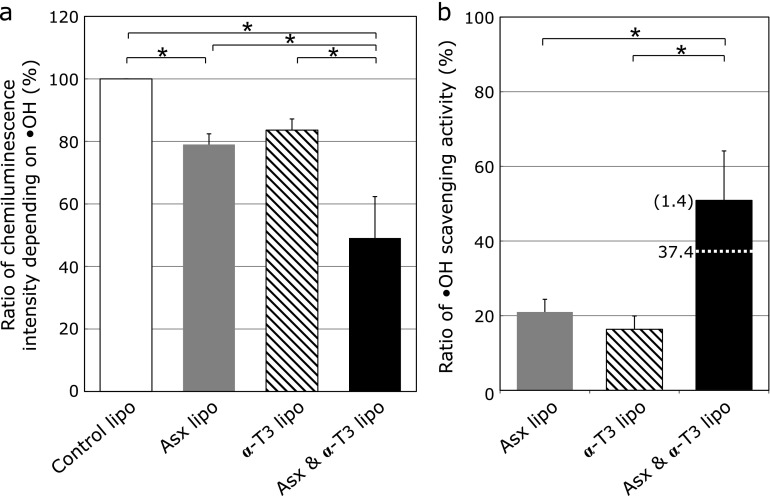
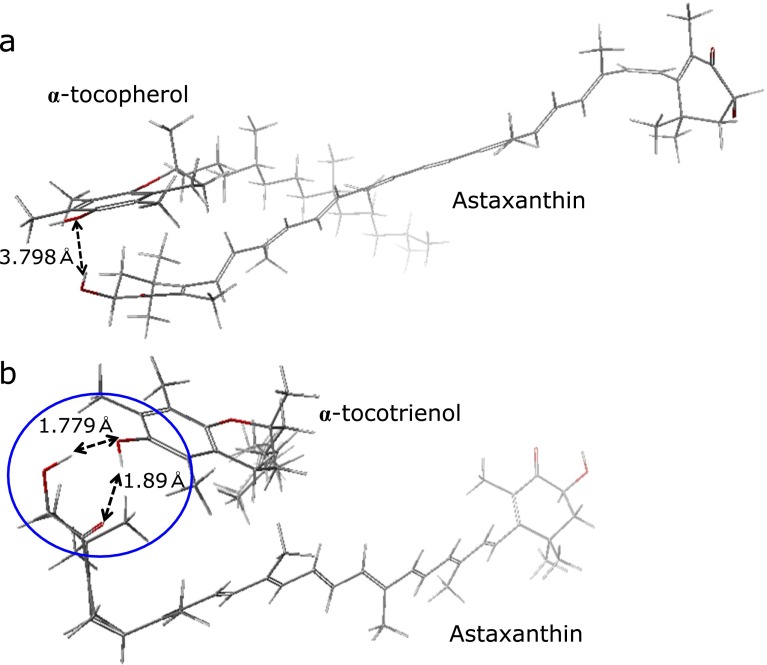
Astaxanthin and vitamin E are both effective antioxidants that are frequently used in cosmetics, as food additives, and in to prevent oxidative damage. A combination of astaxanthin and vitamin E would be expected to show an additive anntioxidative effect. In this study, liposomes co-encapsulating astaxanthin and the vitamin E derivatives α-tocopherol (α-T) or tocotrienols (T3) were prepared, and the antioxidative activity of these liposomes toward singlet oxygen and hydroxyl radical was evaluated . Liposomes co-encapsulating astaxanthin and α-T showed no additive anntioxidative effect, while the actual scavenging activity of liposomes co-encapsulating astaxanthin and T3 was higher than the calculated additive activity. To clarify why this synergistic effect occurs, the most stable structure of astaxanthin in the presence of α-T or α-T3 was calculated. Only α-T3 was predicted to form hydrogen bonding with astaxanthin, and the astaxanthin polyene chain would partially interact with the α-T3 triene chain, which could explain why there was a synergistic effect between astaxanthin and T3 but not α-T. In conclusion, co-encapsulation of astaxanthin and T3 induces synergistic scavenging activity by intermolecular interactions between the two antioxidants.
虾青素和维生素E都是有效的抗氧化剂,常用于化妆品、作为食品添加剂以及预防氧化损伤。虾青素和维生素E的组合预期会表现出相加的抗氧化作用。在本研究中,制备了共包封虾青素和维生素E衍生物α-生育酚(α-T)或生育三烯酚(T3)的脂质体,并评估了这些脂质体对单线态氧和羟基自由基的抗氧化活性。共包封虾青素和α-T的脂质体没有表现出相加的抗氧化作用,而共包封虾青素和T3的脂质体的实际清除活性高于计算出的相加活性。为了阐明这种协同效应为何会发生,计算了在α-T或α-T3存在下虾青素最稳定的结构。预计只有α-T3会与虾青素形成氢键,并且虾青素的多烯链会与α-T3的三烯链部分相互作用,这可以解释为什么虾青素与T3之间存在协同效应而与α-T不存在。总之,虾青素和T3的共包封通过两种抗氧化剂之间的分子间相互作用诱导协同清除活性。