Yoshida Eri, Kudo Daisuke, Nagase Hayato, Shimoda Hiroshi, Suto Shinichiro, Negishi Mika, Kakizaki Ikuko, Endo Masahiko, Hakamada Kenichi
Department of Gastroenterological Surgery, Hirosaki University, Graduate School of Medicine, Hirosaki, Aomori 036-8562, Japan.
Department of Anatomical Science, Hirosaki University, Graduate School of Medicine, Hirosaki, Aomori 036-8562, Japan.
Oncol Lett. 2016 Oct;12(4):2337-2344. doi: 10.3892/ol.2016.4930. Epub 2016 Aug 2.
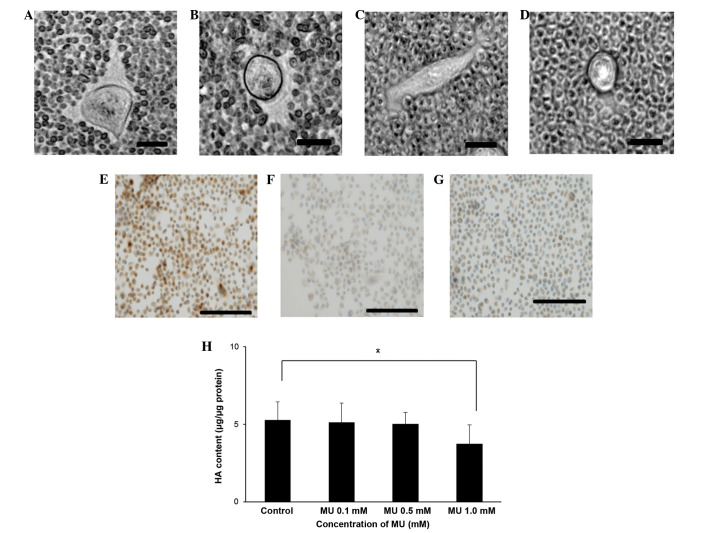
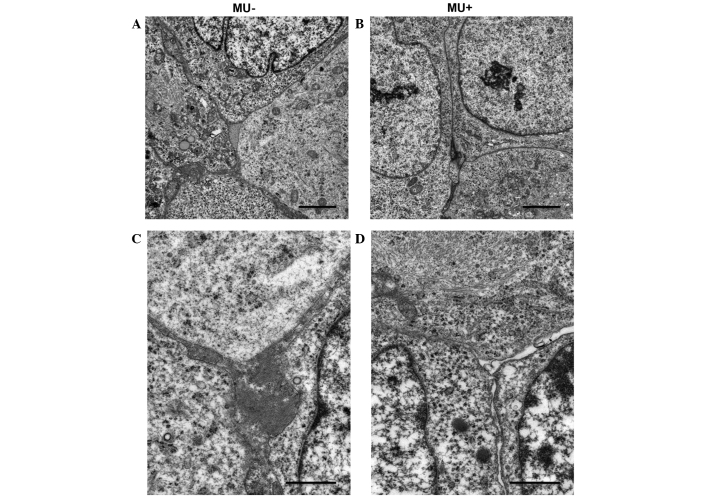
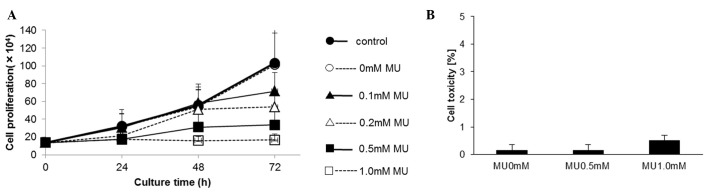
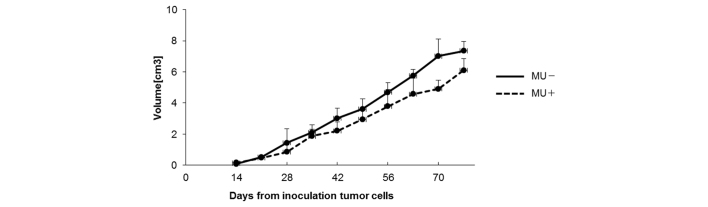
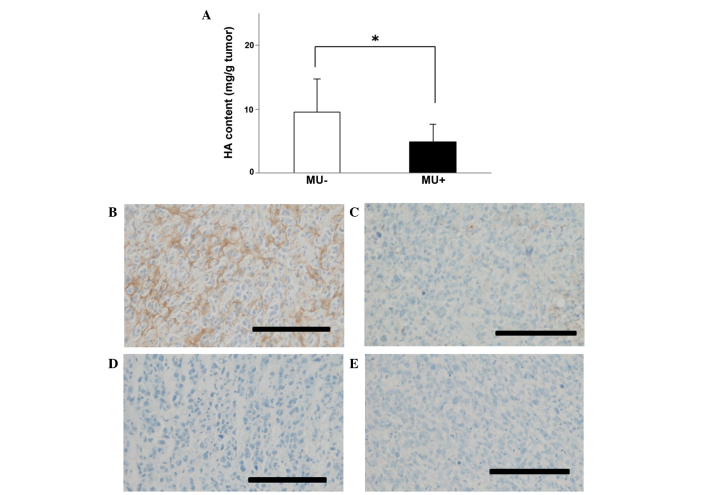
Hyaluronan (HA) is a major component of the extracellular matrix (ECM), and influences tumor invasion and metastasis. In a previous study, the present authors reported for the first time that 4-methylumbelliferone (MU) inhibited HA synthesis and suppressed tumor growth. However, the localization of HA and the changes in ECM morphology caused by MU in pancreatic cancer remain to be examined in detail. In the present study, the cytotoxicity of MU and its effect on cellular proliferation was evaluated in the human pancreatic cancer cell line MIA PaCa-2. The amount of HA synthesized and the retention of HA around the cells were quantitatively and immunohistochemically analyzed and . Structural changes in the ECM in the tumor tissue were investigated using an electron microscope. MU treatment led to a decrease in extracellular HA retention, as evidenced by a particle exclusion assay and immunohistochemical staining. Cell proliferation was suppressed by MU in a dose-dependent manner. The release of lactate dehydrogenase into the culture medium due to damage to the cellular membrane did not increase following MU administration. In tumor-inoculated mice, MU suppressed any increase in tumor volume and decreased the quantity of HA. Electron microscopy revealed that MU attenuated the intercellular space and caused it to be less cohesive. These data indicate that MU inhibits HA synthesis and reduces the amount of HA in the ECM while exhibiting no obvious cytotoxic effect. These findings suggest that MU has potential as a novel therapeutic agent for pancreatic cancer.
透明质酸(HA)是细胞外基质(ECM)的主要成分,影响肿瘤侵袭和转移。在先前的一项研究中,作者首次报道4-甲基伞形酮(MU)抑制HA合成并抑制肿瘤生长。然而,胰腺癌中HA的定位以及MU引起的ECM形态变化仍有待详细研究。在本研究中,评估了MU对人胰腺癌细胞系MIA PaCa-2的细胞毒性及其对细胞增殖的影响。对合成的HA量以及细胞周围HA的保留情况进行了定量和免疫组织化学分析。使用电子显微镜研究肿瘤组织中ECM的结构变化。MU处理导致细胞外HA保留减少,颗粒排除试验和免疫组织化学染色证明了这一点。MU以剂量依赖性方式抑制细胞增殖。MU给药后,由于细胞膜损伤导致乳酸脱氢酶释放到培养基中并未增加。在接种肿瘤的小鼠中,MU抑制肿瘤体积的任何增加并减少HA的量。电子显微镜显示,MU使细胞间隙变窄并使其凝聚力降低。这些数据表明,MU抑制HA合成并减少ECM中HA的量,同时未表现出明显的细胞毒性作用。这些发现表明,MU有潜力作为一种新型胰腺癌治疗药物。