Bourdeau Isabelle, Grunenwald Solange, Burnichon Nelly, Khalifa Emmanuel, Dumas Nadine, Binet Marie-Claire, Nolet Serge, Gimenez-Roqueplo Anne-Paule
Divisions of Endocrinology (I.B., S.G.) and Genetics (I.B., N.D., M.-C.B.), Department of Medicine, and Department of Pathology (S.N.), Centre Hospitalier de l'Université de Montréal, Université de Montréal, Québec, Canada H2W 1T8; Assistance Publique-Hôpitaux de Paris (N.B., E.K., A.-P.G.-R.), Service de Génétique, Hôpital Européen Georges Pompidou, F-75015 Paris, France; Université Paris Descartes (N.B., E.K., G.-R.), Faculté de Médecine, Sorbonne Paris Cité, F-75006 Paris, France; and INSERM (N.B., E.K., G.-R.), Unité Mixte de Recherche 970, Centre de Recherche de l'Hôpital Européen Georges Pompidou, F-75015 Paris, France.
J Clin Endocrinol Metab. 2016 Dec;101(12):4710-4718. doi: 10.1210/jc.2016-1665. Epub 2016 Oct 4.
More than 40% of patients with paragangliomas (PGLs) harbor a germline mutation of the known PGL susceptibility genes, mainly in the SDHB or SDHD genes.
The objective of the study was to characterize the genetic background of the French Canadian (FC) patients with PGLs and provide new clinical and paraclinical insights on SDHC-related PGLs.
Genetic testing has been offered to FC patients affected with PGLs followed up at the adrenal genetics clinic at Centre hospitalier de l'Université de Montréal. After genetic counseling, 29 FC patients consented for PGL genetic testing.
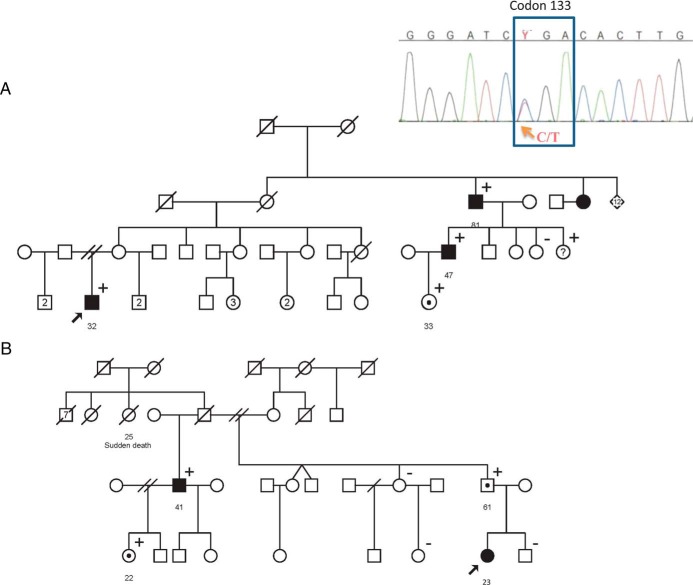
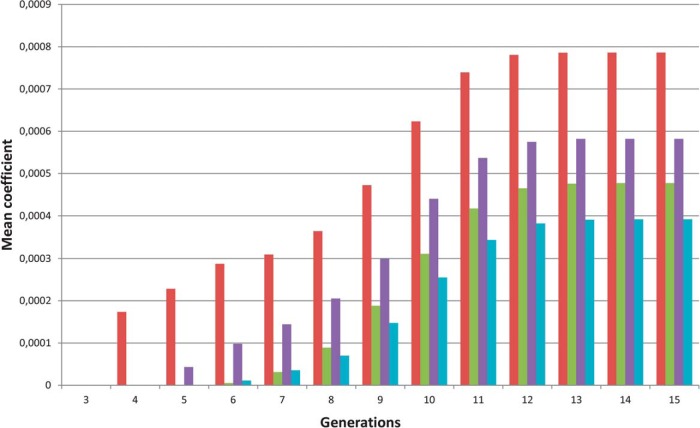
Thirteen of 29 patients (44.8%) carried a germline mutation. The same heterozygous nonsense mutation at codon 133 of exon 5 of the SDHC gene (c.397C>T, p.[Arg133Ter]) was found in nine patients, representing 69.2% of the patients having a germline mutation. Seventy percent of these patients had head and neck PGLs. Twenty percent had multiple and 30% had malignant PGLs. We traced back the ascending genealogy of 10 index cases (nine patients from our cohort and one patient referred to us) and found that this mutation was most probably introduced in Nouvelle France by a couple of French settlers who established themselves in the 17th century.
We found that 31% of the PGLs in the French Canadian can be explained by the SDHC mutation (c.397C>T, p.[Arg133Ter]). The dominance of the SDHC mutation is unique to the FCs and is most likely due to a French founder effect. SDHC gene analysis should be prioritized in FC patients with PGL.
超过40%的副神经节瘤(PGLs)患者携带已知PGL易感基因的种系突变,主要存在于SDHB或SDHD基因中。
本研究旨在描述法裔加拿大(FC)PGLs患者的遗传背景,并提供关于SDHC相关PGLs的新的临床和辅助临床见解。
向在蒙特利尔大学中心医院肾上腺遗传学诊所接受随访的患PGLs的FC患者提供基因检测。经过遗传咨询后,29名FC患者同意进行PGL基因检测。
29名患者中有13名(44.8%)携带种系突变。在9名患者中发现了SDHC基因第5外显子第133密码子处相同的杂合无义突变(c.397C>T,p.[Arg133Ter]),占发生种系突变患者的69.2%。这些患者中有70%患有头颈部PGLs。20%的患者患有多发PGLs,30%的患者患有恶性PGLs。我们追溯了10例索引病例(我们队列中的9名患者和转诊给我们的1名患者)的家族谱系,发现这种突变很可能是由17世纪在新法兰西定居的一对法国定居者引入的。
我们发现法裔加拿大人中31%的PGLs可由SDHC突变(c.397C>T,p.[Arg133Ter])解释。SDHC突变的优势在FC人群中是独特的,很可能是由于法国奠基者效应。对于患PGL的FC患者,应优先进行SDHC基因分析。