Wangpraseurt Daniel, Jacques Steven L, Petrie Tracy, Kühl Michael
Plant Functional Biology and Climate Change Cluster, University of Technology Sydney, SydneyNSW, Australia; Marine Biological Section, Department of Biology, University of CopenhagenHelsingør, Denmark.
Department of Biomedical Engineering, Oregon Health & Science University, Portland OR, USA.
Front Plant Sci. 2016 Sep 21;7:1404. doi: 10.3389/fpls.2016.01404. eCollection 2016.
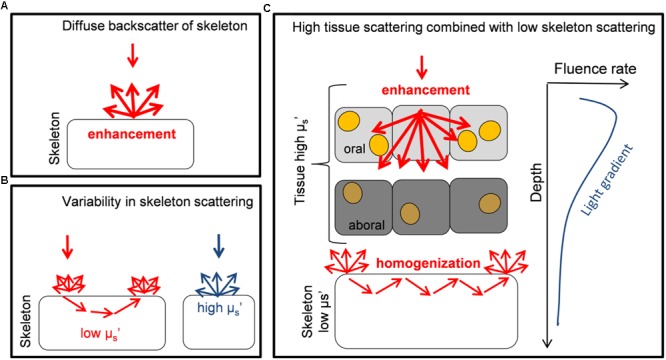
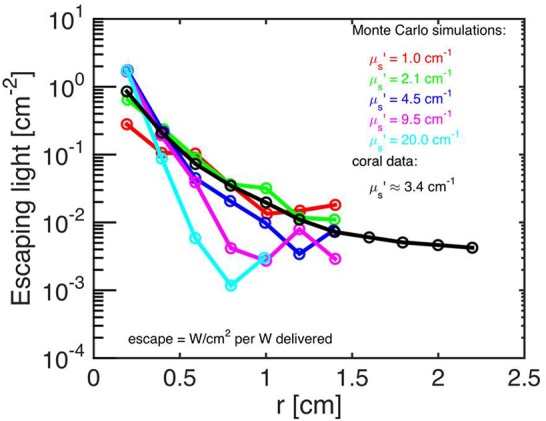
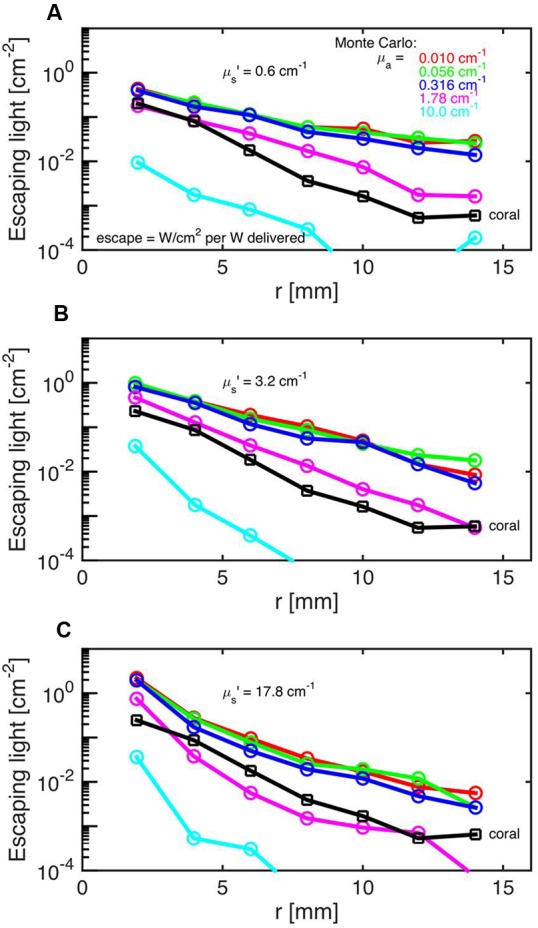
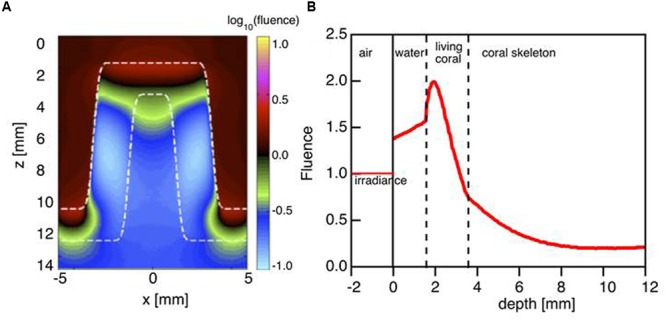
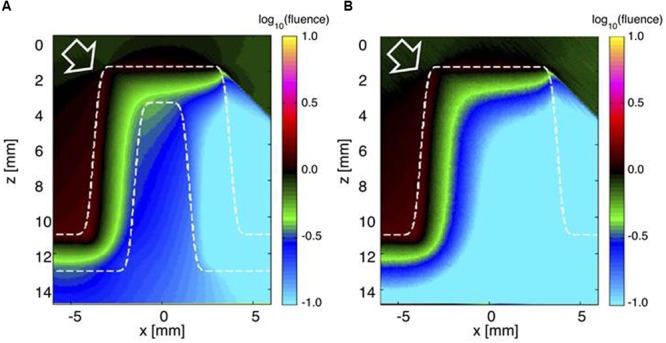
Corals are very efficient at using solar radiation, with photosynthetic quantum efficiencies approaching theoretical limits. Here, we investigated potential mechanisms underlying such outstanding photosynthetic performance through extracting inherent optical properties of the living coral tissue and skeleton in a massive faviid coral. Using Monte Carlo simulations developed for medical tissue optics it is shown that for the investigated faviid coral, the coral tissue was a strongly light scattering matrix with a reduced scattering coefficient of μ' = 10 cm (at 636 nm). In contrast, the scattering coefficient of the coral skeleton was μ' = 3.4 cm, which facilitated the efficient propagation of light to otherwise shaded coral tissue layers, thus supporting photosynthesis in lower tissues. Our study provides a quantification of coral tissue optical properties in a massive faviid coral and suggests a novel light harvesting strategy, where tissue and skeletal optics act in concert to optimize the illumination of the photosynthesizing algal symbionts embedded within the living coral tissue.
珊瑚在利用太阳辐射方面效率极高,其光合量子效率接近理论极限。在此,我们通过提取一种大型鹿角珊瑚中活珊瑚组织和骨骼的固有光学特性,研究了这种卓越光合性能背后的潜在机制。利用为医学组织光学开发的蒙特卡罗模拟表明,对于所研究的鹿角珊瑚,珊瑚组织是一个强光散射基质,其约化散射系数为μ' = 10 cm(在636 nm处)。相比之下,珊瑚骨骼的散射系数为μ' = 3.4 cm,这有利于光有效地传播到原本阴暗的珊瑚组织层,从而支持较低组织中的光合作用。我们的研究对一种大型鹿角珊瑚的珊瑚组织光学特性进行了量化,并提出了一种新的光捕获策略,即组织和骨骼光学协同作用,以优化嵌入活珊瑚组织内的光合藻类共生体的光照。