Gupta Avinash, Roberts Corran, Tysoe Finn, Goff Matthew, Nobes Jenny, Lester James, Marshall Ernie, Corner Carie, Wolstenholme Virginia, Kelly Charles, Wise Adelyn, Collins Linda, Love Sharon, Woodward Martha, Salisbury Amanda, Middleton Mark R
Department of Oncology, Oxford University Hospitals NHS Foundation Trust, Cancer and Haematology Centre, Churchill Hospital, Old Road, Oxford OX3 7LE, UK.
Centre for Statistics in Medicine, Nuffield Department of Orthopaedics, Rheumatology and Musculoskeletal Sciences, University of Oxford, Botnar Research Centre, Windmill Road, Oxford OX3 7LD, UK.
Br J Cancer. 2016 Nov 8;115(10):1193-1200. doi: 10.1038/bjc.2016.318. Epub 2016 Oct 6.
Brain metastases occur in up to 75% of patients with advanced melanoma. Most are treated with whole-brain radiotherapy (WBRT), with limited effectiveness. Vandetanib, an inhibitor of vascular endothelial growth factor receptor, epidermal growth factor receptor and rearranged during transfection tyrosine kinases, is a potent radiosensitiser in xenograft models. We compared WBRT with WBRT plus vandetanib in the treatment of patients with melanoma brain metastases.
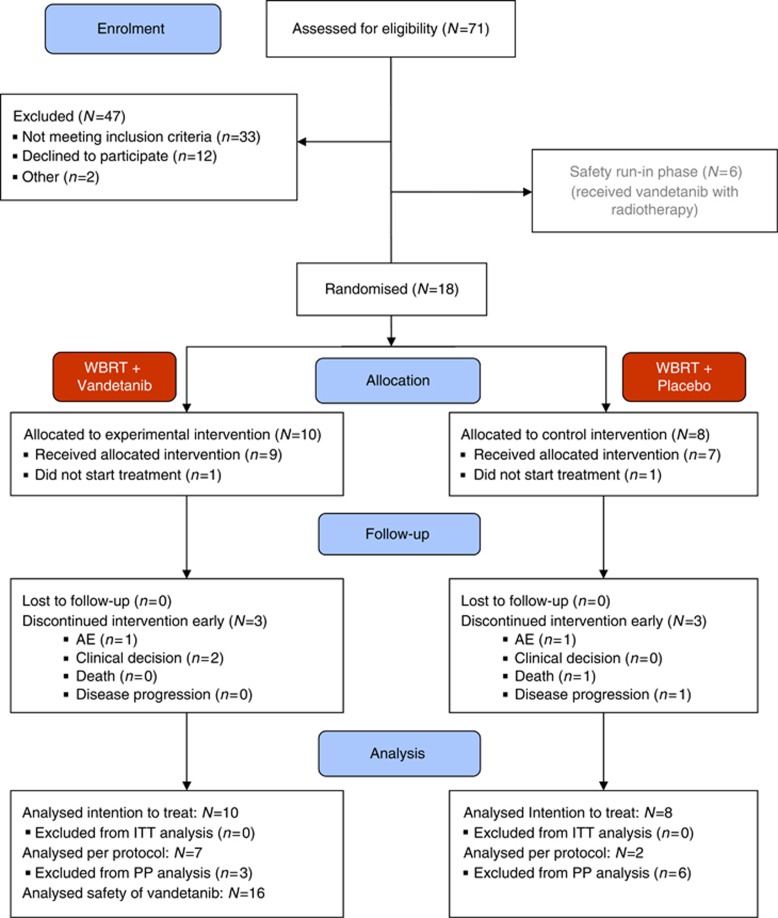
In this double-blind, multi-centre, phase 2 trial patients with melanoma brain metastases were randomised to receive WBRT (30 Gy in 10 fractions) plus 3 weeks of concurrent vandetanib 100 mg once daily or placebo. The primary endpoint was progression-free survival in brain (PFS brain). The main study was preceded by a safety run-in phase to confirm tolerability of the combination. A post-hoc analysis and literature review considered barriers to recruiting patients with melanoma brain metastases to clinical trials.
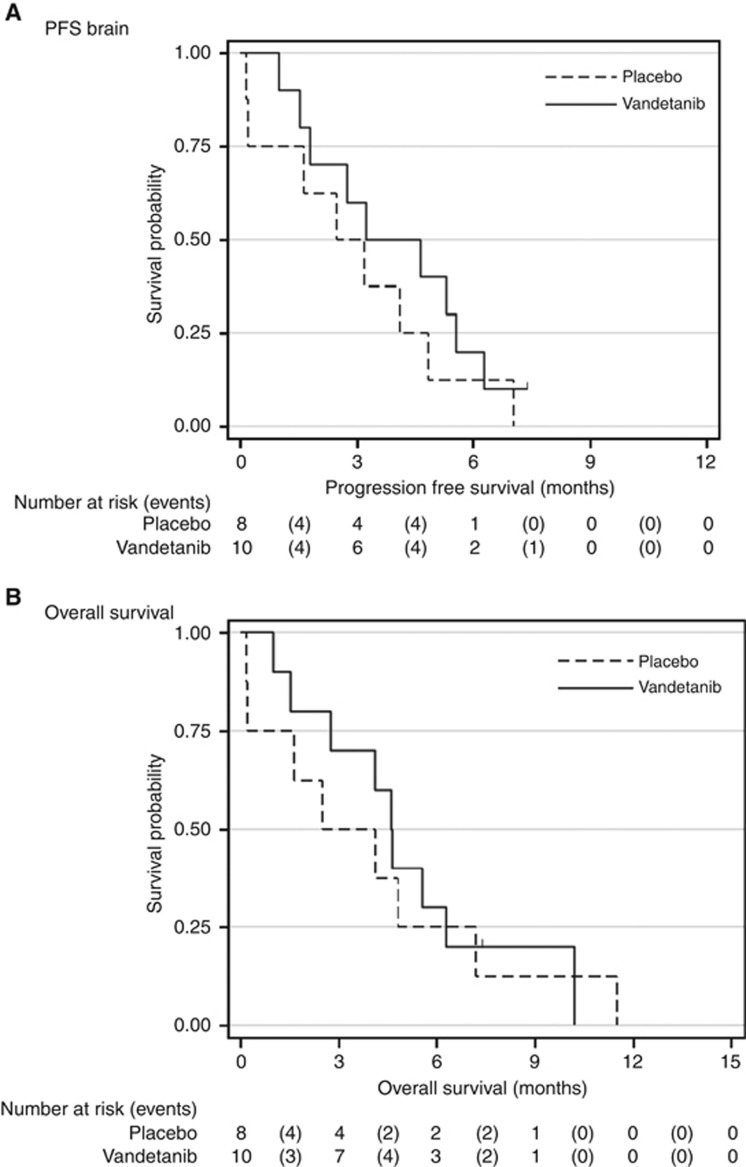
Twenty-four patients were recruited, six to the safety phase and 18 to the randomised phase. The study closed early due to poor recruitment. Median PFS brain was 3.3 months (90% confidence interval (CI): 1.6-5.6) in the vandetanib group and 2.5 months (90% CI: 0.2-4.8) in the placebo group (P=0.34). Median overall survival (OS) was 4.6 months (90% CI: 1.6-6.3) and 2.5 months (90% CI: 0.2-7.2), respectively (P=0.54). The most frequent adverse events were fatigue, alopecia, confusion and nausea. The most common barrier to study recruitment was availability of alternative treatments.
The combination of WBRT plus vandetanib was well tolerated. Compared with WBRT alone, there was no significant improvement in PFS brain or OS, although we are unable to provide a definitive result due to poor accrual. A review of barriers to trial accrual identified several factors that affect study recruitment in this difficult disease area.
高达75%的晚期黑色素瘤患者会发生脑转移。大多数患者接受全脑放疗(WBRT),但其疗效有限。凡德他尼是一种血管内皮生长因子受体、表皮生长因子受体及转染重排酪氨酸激酶的抑制剂,在异种移植模型中是一种有效的放射增敏剂。我们比较了WBRT与WBRT联合凡德他尼治疗黑色素瘤脑转移患者的疗效。
在这项双盲、多中心、2期试验中,黑色素瘤脑转移患者被随机分为接受WBRT(10次分割,共30 Gy)加3周每日1次100 mg凡德他尼或安慰剂。主要终点是脑无进展生存期(PFS脑)。在主要研究之前有一个安全性导入期,以确认联合治疗的耐受性。一项事后分析和文献综述探讨了将黑色素瘤脑转移患者纳入临床试验的障碍。
共招募了24名患者,6名进入安全阶段,18名进入随机阶段。由于入组情况不佳,研究提前结束。凡德他尼组的中位PFS脑为3.3个月(90%置信区间(CI):1.6 - 5.6),安慰剂组为2.5个月(90% CI:0.2 - 4.8)(P = 0.34)。中位总生存期(OS)分别为4.6个月(90% CI:1.6 - 6.3)和2.5个月(90% CI:0.2 - 7.2)(P = 0.54)。最常见的不良事件是疲劳、脱发、意识模糊和恶心。研究招募的最常见障碍是有其他替代治疗方法。
WBRT联合凡德他尼的耐受性良好。与单独使用WBRT相比,PFS脑或OS没有显著改善,不过由于入组不佳,我们无法得出确切结果。对试验入组障碍的综述确定了几个影响这一难治性疾病领域研究招募的因素。