Nguyen Linh Thuy, Gray Emma, O'Leary Aisling, Carr Michael, De Gascun Cillian F
National Virus Reference Laboratory, University College Dublin, Dublin, Ireland.
School of Medicine and Medical Science, University College Dublin, Dublin, Ireland.
PLoS One. 2016 Oct 6;11(10):e0163900. doi: 10.1371/journal.pone.0163900. eCollection 2016.
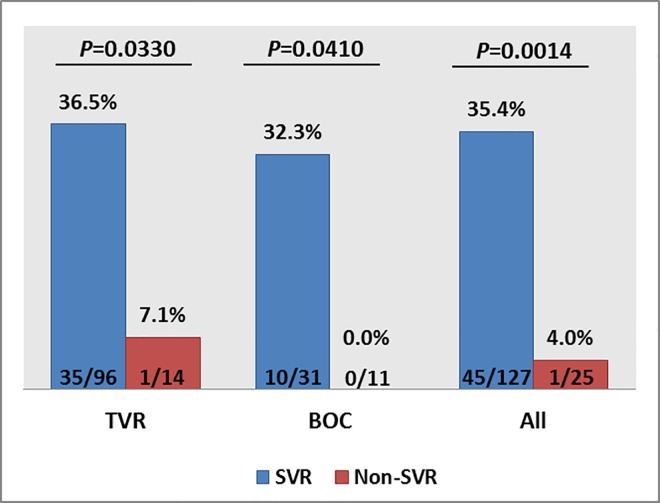
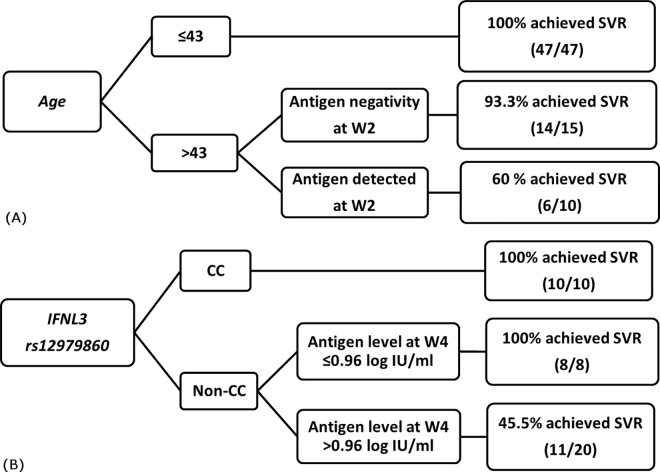
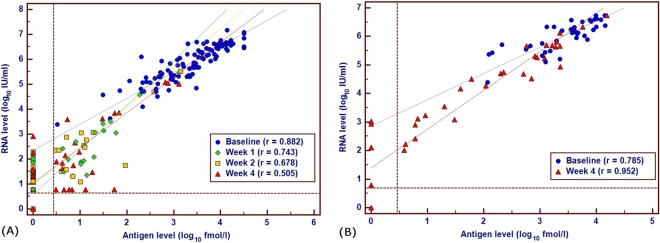
Direct-acting antiviral (DAA) therapies have revolutionised the treatment of hepatitis C virus (HCV). The financial cost of DAAs however is significant, and first generation protease inhibitors (PIs) also require frequent monitoring of viral RNA levels to guide treatment. In this context, we examined the relevance of HCV antigen testing to evaluate the potential role in monitoring virological response to HCV antiviral treatment with the PI-based triple therapies, telaprevir (TVR) and boceprevir (BOC). Chronic HCV-infected individuals (n = 152) enrolled in the Irish Hepatitis C Outcomes Research Network (ICORN) study were prospectively analysed for baseline markers and the early viral kinetics associated with SVR. The sustained virological response (SVR) rates in the cohort receiving TVR and BOC were 87.3% and 73.8%, respectively. Baseline factors associated with successful outcome in TVR therapy were age (P = 0.0098), IFNL3 genotype (P = 0.0330) and viral load (P = 0.0456). RNA level at week 4 (P = 0.0068) and viral antigen negativity at week 2 (P = 0.0359) were predictive of SVR for TVR-based therapy. In BOC therapy, prior interferon treatment (P = 0.0209) and IFNL3 genotype (P = 0.0410) were baseline predictors of SVR. Evidence of viraemia based either on viral RNA or antigen at week 4 predicted SVR in these patients. Our data showed that rapid decline of HCV antigen to negative level at week 2 in TVR treatment and <0.96 log fmol/l in BOC treatment after commencement of PI triple therapy were associated with SVR. HCV antigen measurement should be considered as a potential alternative for monitoring treatment response during DAA-based regimens.
直接抗病毒(DAA)疗法彻底改变了丙型肝炎病毒(HCV)的治疗方式。然而,DAA的经济成本高昂,第一代蛋白酶抑制剂(PI)还需要频繁监测病毒RNA水平以指导治疗。在此背景下,我们研究了HCV抗原检测的相关性,以评估其在监测基于PI的三联疗法(特拉匹韦(TVR)和博赛匹韦(BOC))对HCV抗病毒治疗的病毒学反应中的潜在作用。对纳入爱尔兰丙型肝炎结局研究网络(ICORN)研究的慢性HCV感染个体(n = 152)进行前瞻性分析,以确定基线标志物以及与持续病毒学应答(SVR)相关的早期病毒动力学。接受TVR和BOC治疗的队列中的持续病毒学应答(SVR)率分别为87.3%和73.8%。与TVR治疗成功结局相关的基线因素为年龄(P = 0.0098)、IFNL3基因型(P = 0.0330)和病毒载量(P = 0.0456)。第4周时的RNA水平(P = 0.0068)和第2周时的病毒抗原阴性(P = 0.0359)可预测基于TVR的治疗的SVR。在BOC治疗中,既往干扰素治疗(P = 0.0209)和IFNL3基因型(P = 0.0410)是SVR的基线预测指标。这些患者中,第4周基于病毒RNA或抗原的病毒血症证据可预测SVR。我们的数据显示,PI三联疗法开始后,TVR治疗第2周时HCV抗原迅速降至阴性水平以及BOC治疗时降至<0.96 log fmol/l与SVR相关。在基于DAA的治疗方案中,应考虑将HCV抗原检测作为监测治疗反应的潜在替代方法。