Yuen Hiu-Fung, Chan Ka-Kui, Platt-Higgins Angela, Dakir el-Habib, Matchett Kyle B, Haggag Yusuf Ahmed, Jithesh Puthen V, Habib Tanwir, Faheem Ahmed, Dean Fennell A, Morgan Richard, Rudland Philip S, El-Tanani Mohamed
Center for Cancer Research and Cell Biology, Queen's University Belfast, Belfast, UK.
Cancer and Polio Research Fund Laboratories, School of Biological Sciences, University of Liverpool, Liverpool, UK.
Oncotarget. 2016 Nov 15;7(46):75854-75864. doi: 10.18632/oncotarget.12420.
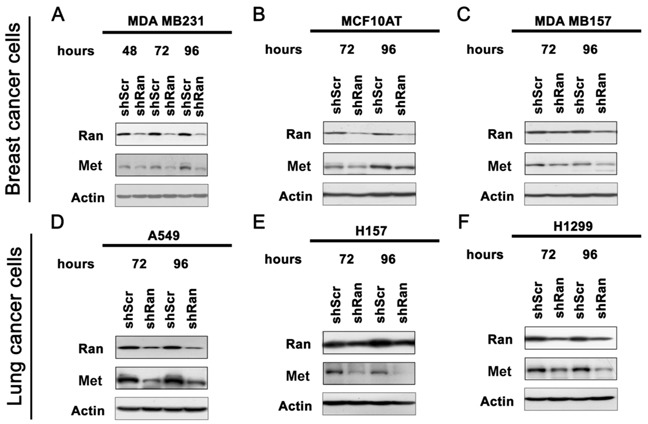
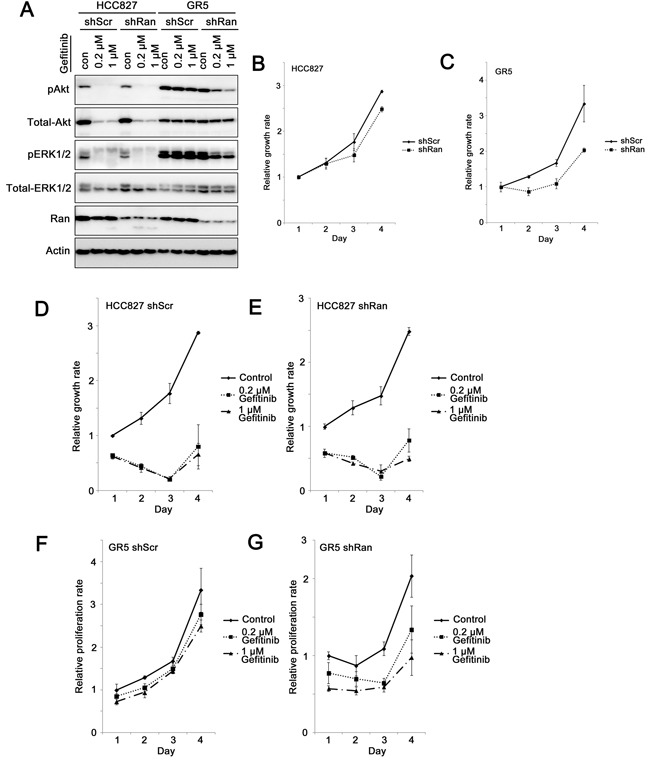
It has been shown previously that cancer cells with an activated oncogenic pathway, including Met activation, require Ran for growth and survival.Here, we show that knockdown of Ran leads to a reduction of Met receptor expression in several breast and lung cancer cell lines. This, in turn suppressed HGF expression and the Met-mediated activation of the Akt pathway, as well as cell adhesion, migration, and invasion. In a cell line model where Met amplification has previously been shown to contribute to gefitinib resistance, Ran knockdown sensitized cells to gefitinib-mediated inhibition of Akt and ERK1/2 phosphorylation and consequently reduced cell proliferation. We further demonstrate that Met reduction-mediated by knockdown of Ran, occurs at the post-transcriptional level, probably via a matrix metalloproteinase. Moreover, the level of immunoreactive Ran and Met are positively associated in human breast cancer specimens, suggesting that a high level of Ran may be a pre-requisite for Met overexpression. Interestingly, a high level of immunoreactive Ran dictates the prognostic significance of Met, indicating that the co-overexpression of Met and Ran may be associated with cancer progression and could be used in combination as a prognostic indicator.
先前的研究表明,具有激活致癌途径(包括Met激活)的癌细胞生长和存活需要Ran。在此,我们表明,敲低Ran会导致几种乳腺癌和肺癌细胞系中Met受体表达降低。这进而抑制了HGF表达以及Akt途径的Met介导的激活,以及细胞粘附、迁移和侵袭。在先前已证明Met扩增导致吉非替尼耐药的细胞系模型中,敲低Ran使细胞对吉非替尼介导的Akt和ERK1/2磷酸化抑制敏感,从而减少细胞增殖。我们进一步证明,敲低Ran介导的Met减少发生在转录后水平,可能通过基质金属蛋白酶。此外,在人乳腺癌标本中,免疫反应性Ran和Met的水平呈正相关,表明高水平的Ran可能是Met过表达的先决条件。有趣的是,高水平的免疫反应性Ran决定了Met的预后意义,表明Met和Ran的共过表达可能与癌症进展相关,并可联合用作预后指标。