Liu Ganqiang, Boot Brendon, Locascio Joseph J, Jansen Iris E, Winder-Rhodes Sophie, Eberly Shirley, Elbaz Alexis, Brice Alexis, Ravina Bernard, van Hilten Jacobus J, Cormier-Dequaire Florence, Corvol Jean-Christophe, Barker Roger A, Heutink Peter, Marinus Johan, Williams-Gray Caroline H, Scherzer Clemens R
Neurogenomics Lab and Parkinson Personalized Medicine Program, Harvard Medical School and Brigham & Women's Hospital, Cambridge, MA.
Ann Romney Center for Neurologic Diseases, Brigham and Women's Hospital, Boston, MA.
Ann Neurol. 2016 Nov;80(5):674-685. doi: 10.1002/ana.24781.
We hypothesized that specific mutations in the β-glucocerebrosidase gene (GBA) causing neuropathic Gaucher's disease (GD) in homozygotes lead to aggressive cognitive decline in heterozygous Parkinson's disease (PD) patients, whereas non-neuropathic GD mutations confer intermediate progression rates.
A total of 2,304 patients with PD and 20,868 longitudinal visits for up to 12.8 years (median, 4.1) from seven cohorts were analyzed. Differential effects of four types of genetic variation in GBA on longitudinal cognitive decline were evaluated using mixed random and fixed effects and Cox proportional hazards models.
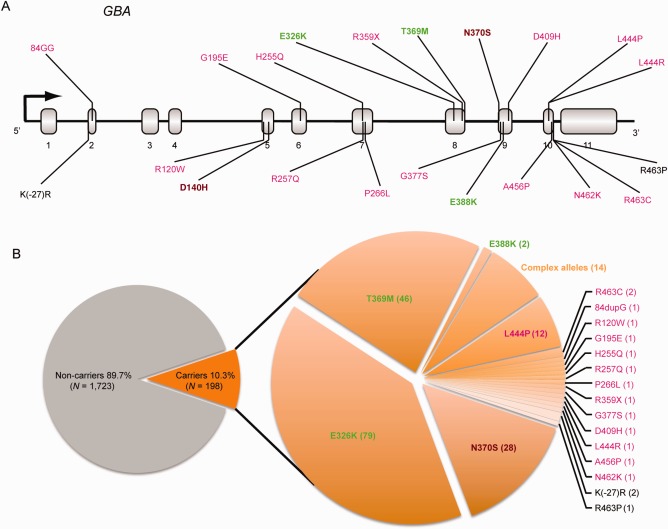
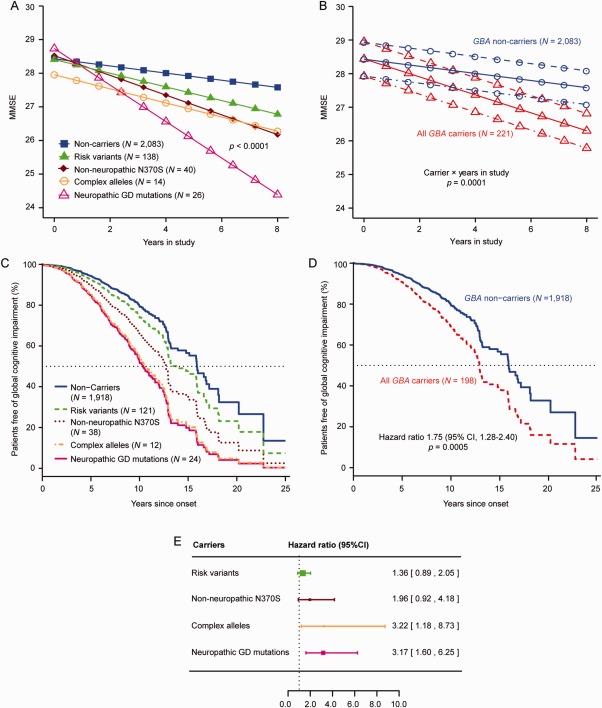
Overall, 10.3% of patients with PD and GBA sequencing carried a mutation. Carriers of neuropathic GD mutations (1.4% of patients) had hazard ratios (HRs) for global cognitive impairment of 3.17 (95% confidence interval [CI], 1.60-6.25) and a hastened decline in Mini-Mental State Exam scores compared to noncarriers (p = 0.0009). Carriers of complex GBA alleles (0.7%) had an HR of 3.22 (95% CI, 1.18-8.73; p = 0.022). By contrast, the common, non-neuropathic N370S mutation (1.5% of patients; HR, 1.96; 95% CI, 0.92-4.18) or nonpathogenic risk variants (6.6% of patients; HR, 1.36; 95% CI, 0.89-2.05) did not reach significance.
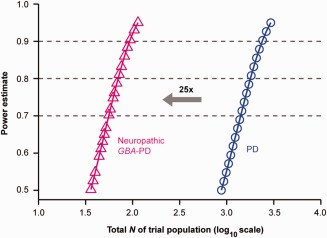
Mutations in the GBA gene pathogenic for neuropathic GD and complex alleles shift longitudinal cognitive decline in PD into "high gear." These findings suggest a relationship between specific types of GBA mutations and aggressive cognitive decline and have direct implications for improving the design of clinical trials. Ann Neurol 2016;80:674-685.
我们推测,β-葡萄糖脑苷脂酶基因(GBA)中的特定突变在纯合子中导致神经性戈谢病(GD),会使杂合子帕金森病(PD)患者出现快速认知衰退,而非神经性GD突变则导致中等程度的进展速度。
分析了来自7个队列的总共2304例PD患者以及长达12.8年(中位数为4.1年)的20868次纵向随访数据。使用混合随机和固定效应模型以及Cox比例风险模型评估GBA中四种基因变异对纵向认知衰退的不同影响。
总体而言,进行GBA测序的PD患者中有10.3%携带突变。神经性GD突变携带者(占患者的1.4%)发生全球认知障碍的风险比(HR)为3.17(95%置信区间[CI],1.60 - 6.25),与非携带者相比,简易精神状态检查表评分下降更快(p = 0.0009)。复杂GBA等位基因携带者(0.7%)的HR为3.22(95% CI,1.18 - 8.73;p = 0.022)。相比之下,常见的非神经性N370S突变(占患者的1.5%;HR,1.96;95% CI,0.92 - 4.18)或非致病性风险变异(占患者的6.6%;HR,1.36;95% CI,0.89 - 2.05)未达到显著水平。
对神经性GD致病的GBA基因突变和复杂等位基因会使PD患者的纵向认知衰退进入“高速档”。这些发现表明特定类型的GBA突变与快速认知衰退之间存在关联,对改进临床试验设计具有直接意义。《神经病学纪事》2016年;80:674 - 685。