Gotham Dzintars, Meldrum Jonathan, Nageshwaran Vaitehi, Counts Christopher, Kumari Nina, Martin Manuel, Beattie Ben, Post Nathan
Universities Allied for Essential Medicines - Europe, Berlin, Germany.
Faculty of Medicine, Imperial College London, Exhibition Road, London, United Kingdom.
Health Res Policy Syst. 2016 Oct 10;14(1):76. doi: 10.1186/s12961-016-0148-6.
Universities are significant contributors to research and technologies in health; however, the health needs of the world's poor are historically neglected in research. Medical discoveries are frequently licensed exclusively to one producer, allowing a monopoly and inequitable pricing. Similarly, research is often published in ways that make it inaccessible. Universities can adopt policies and practices to overcome neglect and ensure equitable access to research and its products.
For 25 United Kingdom universities, data on health research funding were extracted from the top five United Kingdom funders' databases and coded as research on neglected diseases (NDs) and/or health in low- and lower-middle-income countries (hLLMIC). Data on intellectual property licensing policies and practices and open-access policies were obtained from publicly available sources and by direct contact with universities. Proportions of research articles published as open-access were extracted from PubMed and PubMed Central.
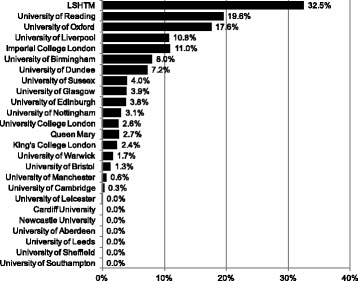
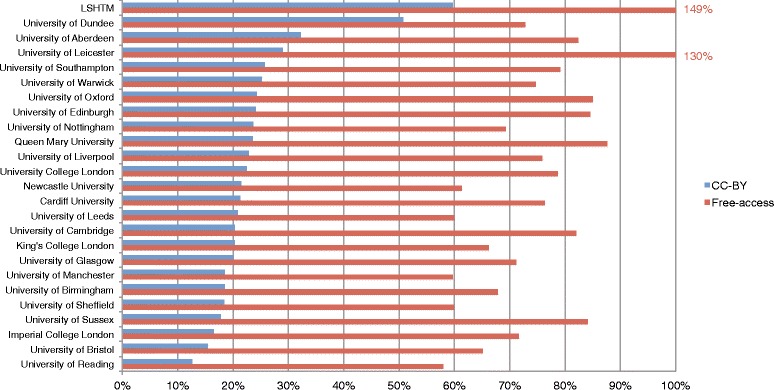
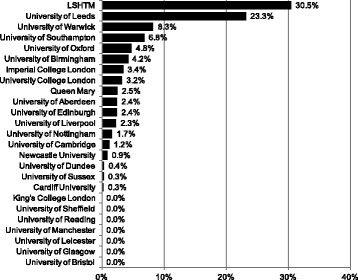
Across United Kingdom universities, the median proportion of 2011-2014 health research funds attributable to ND research was 2.6% and for hLLMIC it was 1.7%. Overall, 79% of all ND funding and 74% of hLLMIC funding were granted to the top four institutions within each category. Seven institutions had policies to ensure that technologies developed from their research are affordable globally. Mostly, universities licensed their inventions to third parties in a way that confers monopoly rights. Fifteen institutions had an institutional open-access publishing policy; three had an institutional open-access publishing fund. The proportion of health-related articles with full-text versions freely available online ranged from 58% to 100% across universities (2012-2013); 23% of articles also had a creative commons CC-BY license.
There is wide variation in the amount of global health research undertaken by United Kingdom universities, with a large proportion of total research funding awarded to a few institutions. To meet a level of research commitment in line with the global burden of disease, most universities should seek to expand their research activity. Most universities do not license their intellectual property in a way that is likely to encourage access in resource-poor settings, and lack policies to do so. The majority of recent research publications are published open-access, but not as gold standard (CC-BY) open-access.
大学是健康领域研究和技术的重要贡献者;然而,世界贫困人口的健康需求在历史上一直被研究忽视。医学发现常常被独家授权给一家生产商,从而形成垄断并导致定价不公。同样,研究成果的发表方式往往使其难以获取。大学可以采取政策和措施来克服这种忽视,并确保公平获取研究及其产品。
对于英国的25所大学,从英国五大资助者的数据库中提取健康研究资金数据,并编码为关于被忽视疾病(NDs)和/或低收入和中低收入国家(hLLMIC)健康的研究。关于知识产权许可政策和做法以及开放获取政策的数据来自公开可用来源,并通过与大学直接联系获得。从PubMed和PubMed Central中提取以开放获取形式发表的研究文章比例。
在英国各大学中,2011 - 2014年归因于ND研究的健康研究资金中位数比例为2.6%,归因于hLLMIC的为1.7%。总体而言,所有ND资金的79%和hLLMIC资金的74%授予了每个类别中的前四大机构。七所机构制定了政策,以确保其研究开发的技术在全球范围内都能负担得起。大多数情况下,大学将其发明授权给第三方的方式赋予了垄断权。15所机构有机构开放获取出版政策;三所机构有机构开放获取出版基金。各大学中可在网上免费获取全文版本的健康相关文章比例在58%至100%之间(2012 - 2013年);23%的文章还拥有知识共享CC - BY许可。
英国各大学开展的全球健康研究数量差异很大,大部分研究资金授予了少数机构。为了达到与全球疾病负担相匹配的研究投入水平,大多数大学应寻求扩大其研究活动。大多数大学对其知识产权的许可方式不太可能鼓励资源匮乏地区获取相关技术,并且缺乏这样做的政策。近期的大多数研究出版物是以开放获取形式发表的,但并非黄金标准(CC - BY)的开放获取。