Roskies M, Kay-Rivest E, Mascarella M A, Sultanem K, Mlynarek A, Hier M
Department of Otolaryngology-Head and Neck Surgery, Jewish General Hospital, McGill University, Montreal, Quebec, Canada.
Department of Radiation Oncology, Jewish General Hospital, McGill University, Montreal, Quebec, Canada.
J Otolaryngol Head Neck Surg. 2016 Oct 10;45(1):50. doi: 10.1186/s40463-016-0163-1.
A commonly employed treatment for advanced staged oropharyngeal squamous cell carcinoma (OPSCC) is concurrent radiation and chemotherapy with cisplatin as the gold standard. Carboplatin is reported to have the same radiopotentiation properties and a superior side effect profile; however, its use in head and neck cancer has been limited due to the paucity of data and reported hematologic side effects. In this study, we describe our institution's experience with carboplatin, paclitaxel and radiation in the treatment of oropharyngeal squamous cell carcinoma over a 10 year period.
A retrospective chart review of patients aged 18 to 80 years old with stage III-IV OPSCC treated with weekly carboplatin, paclitaxel and intensity modulated radiotherapy (IMRT) was performed. Data collected included patient demographics, tumor location and stage and survival outcomes. In addition, we noted treatment morbidities according to the Radiation Therapy Oncology Group (RTOG) scoring criteria scale. The data was analyzed using the student's t-test and analysis of variables.
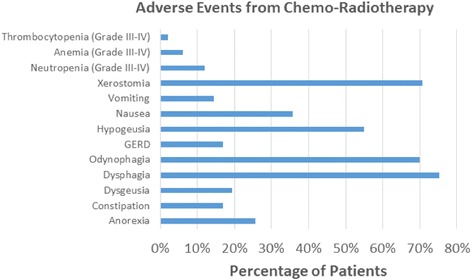
Over a 10 year period, 160 patients received chemoradiation with carboplatin and paclitaxel for OPSCC. One-hundred-four and 65 patients were followed for at least 3 and 5 years, respectively. Overall survival for all patients was 81.7 and 70.7 % at 3 and 5 years, respectively. Disease free survival and locoregional recurrence-free survival at 5 years was 64.6 and 89.2 %, respectively. There was no association of survival with stage, regional nodal status or subsite. The most common side effect attributed to treatment was acute dysphagia (75.25 %) followed by odynophagia, xerostomia and hypogeusia. Hospitalizations and non-hospitalization emergency department visits attributed to treatment totalled 33 and 11, respectively. Hematologic toxicities greater than grade II were: 11.9 % neutropenia, 6.3 % anemia, 1.8 % thrombocytopenia. The incidence of febrile neutropenia was 5.0 % (8/160).
In conclusion, the overall, disease-free and locoregional recurrence-free survival of patients treated with carboplatin and radiotherapy for advanced stage OPSCC parallels what has been described in the literature for cisplatin, with an acceptable side effect profile.
晚期口咽鳞状细胞癌(OPSCC)常用的治疗方法是顺铂同步放化疗,这是金标准。据报道,卡铂具有相同的放射增敏特性且副作用较小;然而,由于数据有限以及报道的血液学副作用,其在头颈癌中的应用受到限制。在本研究中,我们描述了我们机构在10年期间使用卡铂、紫杉醇和放疗治疗口咽鳞状细胞癌的经验。
对年龄在18至80岁、接受每周一次卡铂、紫杉醇和调强放疗(IMRT)治疗的III-IV期OPSCC患者进行回顾性病历审查。收集的数据包括患者人口统计学、肿瘤位置和分期以及生存结果。此外,我们根据放射肿瘤学组(RTOG)评分标准记录治疗并发症。使用学生t检验和变量分析对数据进行分析。
在10年期间,160例患者接受了卡铂和紫杉醇同步放化疗治疗OPSCC。分别有104例和65例患者随访至少3年和5年。所有患者3年和5年的总生存率分别为81.7%和70.7%。5年无病生存率和局部区域无复发生存率分别为64.6%和89.2%。生存率与分期、区域淋巴结状态或亚部位无关。治疗最常见的副作用是急性吞咽困难(75.25%),其次是吞咽痛、口干和味觉减退。因治疗导致的住院和非住院急诊科就诊分别为33次和11次。大于II级的血液学毒性为:11.9%的中性粒细胞减少、6.3%的贫血、1.8%的血小板减少。发热性中性粒细胞减少的发生率为5.0%(8/...160)。
总之,卡铂和放疗治疗晚期OPSCC患者的总体、无病和局部区域无复发生存率与文献中描述的顺铂相似,且副作用可接受。