Vargas José Eduardo, Chicaybam Leonardo, Stein Renato Tetelbom, Tanuri Amilcar, Delgado-Cañedo Andrés, Bonamino Martin H
Centro Infantil-Pontifícia Universidade Católica do Rio Grande do Sul-PUCRS, Porto Alegre, Brazil.
Programa de Carcinogênese Molecular, Instituto Nacional de Câncer (INCA), Rua Andre Cavalcanti 37/6º andar, Centro, Rio de Janeiro, 20231-050, Brazil.
J Transl Med. 2016 Oct 12;14(1):288. doi: 10.1186/s12967-016-1047-x.
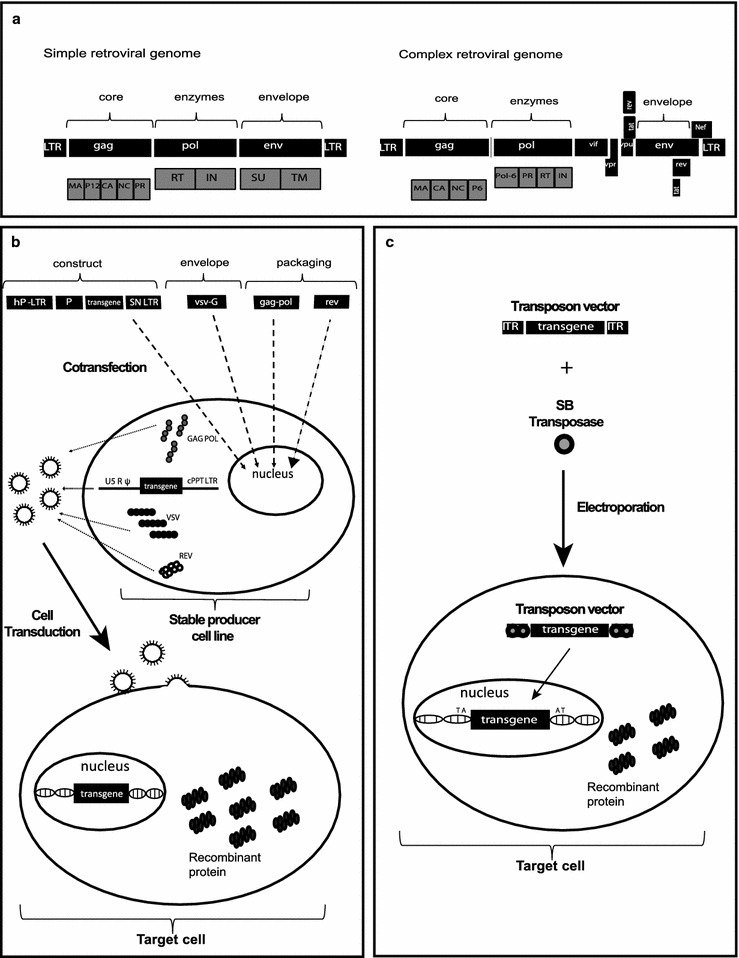
Gene therapy protocols require robust and long-term gene expression. For two decades, retrovirus family vectors have offered several attractive properties as stable gene-delivery vehicles. These vectors represent a technology with widespread use in basic biology and translational studies that require persistent gene expression for treatment of several monogenic diseases. Immunogenicity and insertional mutagenesis represent the main obstacles to a wider clinical use of these vectors. Efficient and safe non-viral vectors are emerging as a promising alternative and facilitate clinical gene therapy studies. Here, we present an updated review for beginners and expert readers on retro and lentiviruses and the latest generation of transposon vectors (sleeping beauty and piggyBac) used in stable gene transfer and gene therapy clinical trials. We discuss the potential advantages and disadvantages of these systems such as cellular responses (immunogenicity or genome modification of the target cell) following exogenous DNA integration. Additionally, we discuss potential implications of these genome modification tools in gene therapy and other basic and applied science contexts.
基因治疗方案需要强大且长期的基因表达。二十年来,逆转录病毒家族载体作为稳定的基因传递载体具有若干吸引人的特性。这些载体代表了一种在基础生物学和转化研究中广泛使用的技术,这些研究需要持续的基因表达来治疗多种单基因疾病。免疫原性和插入诱变是这些载体更广泛临床应用的主要障碍。高效且安全的非病毒载体正在成为一种有前景的替代方案,并推动临床基因治疗研究。在此,我们为初学者和专业读者提供一篇关于逆转录病毒和慢病毒以及用于稳定基因转移和基因治疗临床试验的新一代转座子载体(睡美人转座子和猪尾巴转座子)的最新综述。我们讨论了这些系统的潜在优缺点,例如外源DNA整合后的细胞反应(免疫原性或靶细胞的基因组修饰)。此外,我们还讨论了这些基因组修饰工具在基因治疗以及其他基础和应用科学背景下的潜在影响。