Gill David M, Stenehjem David D, Parikh Kinjal, Merriman Joseph, Sendilnathan Arun, Agarwal Archana M, Hahn Andrew W, Gupta Sumati, Tantravahi Srinivas Kiran, Samlowski Wolfram E, Agarwal Neeraj
University of Utah Huntsman Cancer Institute, Salt Lake City, UT 84112, USA; Equal contribution.
Department of Pharmacotherapy, College of Pharmacy, University of Utah, Salt Lake City, UT 84112, USA; Equal contribution.
Ecancermedicalscience. 2016 Sep 29;10:676. doi: 10.3332/ecancer.2016.676. eCollection 2016.
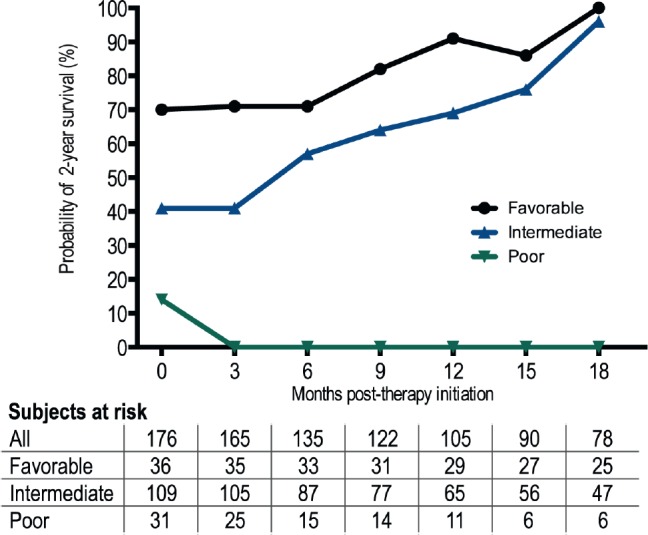
Conditional survival (CS) is a clinically useful prediction measure which adjusts a patient's prognosis based on their duration of survival since initiation of therapy. CS has been described in numerous malignancies, and recently described in patients with metastatic renal cell carcinoma (mRCC) who received vascular endothelial growth factor tyrosine kinase inhibitor (VEGFTKI) therapy. However, CS has been not reported in the context of mRCC treated with high-dose interleukin-2 therapy (HDIL-2). A total of 176 patients with histologically confirmed metastatic clear cell RCC (mccRCC) treated with HDIL-2 at the University of Utah Huntsman Cancer Institute from 1988-2012 were evaluated. Using the Heng/IMDC model, they were stratified by performance status and prognostic risk groups. Two-year CS was defined as the probability of surviving an additional two years from initiation of HDIL-2 to 18 months after the start of HDIL-2 at three-month intervals. The median overall survival (OS) was 19.9 months. Stratifying patients into favourable (n = 35; 20%), intermediate (n = 110; 63%), and poor (n = 31; 18%) prognostic groups resulted in median OS of 47.5 (HR 0.57, 95% CI 0.35-0.88, p = 0.0106 versus intermediate), 19.6 (HR 0.33, 95% CI 0.10-0.33, p < 0.0001 versus poor), and 8.8 (HR 5.34, 95% CI 3.00-9.62, p < 0.0001 versus favourable) months respectively. Two-year overall CS increased from 43% at therapy initiation to 100% at 18 months. These results have significant ramifications in prognostication. Furthermore, it is important when counseling patients with mccRCC who have completed treatment with HDIL-2 and are in active follow-up.
条件生存(CS)是一种临床实用的预测指标,它根据患者自治疗开始后的生存时间来调整其预后。CS已在多种恶性肿瘤中有所描述,最近也在接受血管内皮生长因子酪氨酸激酶抑制剂(VEGFTKI)治疗的转移性肾细胞癌(mRCC)患者中被提及。然而,在接受高剂量白细胞介素-2治疗(HDIL-2)的mRCC患者中尚未报道过CS情况。对1988年至2012年在犹他大学亨茨曼癌症研究所接受HDIL-2治疗的176例经组织学确诊的转移性透明细胞肾细胞癌(mccRCC)患者进行了评估。使用亨氏/国际转移性肾细胞癌数据库(IMDC)模型,根据患者的体能状态和预后风险组进行分层。两年CS被定义为从HDIL-2开始至HDIL-2开始后18个月,每隔三个月存活额外两年的概率。中位总生存期(OS)为19.9个月。将患者分为预后良好组(n = 35;20%)、中等组(n = 110;63%)和不良组(n = 31;18%),其OS中位数分别为47.5个月(HR 0.57,95% CI 0.35 - 0.88,与中等组相比,p = 0.0106)、19.6个月(HR 0.33,95% CI 0.10 - 0.33,与不良组相比,p < 0.0001)和8.8个月(HR 5.34,95% CI 3.00 - 9.62,与良好组相比,p < 0.0001)。两年总CS从治疗开始时的43%增加到18个月时的100%。这些结果在预后评估方面具有重要意义。此外,对于完成HDIL-2治疗并处于积极随访中的mccRCC患者进行咨询时,这一点很重要。