Zhang Xiujun, Qu Yinbo, Qin Yuqi
National Glycoengineering Research Center and State Key Lab of Microbial Technology, Shandong University, Jinan, 250100 China ; Shandong Provincial Key Laboratory of Carbohydrate Chemistry and Glycobiology, Shandong University, Jinan, 250100 China.
National Glycoengineering Research Center and State Key Lab of Microbial Technology, Shandong University, Jinan, 250100 China.
Biotechnol Biofuels. 2016 Oct 3;9:206. doi: 10.1186/s13068-016-0624-9. eCollection 2016.
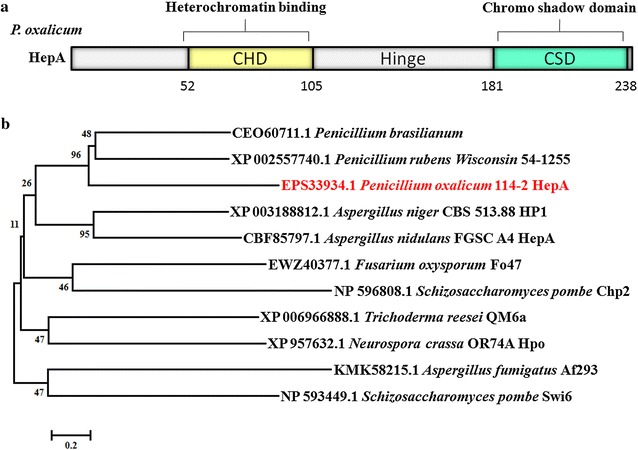
Heterochromatin protein 1 (HP1, homologue HepA in ) binding is associated with a highly compact chromatin state accompanied by gene silencing or repression. HP1 loss leads to the derepression of gene expression. We investigated HepA roles in regulating cellulolytic enzyme gene expression, as an increasingly number of studies have suggested that cellulolytic enzyme gene expression is not only regulated by transcription factors, but is also affected by the chromatin status.
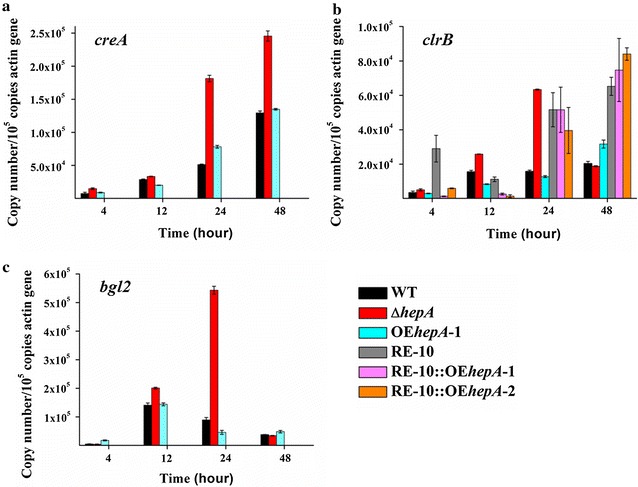
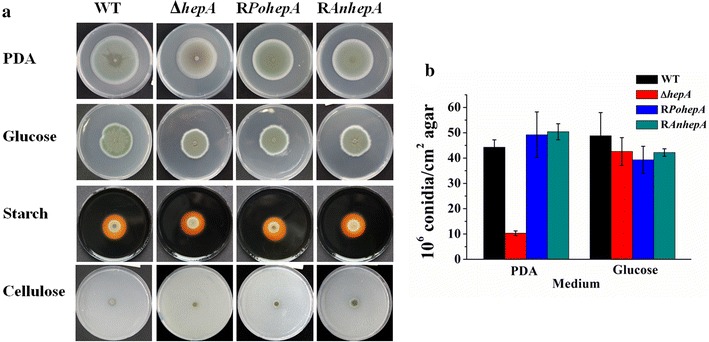
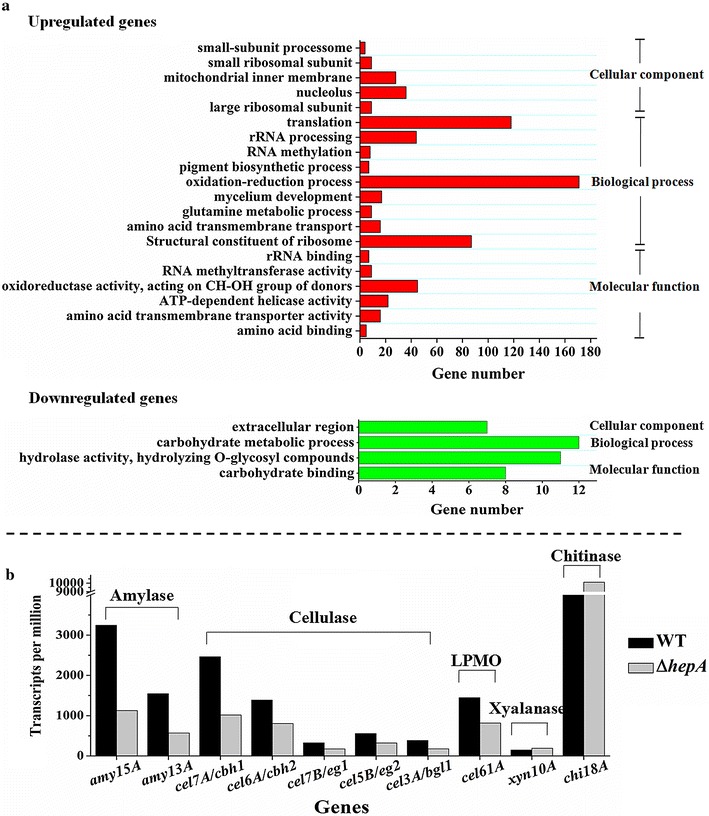
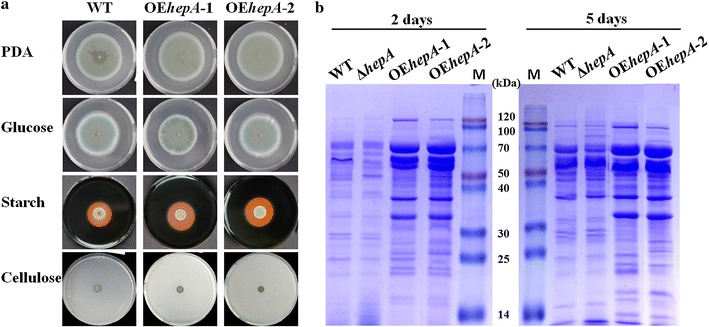
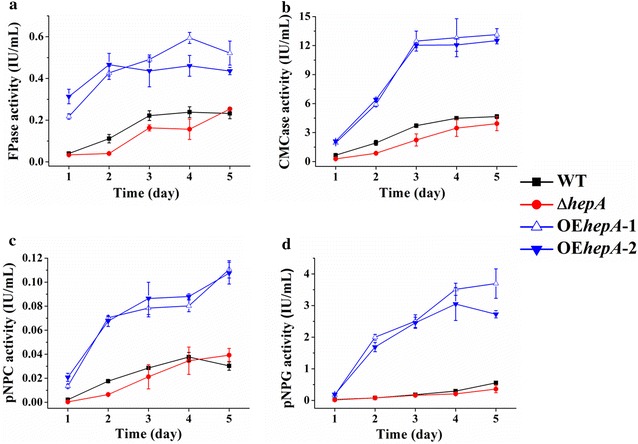
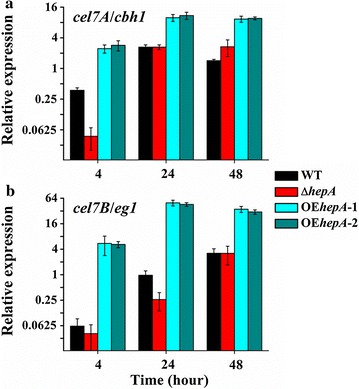
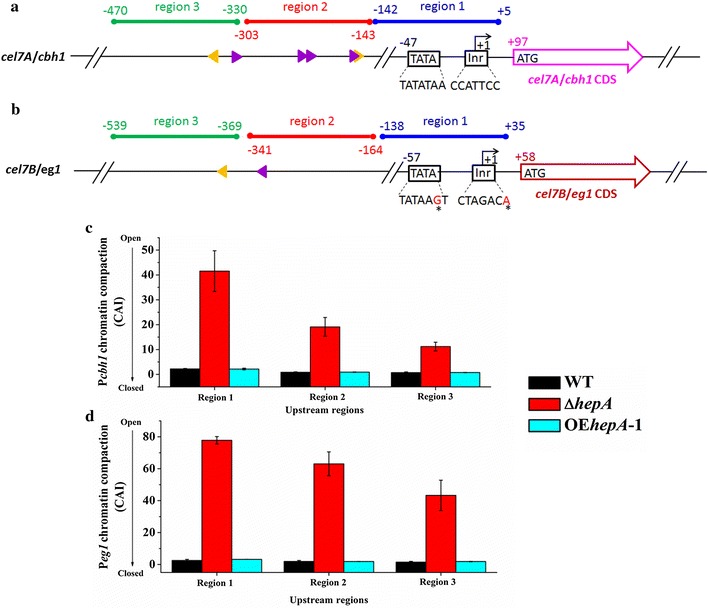
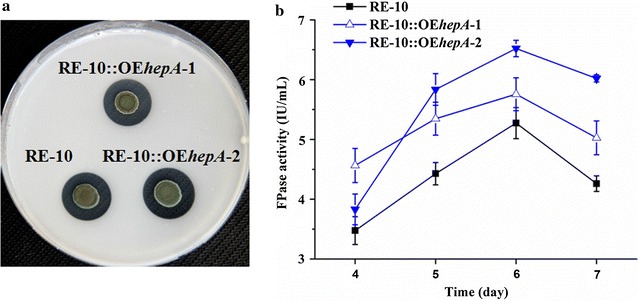
Among the genes that exhibited significant differences between the deletion strain (Δ) and the wild type (WT), most (95.0 %) were upregulated in Δ compared with WT. The expression of the key transcription factor for cellulolytic enzyme gene (e.g., repressor CreA and activator ClrB) increased significantly. However, the deletion of led to downregulation of prominent extracellular cellulolytic enzyme genes. Among the top 10 extracellular glycoside hydrolases (Amy15A, Amy13A, Cel7A/CBHI, Cel61A, Chi18A, Cel3A/BGLI, Xyn10A, Cel7B/EGI, Cel5B/EGII, and Cel6A/CBHII), in which secretion amount is from the highest to the tenth in . secretome, eight genes, including two amylase genes ( and ), all five cellulase genes (/, /, /, /, and /), and the cellulose-active LPMO gene () expression were downregulated. Results of chromatin accessibility real-time PCR (CHART-PCR) showed that the chromatin of all three tested upstream regions opened specifically because of the deletion of in the case of two prominent cellulase genes and . However, the open chromatin status did not occur along with the activation of cellulolytic enzyme gene expression. The overexpression of upregulated the cellulolytic enzyme gene expression without chromatin modification. The overexpression of remarkably activated the cellulolytic enzyme synthesis, not only in WT (150 % filter paper activity (FPA) increase), but also in the industry strain RE-10 (20-30 % FPA increase).
HepA is required for chromatin condensation of prominent cellulase genes. However, the opening of chromatin mediated by the deletion of was not positively correlated with cellulolytic enzyme gene activation. HepA is actually a positive regulator for cellulolytic enzyme gene expression and could be a promising target for genetic modification to improve cellulolytic enzyme synthesis.
异染色质蛋白1(HP1,在[具体物种]中的同源物HepA)的结合与高度紧密的染色质状态相关,伴随着基因沉默或抑制。HP1缺失导致基因表达的去抑制。我们研究了HepA在调节纤维素酶基因表达中的作用,因为越来越多的研究表明纤维素酶基因表达不仅受转录因子调节,还受染色质状态影响。
在缺失菌株(Δ)和野生型(WT)之间表现出显著差异的基因中,大多数(95.0%)在Δ中相对于WT上调。纤维素酶基因的关键转录因子(如阻遏物CreA和激活剂ClrB)的表达显著增加。然而,[具体基因]的缺失导致突出的细胞外纤维素酶基因下调。在分泌量从高到低排名前十的细胞外糖苷水解酶(Amy15A、Amy13A、Cel7A/CBHI、Cel61A、Chi18A、Cel3A/BGLI、Xyn10A、Cel7B/EGI、Cel5B/EGII和Cel6A/CBHII)中,[具体物种]分泌组中的八个基因,包括两个淀粉酶基因([基因名称1]和[基因名称2])、所有五个纤维素酶基因([基因名称3]/[基因名称4]、[基因名称5]/[基因名称6]、[基因名称7]/[基因名称8]、[基因名称9]/[基因名称10]和[基因名称11]/[基因名称12])以及纤维素活性LPMO基因([基因名称13])的表达均下调。染色质可及性实时PCR(CHART-PCR)结果表明,对于两个突出的纤维素酶基因[基因名称14]和[基因名称15],由于[具体基因]的缺失,所有三个测试的上游区域的染色质特异性开放。然而,开放的染色质状态并未伴随着纤维素酶基因表达的激活。[具体基因]的过表达上调了纤维素酶基因表达而无需染色质修饰。[具体基因]的过表达显著激活了纤维素酶的合成,不仅在WT中(滤纸活性(FPA)增加约150%),而且在工业菌株RE-10中(FPA增加约20 - 30%)。
HepA是突出的纤维素酶基因染色质浓缩所必需的。然而,由[具体基因]缺失介导的染色质开放与纤维素酶基因激活没有正相关。HepA实际上是纤维素酶基因表达的正调节因子,可能是用于改善纤维素酶合成的基因改造的有前途的靶点。