Juhásová Ludmila, Králová-Hromadová Ivica, Bazsalovicsová Eva, Minárik Gabriel, Štefka Jan, Mikulíček Peter, Pálková Lenka, Pybus Margo
Institute of Parasitology, Slovak Academy of Sciences, Hlinkova 3, 040 01, Košice, Slovakia.
Department of Molecular Biology, Faculty of Natural Sciences, Comenius University in Bratislava, Ilkovičova 6, Mlynská dolina, 842 15, Bratislava, Slovakia.
Parasit Vectors. 2016 Oct 13;9(1):547. doi: 10.1186/s13071-016-1811-z.
Fascioloides magna (Trematoda: Fasciolidae) is an important liver parasite of a wide range of free-living and domestic ruminants; it represents a remarkable species due to its large spatial distribution, invasive character, and potential to colonize new territories. The present study provides patterns of population genetic structure and admixture in F. magna across all enzootic regions in North America and natural foci in Europe, and infers migratory routes of the parasite on both continents.
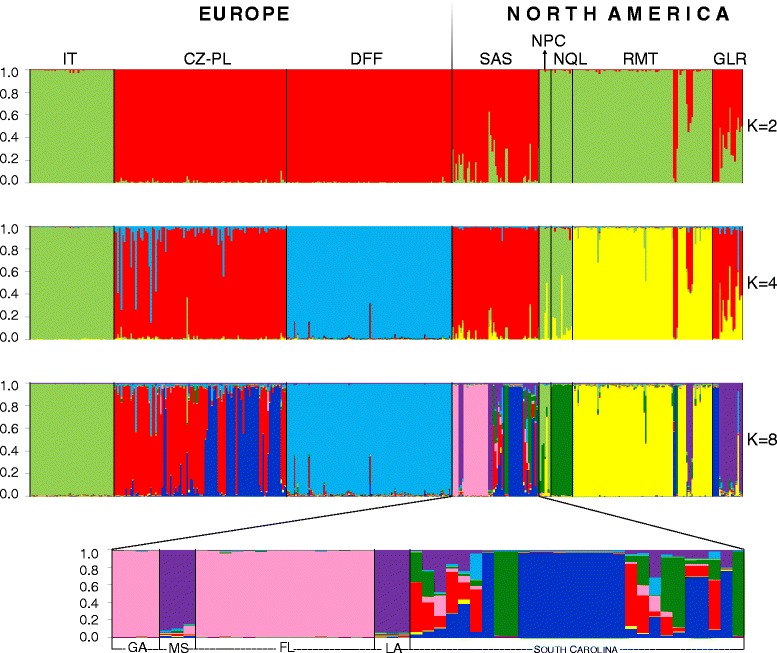
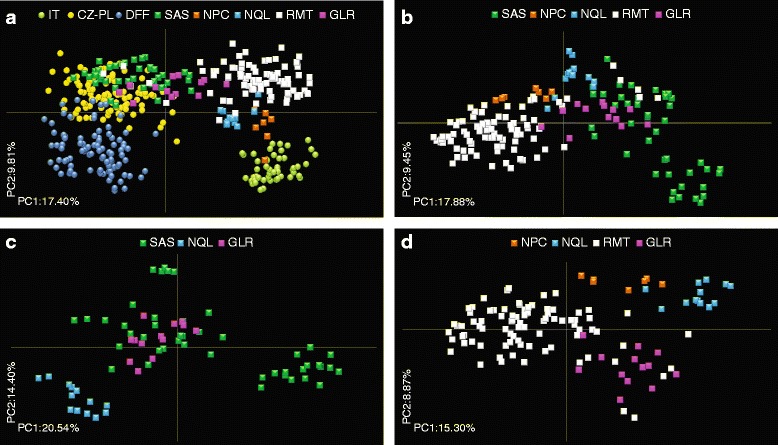
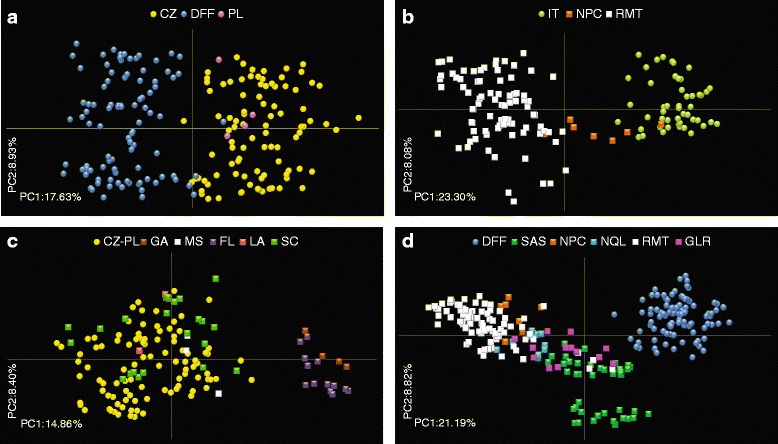
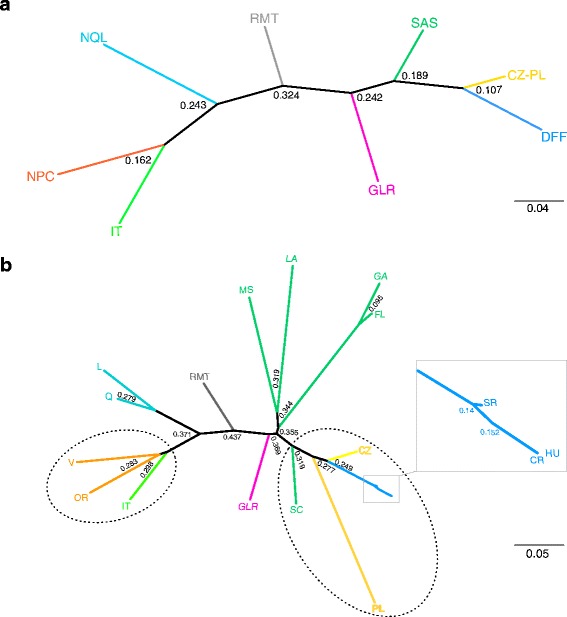
In total, 432 individuals from five North American enzootic regions and three European foci were analysed by 11 microsatellite loci. Genetic data were evaluated by several statistical approaches: (i) the population genetic structure of F. magna was inferred using program STRUCTURE; (ii) the genetic interrelationships between populations were analysed by PRINCIPAL COORDINATES ANALYSIS; and (iii) historical dispersal routes in North America and recent invasion routes in Europe were explored using MIGRATE.
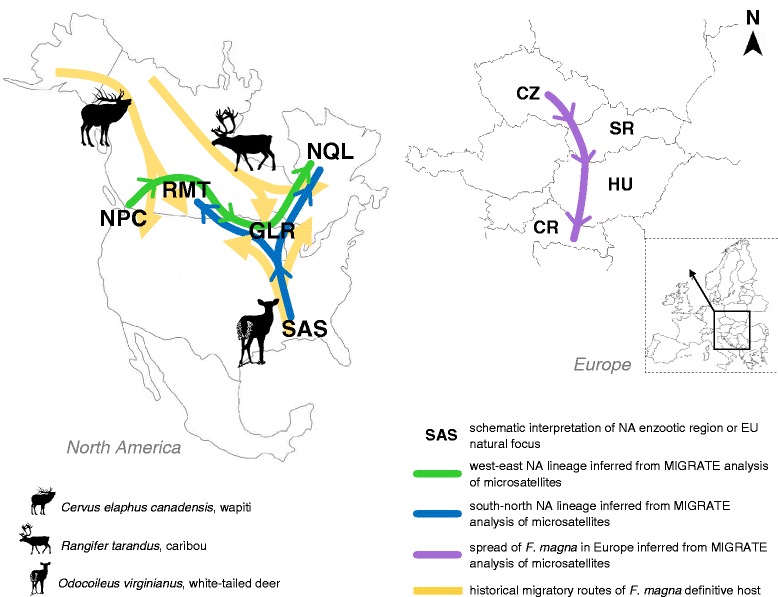
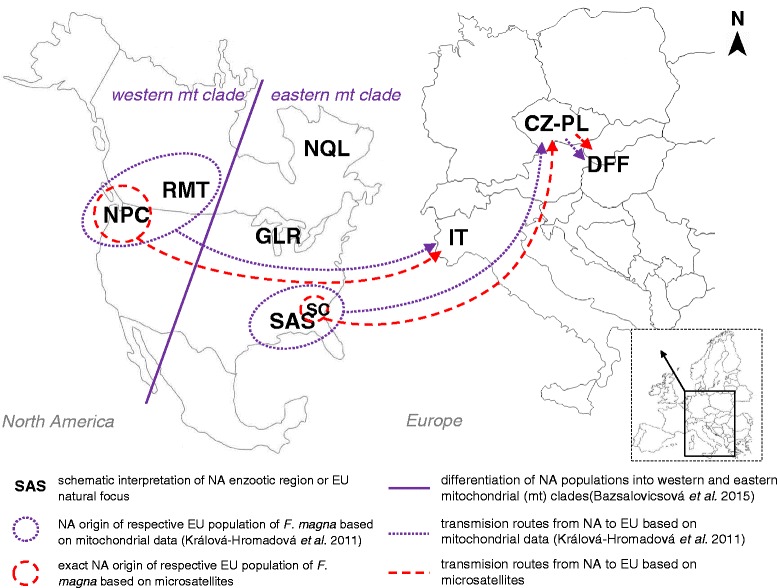
The analysis of dispersal routes of the parasite in North America revealed west-east and south-north lineages that partially overlapped in the central part of the continent, where different host populations historically met. The exact origin of European populations of F. magna and their potential translocation routes were determined. Flukes from the first European focus, Italy, were related to F. magna from northern Pacific coast, while parasites from the Czech focus originated from south-eastern USA, particularly South Carolina. The Danube floodplain forests (third and still expanding focus) did not display relationship with any North American population; instead the Czech origin of the Danube population was indicated. A serial dilution of genetic diversity along the dispersion route across central and eastern Europe was observed. The results of microsatellite analyses were compared to previously acquired outputs from mitochondrial haplotype data and correlated with past human-directed translocations and natural migration of the final cervid hosts of F. magna.
The present study revealed a complex picture of the population genetic structure and interrelationships of North American and European populations, global distribution and migratory routes of F. magna and an origin of European foci.
巨片形吸虫(吸虫纲:片形科)是多种自由生活和家养反刍动物重要的肝脏寄生虫;因其广泛的空间分布、侵袭性特征以及在新区域定殖的潜力,它是一个引人注目的物种。本研究提供了北美所有动物疫病流行区和欧洲自然疫源地的巨片形吸虫种群遗传结构和混合模式,并推断了该寄生虫在两大洲的迁徙路线。
总共对来自北美五个动物疫病流行区和欧洲三个疫源地的432个个体进行了11个微卫星位点分析。通过几种统计方法评估遗传数据:(i)使用STRUCTURE程序推断巨片形吸虫的种群遗传结构;(ii)通过主坐标分析分析种群间的遗传相互关系;(iii)使用MIGRATE探索北美历史上的扩散路线和欧洲最近的入侵路线。
对该寄生虫在北美的扩散路线分析揭示了西 - 东和南 - 北谱系,它们在大陆中部部分重叠,不同宿主种群在历史上在此相遇。确定了欧洲巨片形吸虫种群的确切起源及其潜在的迁移路线。来自欧洲第一个疫源地意大利的吸虫与北太平洋海岸的巨片形吸虫有关,而来自捷克疫源地的寄生虫起源于美国东南部,特别是南卡罗来纳州。多瑙河漫滩森林(第三个且仍在扩大的疫源地)与任何北美种群均无关联;相反,表明多瑙河种群起源于捷克。观察到沿中欧和东欧扩散路线的遗传多样性呈连续稀释。将微卫星分析结果与先前从线粒体单倍型数据获得的结果进行比较,并与过去人类主导的迁移以及巨片形吸虫最终鹿类宿主的自然迁移相关联。
本研究揭示了北美和欧洲种群的种群遗传结构和相互关系、巨片形吸虫的全球分布和迁移路线以及欧洲疫源地起源的复杂情况。