Zhao Lianxing, Li Chunsheng, Shao Rui, Fang Yingying
Department of Emergency Medicine, Beijing Chao-Yang Hospital, Capital Medical University, Chao-Yang District, Beijing, China.
Medicine (Baltimore). 2016 Oct;95(41):e4539. doi: 10.1097/MD.0000000000004539.
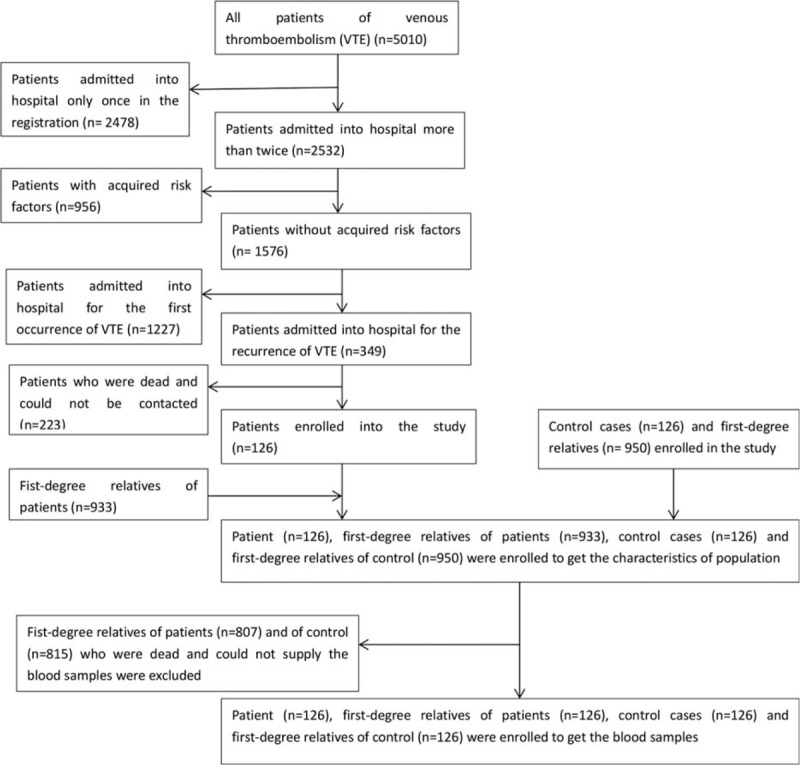
Having encountered several subjects with venous thromboembolism (VTE) in 1 family in which 1 proband has recurrent VTE (rVTE), we aimed to assess the risk of VTE in first-degree relatives, especially the children of individuals with rVTE, and to investigate the association of endothelial nitric oxide synthase (eNOS) G894T polymorphism between Chinese persons with rVTE and their offspring.We collected information about family histories and blood samples from 126 individuals with rVTE who had presented to our institute from 2003 to 2014, and 126 population-based controls and the first-degree relatives of subjects in these 2 groups. We tested blood samples for heritable thrombophilia and calculated odds ratios (ORs) and kappa coefficients.First-degree relatives of individuals with rVTE patients had a statistically significant risk of developing VTE (OR 2.62, 95% confidence interval [CI] 1.61-4.26, P < 0.001). For siblings, the OR was 2.72 (95% CI 1.56-4.73, P < .001). Moreover, for each year that the patient was older, the OR was 0.98 (95% CI 0.97-0.99, P = 0.03). One (11.2%) of the 9 individuals who had the same eNOS G894T polymorphism as their probands had a history of VTE, whereas none of the 17 relatives without the same polymorphism had developed VTE. The associations between patients and their children were statistically significant for VTE (kappa = 0.23, P < 0.001) and for eNOS G894T (kappa = 0.03, P = 0.04).In this case-controlled study, we demonstrated a higher risk of VTE among first-degree relatives of individuals with rVTE, especially in siblings of younger subjects with rVTE. We also found that eNOS G894T polymorphism may be a predictor of VTE in offspring of individuals with rVTE.
在一个家庭中遇到了几名患有静脉血栓栓塞症(VTE)的受试者,其中一名先证者有复发性VTE(rVTE),我们旨在评估一级亲属,尤其是rVTE患者子女发生VTE的风险,并研究中国rVTE患者与其后代之间内皮型一氧化氮合酶(eNOS)G894T基因多态性的关联。我们收集了2003年至2014年到我院就诊的126例rVTE患者、126例基于人群的对照以及这两组受试者的一级亲属的家族史信息和血样。我们检测血样中的遗传性易栓症,并计算比值比(OR)和kappa系数。rVTE患者的一级亲属发生VTE的风险具有统计学意义(OR 2.62,95%置信区间[CI] 1.61 - 4.26,P<0.001)。对于兄弟姐妹,OR为2.72(95% CI 1.56 - 4.73,P<0.001)。此外,患者每年长一岁,OR为0.98(95% CI 0.97 - 0.99,P = 0.03)。9名与先证者具有相同eNOS G894T基因多态性的亲属中有1名(11.2%)有VTE病史,而17名没有相同基因多态性的亲属中无人发生VTE。患者与其子女之间在VTE方面(kappa = 0.23,P<0.001)以及eNOS G894T方面(kappa = 0.03,P = 0.04)的关联具有统计学意义。在这项病例对照研究中,我们证明rVTE患者的一级亲属,尤其是年轻rVTE患者的兄弟姐妹发生VTE的风险更高。我们还发现eNOS G894T基因多态性可能是rVTE患者后代发生VTE的一个预测指标。