Liu Sidong, Cai Weidong, Liu Siqi, Zhang Fan, Fulham Michael, Feng Dagan, Pujol Sonia, Kikinis Ron
School of IT, The University of Sydney, Sydney, Australia.
Surgical Planning Laboratory, Harvard Medical School, Boston, USA.
Brain Inform. 2015 Sep;2(3):181-195. doi: 10.1007/s40708-015-0020-4. Epub 2015 Sep 4.
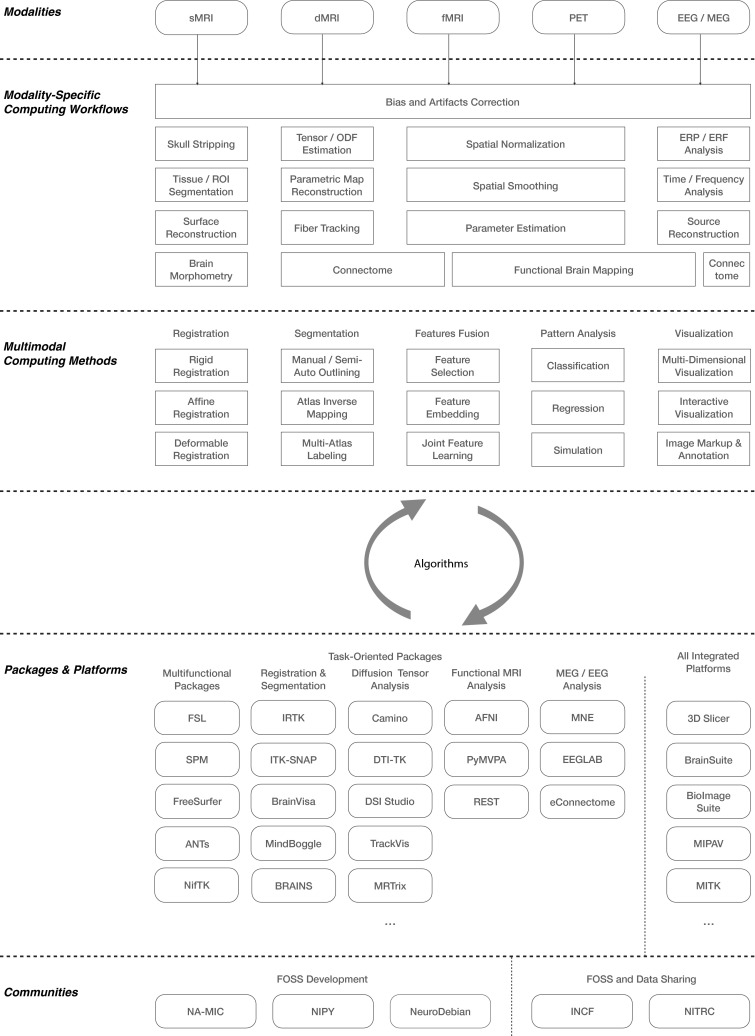
The last two decades have witnessed the explosive growth in the development and use of noninvasive neuroimaging technologies that advance the research on human brain under normal and pathological conditions. Multimodal neuroimaging has become a major driver of current neuroimaging research due to the recognition of the clinical benefits of multimodal data, and the better access to hybrid devices. Multimodal neuroimaging computing is very challenging, and requires sophisticated computing to address the variations in spatiotemporal resolution and merge the biophysical/biochemical information. We review the current workflows and methods for multimodal neuroimaging computing, and also demonstrate how to conduct research using the established neuroimaging computing packages and platforms.
在过去二十年中,非侵入性神经成像技术的开发和应用呈爆发式增长,这些技术推动了在正常和病理条件下对人类大脑的研究。由于认识到多模态数据的临床益处以及更容易获得混合设备,多模态神经成像已成为当前神经成像研究的主要驱动力。多模态神经成像计算极具挑战性,需要复杂的计算来处理时空分辨率的变化并融合生物物理/生物化学信息。我们回顾了当前多模态神经成像计算的工作流程和方法,并展示了如何使用已建立的神经成像计算软件包和平台进行研究。