George M Anne, Jin Andrew, Brussoni Mariana, Lalonde Christopher E, McCormick Rod
Department of Pediatrics, University of British Columbia, Vancouver, British Columbia, Canada.
Child & Family Research Institute, Vancouver, British Columbia, Canada.
Inj Epidemiol. 2015 Dec;2(1):7. doi: 10.1186/s40621-015-0039-2. Epub 2015 May 21.
Children and youth worldwide are at high risk of injury resulting in morbidity, disability or mortality. Disparities in risk exist between and within countries, and by sex and ethnicity. Our aim is to contribute data on disparities of injury rates for Aboriginal children and youth compared with those of the general population in British Columbia (BC), Canada, by examining risks for the two populations, utilizing provincial administrative data over a 24-year period.
Hospital discharge records from the provincial health care database for children and youth were used to identify injury for the years 1986 to 2009. Within the total BC population, the Aboriginal population was identified. Crude rates and standardized relative risks (SRR) of hospitalization were calculated, by year and category of injury type and external cause, and compared to the total BC population for males and females under age 25 years.
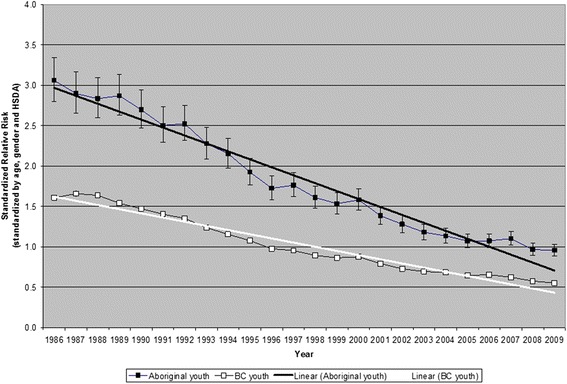
Over the 24-year period, substantive decreases were found in hospitalization injury risks for children and youth in both Aboriginal and total populations, for both sexes, and for most categories and types of injuries. Risk in overall injury dropped by 69% for the Aboriginal population and by 66% for the total BC population, yet in every year, the Aboriginal population had a higher risk than the total BC population. There were over 70% declines in risks among females of intentionally inflicted injury by another, among both the Aboriginal and total BC populations. Risk of injury caused by transport vehicles has decreased by an overwhelming 83% and 72% for the Aboriginal male population and for the total BC male population, respectively.
The over 70% declines in risks for females of intentionally inflicted injury by another, among both the Aboriginal and total BC populations is excellent news. Risk of injury caused by transport vehicles for males decreased overwhelmingly for both populations. Disparities in rates between the Aboriginal population and total BC population remain because of similarity in the proportional reductions among the two populations. Since the Aboriginal population started at a much higher risk, in absolute terms, the gap between the two populations is shrinking.
全世界的儿童和青少年面临着因受伤而导致发病、残疾或死亡的高风险。国家之间、国家内部以及不同性别和种族之间存在风险差异。我们的目标是通过在24年期间利用省级行政数据,研究加拿大不列颠哥伦比亚省(BC)原住民儿童和青少年与普通人群的受伤率差异,为这两类人群的风险情况提供数据。
使用省级医疗保健数据库中儿童和青少年的医院出院记录来确定1986年至2009年期间的受伤情况。在BC省总人口中识别出原住民人口。按年份、伤害类型和外部原因类别计算住院的粗率和标准化相对风险(SRR),并与25岁以下BC省总人口的男性和女性进行比较。
在这24年期间,原住民和总人口中的儿童和青少年、男女以及大多数伤害类别和类型的住院受伤风险都有显著下降。原住民总体伤害风险下降了69%,BC省总人口下降了66%,但每年原住民人口的风险都高于BC省总人口。原住民和BC省总人口中,女性受他人故意伤害的风险下降了70%以上。原住民男性人口和BC省男性总人口中,运输车辆造成的伤害风险分别大幅下降了83%和72%。
原住民和BC省总人口中,女性受他人故意伤害的风险下降70%以上,这是个好消息。两类人群中,男性因运输车辆造成的伤害风险都大幅下降。原住民人口与BC省总人口之间的率差仍然存在,因为两类人群的比例下降相似。由于原住民人口一开始的风险要高得多,从绝对数值来看,两类人群之间的差距正在缩小。