White Kirsten A M, Luo Li, Thompson Todd A, Torres Salina, Hu Chien-An Andy, Thomas Nancy E, Lilyquist Jenna, Anton-Culver Hoda, Gruber Stephen B, From Lynn, Busam Klaus J, Orlow Irene, Kanetsky Peter A, Marrett Loraine D, Gallagher Richard P, Sacchetto Lidia, Rosso Stefano, Dwyer Terence, Cust Anne E, Begg Colin B, Berwick Marianne
Department of Medicine, Division of Epidemiology, University of New Mexico, Albuquerque, New Mexico.
Department of Pharmaceutical Sciences, College of Pharmacy, University of New Mexico, Albuquerque, New Mexico.
Cancer Med. 2016 Nov;5(11):3336-3345. doi: 10.1002/cam4.929. Epub 2016 Oct 17.
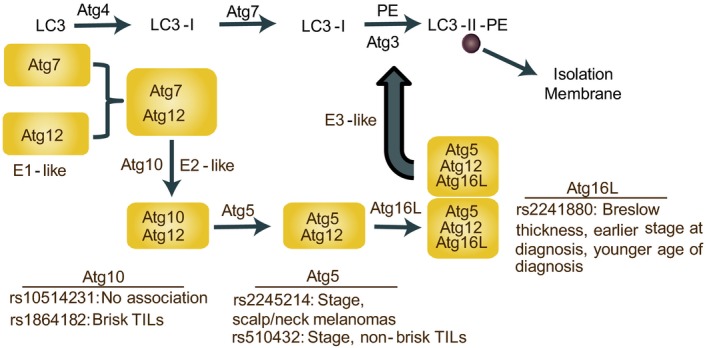
Autophagy has been linked with melanoma risk and survival, but no polymorphisms in autophagy-related (ATG) genes have been investigated in relation to melanoma progression. We examined five single-nucleotide polymorphisms (SNPs) in three ATG genes (ATG5; ATG10; and ATG16L) with known or suspected impact on autophagic flux in an international population-based case-control study of melanoma. DNA from 911 melanoma patients was genotyped. An association was identified between (GG) (rs2241880) and earlier stage at diagnosis (OR 0.47; 95% Confidence Intervals (CI) = 0.27-0.81, P = 0.02) and a decrease in Breslow thickness (P = 0.03). The ATG16L heterozygous genotype (AG) (rs2241880) was associated with younger age at diagnosis (P = 0.02). Two SNPs in ATG5 were found to be associated with increased stage (rs2245214 CG, OR 1.47; 95% CI = 1.11-1.94, P = 0.03; rs510432 CC, OR 1.84; 95% CI = 1.12-3.02, P = 0.05). Finally, we identified inverse associations between ATG5 (GG rs2245214) and melanomas on the scalp or neck (OR 0.20, 95% CI = 0.05-0.86, P = 0.03); ATG10 (CC) (rs1864182) and brisk tumor infiltrating lymphocytes (TILs) (OR 0.42; 95% CI = 0.21-0.88, P = 0.02), and ATG5 (CC) (rs510432) with nonbrisk TILs (OR 0.55; 95% CI = 0.34-0.87, P = 0.01). Our data suggest that ATG SNPs might be differentially associated with specific host and tumor characteristics including age at diagnosis, TILs, and stage. These associations may be critical to understanding the role of autophagy in cancer, and further investigation will help characterize the contribution of these variants to melanoma progression.
自噬与黑色素瘤的风险和生存率相关,但尚未对自噬相关(ATG)基因的多态性与黑色素瘤进展的关系进行研究。在一项基于国际人群的黑色素瘤病例对照研究中,我们检测了三个对自噬通量有已知或疑似影响的ATG基因(ATG5、ATG10和ATG16L)中的五个单核苷酸多态性(SNP)。对911名黑色素瘤患者的DNA进行了基因分型。发现(GG)(rs2241880)与诊断时较早分期相关(比值比[OR]为0.47;95%置信区间[CI]=0.27 - 0.81,P = 0.02),且Breslow厚度降低(P = 0.03)。ATG16L杂合基因型(AG)(rs2241880)与诊断时较年轻的年龄相关(P = 0.02)。发现ATG5中的两个SNP与分期增加相关(rs2245214 CG,OR 1.47;95% CI = 1.11 - 1.94,P = 0.03;rs510432 CC,OR 1.84;95% CI = 1.12 - 3.02,P = 0.05)。最后,我们发现ATG5(GG rs2245214)与头皮或颈部黑色素瘤之间存在负相关(OR 0.20,95% CI = 0.05 - 0.86,P = 0.03);ATG10(CC)(rs1864182)与活跃的肿瘤浸润淋巴细胞(TILs)之间存在负相关(OR 0.42;95% CI = 0.21 - 0.88,P = 0.