Qvarnström Miriam, Kahan Thomas, Kieler Helle, Brandt Lena, Hasselström Jan, Boström Kristina Bengtsson, Manhem Karin, Hjerpe Per, Wettermark Björn
Department of Medicine, Center for Pharmacoepidemiology, Karolinska Institutet Department of Clinical Sciences, Danderyd Hospital, Division of Cardiovascular Medicine, Karolinska Institutet Department of Neurobiology, Care Sciences and Society, Center for Family and Community Medicine, Karolinska Institutet, Stockholm Närhälsan R&D Primary Care, R&D-Center Skaraborg, Skövde Department of Molecular and Clinical Medicine/Cardiology, Institute of Medicine, Sahlgrenska University Hospital, Sahlgrenska Academy, University of Gothenburg, Gothenburg Department of Healthcare Development, Public Healthcare Services Committee, Stockholm County Council, Stockholm, Sweden.
Medicine (Baltimore). 2016 Oct;95(40):e4908. doi: 10.1097/MD.0000000000004908.
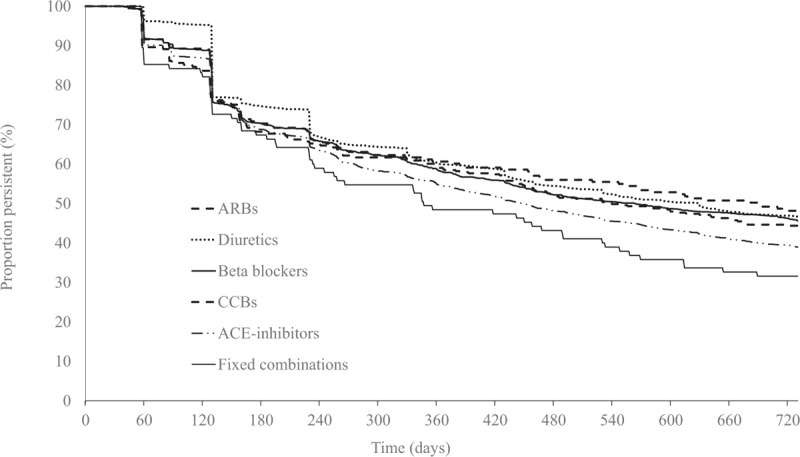
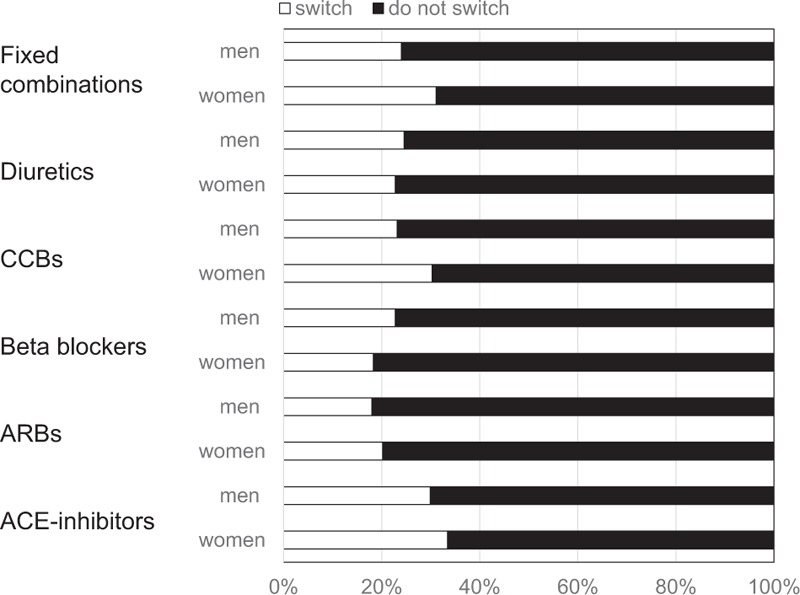
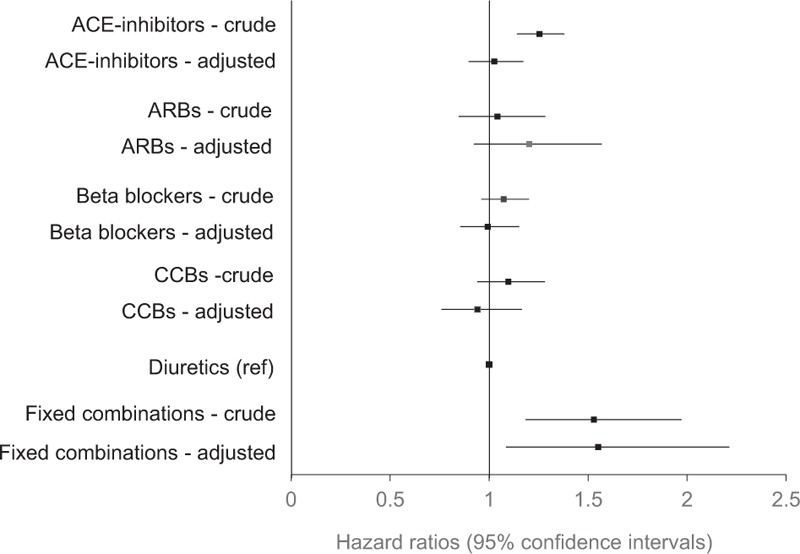
The aim was to study persistence to, and switching between, antihypertensive drug classes and to determine factors associated with poor persistence.This was an observational cohort study. The Swedish Primary Care Cardiovascular Database includes data from medical records, socioeconomic data, filled prescriptions, and hospitalizations from national registries for 75,000 patients with hypertension. Patients included in the study were initiated on antihypertensive drug treatment in primary healthcare in 2006 to 2007. We defined class persistence as the proportion remaining on the initial drug class, including 30 days of gap. Patients with a filled prescription of another antihypertensive drug class after discontinuation of the initial drug, including 30 days of gap, were classified as switchers. Persistence to the various drug classes were compared with that for diuretics.We identified 4997 patients (mean age 60 ± 12 years in men and 63 ± 13 years in women). Out of these, 95 (2%) filled their first prescription for fixed combination therapy and 4902 (98%) for monotherapy, including angiotensin converting enzyme inhibitors (37%), angiotensin receptor blockers (4%), beta blockers (21%), calcium channel blockers (8%), and diuretics (28%). Persistence to the initial drug class was 57% after 1 year and 43% after 2 years. There were no differences in persistence between diuretics and any of the other antihypertensive drug classes, after adjustment for confounders. Discontinuation (all adjusted) was more common in men (P = 0.004), younger patients (P < 0.001), those with mild systolic blood pressure elevation (P < 0.001), and patients born outside the Nordic countries (P < 0.001). Among 1295 patients who switched drug class after their first prescription, only 21% had a blood pressure recorded before the switch occurred; and out them 69% still had high blood pressures.In conclusion, there appears to be no difference in drug class persistence between diuretics and other major antihypertensive drug classes, when factors known to be associated with poor persistence are taken into account.
本研究旨在探讨高血压患者对抗高血压药物种类的持续性及换药情况,并确定与持续性差相关的因素。这是一项观察性队列研究。瑞典初级保健心血管数据库包含来自医疗记录、社会经济数据、已配药处方以及国家登记处的75000例高血压患者的住院信息。纳入研究的患者于2006年至2007年在初级医疗保健机构开始接受抗高血压药物治疗。我们将药物种类持续性定义为继续使用初始药物种类的患者比例(包括30天的间断期)。在停用初始药物后(包括30天的间断期),开具了另一种抗高血压药物处方的患者被归类为换药者。将各类药物的持续性与利尿剂进行比较。
我们共纳入4997例患者(男性平均年龄60±12岁,女性平均年龄63±13岁)。其中,95例(2%)首次开具固定复方制剂处方,4902例(98%)开具单药处方,包括血管紧张素转换酶抑制剂(37%)、血管紧张素受体阻滞剂(4%)、β受体阻滞剂(21%)、钙通道阻滞剂(8%)和利尿剂(28%)。初始药物种类的1年持续性为57%,2年持续性为43%。在调整混杂因素后,利尿剂与其他任何抗高血压药物种类的持续性无差异。停药(所有因素调整后)在男性(P = 0.004)、年轻患者(P < 0.001)、收缩压轻度升高患者(P < 0.001)以及北欧国家以外出生的患者(P < 0.001)中更为常见。在1295例首次处方后换药的患者中,只有21%在换药前记录了血压;其中69%仍患有高血压。
总之,在考虑已知与持续性差相关的因素后,利尿剂与其他主要抗高血压药物种类在药物种类持续性方面似乎没有差异。