Starost Laura Julia, Karassek Sascha, Sano Yasuteru, Kanda Takashi, Kim Kwang Sik, Dobrindt Ulrich, Rüter Christian, Schmidt Marcus Alexander
Institute of Infectiology, Center of Molecular Biology of Inflammation, Westfälische Wilhelms-Universität Münster, Münster D-48149, Germany.
Department of Neurology and Clinical Neuroscience, Yamaguchi University Graduate School of Medicine, Yamaguchi, Ube City 755-8505, Japan.
Toxins (Basel). 2016 Oct 13;8(10):291. doi: 10.3390/toxins8100291.
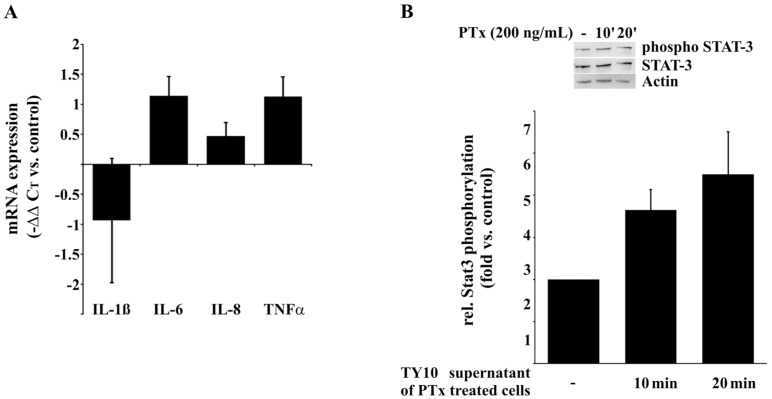
Pertussis toxin (PTx), the major virulence factor of the whooping cough-causing bacterial pathogen , permeabilizes the blood-brain barrier (BBB) in vitro and in vivo. Breaking barriers might promote translocation of meningitis-causing bacteria across the BBB, thereby facilitating infection. PTx activates several host cell signaling pathways exploited by the neonatal meningitis-causing K1-RS218 for invasion and translocation across the BBB. Here, we investigated whether PTx and K1-RS218 exert similar effects on MAPK p38, NF-κB activation and transcription of downstream targets in human cerebral endothelial TY10 cells using qRT-PCR, Western blotting, and ELISA in combination with specific inhibitors. PTx and K1-RS218 activate MAPK p38, but only K1-RS218 activates the NF-κB pathway. mRNA and protein levels of p38 and NF-κB downstream targets including IL-6, IL-8, CxCL-1, CxCL-2 and ICAM-1 were increased. The p38 specific inhibitor SB203590 blocked PTx-enhanced activity, whereas K1-RS218's effects were inhibited by the NF-κB inhibitor Bay 11-7082. Further, we found that PTx enhances the adherence of human monocytic THP-1 cells to human cerebral endothelial TY10 cells, thereby contributing to enhanced translocation. These modulations of host cell signaling pathways by PTx and meningitis-causing support their contributions to pathogen and monocytic THP-1 cells translocation across the BBB.
百日咳毒素(PTx)是引起百日咳的细菌病原体的主要毒力因子,在体外和体内均可使血脑屏障(BBB)通透性增加。破坏屏障可能会促进引起脑膜炎的细菌穿过血脑屏障,从而便于感染。PTx激活了几种宿主细胞信号通路,导致新生儿脑膜炎的K1-RS218利用这些通路穿过血脑屏障进行侵袭和移位。在此,我们使用qRT-PCR、蛋白质印迹法和ELISA并结合特异性抑制剂,研究了PTx和K1-RS218对人脑血管内皮TY10细胞中丝裂原活化蛋白激酶p38(MAPK p38)、核因子κB(NF-κB)激活及下游靶标转录是否具有相似作用。PTx和K1-RS218均可激活MAPK p38,但只有K1-RS218能激活NF-κB通路。p38和NF-κB下游靶标的mRNA和蛋白质水平,包括白细胞介素-6(IL-6)、白细胞介素-8(IL-8)、趋化因子配体-1(CxCL-1)、趋化因子配体-2(CxCL-2)和细胞间黏附分子-1(ICAM-1)均升高。p38特异性抑制剂SB203590可阻断PTx增强的活性,而K1-RS218的作用则被NF-κB抑制剂Bay 11-7082抑制。此外,我们发现PTx可增强人单核细胞THP-1细胞与人脑血管内皮TY10细胞的黏附,从而促进移位增加。PTx和引起脑膜炎的病原体对宿主细胞信号通路的这些调节作用,支持了它们在病原体和单核细胞THP-1细胞穿过血脑屏障过程中的作用。