Xu Chunxiao, Zhou Dan, Pan Feixia, Liu Yi, Zhang Dandan, Lin Aifen, Miao Xiaoping, Ni Yaqin, Lv Duo, Zhang Shuai, Li Xiaobo, Zhu Yimin, Lai Maode
Department of Epidemiology and Biostatistics, School of Public Health, Zhejiang University, 866 Yuhangtang Road, Hangzhou, 310058, Zhejiang Province, China.
Department of Chronic Non-Communicable Diseases Control and Prevention, Zhejiang Provincial Center for Disease Control and Prevention, Hangzhou, Zhejiang Province, China.
BMC Cancer. 2016 Oct 18;16(1):807. doi: 10.1186/s12885-016-2843-7.
Genes in inflammatory pathways play a pivotal role in the development of colorectal cancer. We conducted a two-stage case-control study and aimed at screening the colorectal cancer-associated genetic variations in inflammatory genes.
Twenty-three candidate variants were genotyped in 952 primary colorectal cancer cases and 875 cancer-free controls from eastern China. Promising single nucleotide polymorphisms were further genotyped in 518 cases and 554 controls from middle China. Expression quantitative trait loci and differential gene expression analyses were performed for the associated gene.
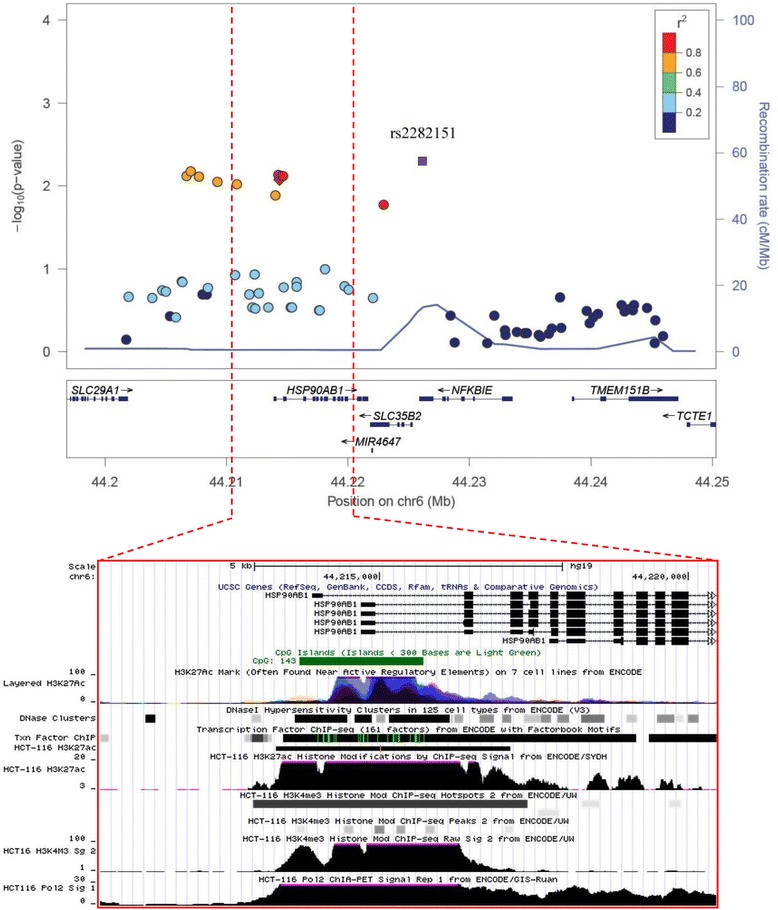
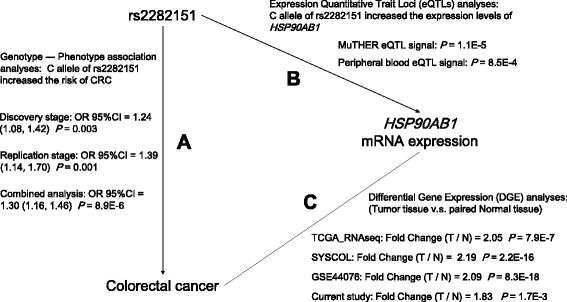
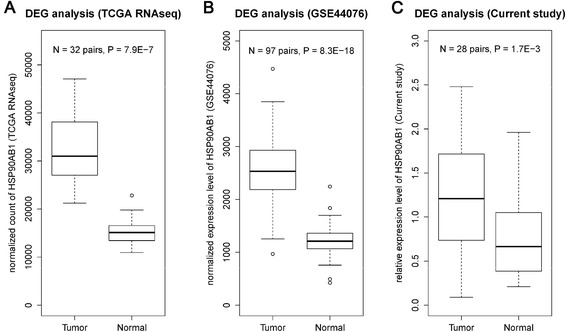
rs2282151 presented consistently significant associations with the risk of colorectal cancer in both stages (odds ratio (95 % confidence interval) = 1.30 (1.16-1.46), risk allele = C, P = 8.9E-6). Gene expression quantitative trait loci analyzes uncovered consistent cis-regulatory signals which showed that the C allele of rs2282151 was associated with increased expression level of heat shock protein 90 alpha family class B member 1 (HSP90AB1). Then we found that the mRNA expression levels of HSP90AB1 were significantly higher in tumor tissues than normal tissues (fold-change = 1.83) in 28 pairs of colorectal tissue samples. The expression difference was consistent with data from online datasets. Additionally, we observed notable peaks of H3K27ac and H3K4me3 near the first intron of HSP90AB1 using ChIP-seq data from multiple cell lines (including HCT116).
Our findings indicate that the C allele of the novel colorectal cancer-associated variant rs2282151 is associated with increased expression levels of HSP90AB1, which is expressed higher in colorectal tumor tissues than in normal tissues.
炎症通路中的基因在结直肠癌的发生发展中起关键作用。我们开展了一项两阶段病例对照研究,旨在筛查炎症基因中与结直肠癌相关的基因变异。
对来自中国东部的952例原发性结直肠癌病例和875例无癌对照进行了23个候选变异的基因分型。对来自中国中部的518例病例和554例对照进一步进行了有前景的单核苷酸多态性基因分型。对相关基因进行了表达数量性状位点和差异基因表达分析。
rs2282151在两个阶段均与结直肠癌风险呈现出一致的显著关联(优势比(95%置信区间)=1.30(1.16 - 1.46),风险等位基因为C,P = 8.9E - 6)。基因表达数量性状位点分析发现了一致的顺式调控信号,表明rs2282151的C等位基因与热休克蛋白90α家族B类成员1(HSP90AB1)的表达水平升高相关。然后我们发现,在28对结直肠组织样本中,肿瘤组织中HSP90AB1的mRNA表达水平显著高于正常组织(倍数变化=1.83)。该表达差异与在线数据集的数据一致。此外,利用来自多个细胞系(包括HCT116)的ChIP-seq数据,我们在HSP90AB1的第一个内含子附近观察到H3K27ac和H3K4me3的显著峰。
我们的研究结果表明,新发现的与结直肠癌相关的变异rs2282151的C等位基因与HSP90AB1表达水平升高相关,HSP90AB1在结直肠肿瘤组织中的表达高于正常组织。