Thiriet Pierre D, Di Franco Antonio, Cheminée Adrien, Guidetti Paolo, Bianchimani Olivier, Basthard-Bogain Solène, Cottalorda Jean-Michel, Arceo Hazel, Moranta Joan, Lejeune Pierre, Francour Patrice, Mangialajo Luisa
Université Nice Sophia Antipolis, CNRS, FRE 3729 ECOMERS, Parc Valrose 28, Nice, France.
Muséum National d'Histoire Naturelle, UMR 7208 BOREA, Station Marine de Dinard-CRESCO, Dinard, France.
PLoS One. 2016 Oct 19;11(10):e0164121. doi: 10.1371/journal.pone.0164121. eCollection 2016.
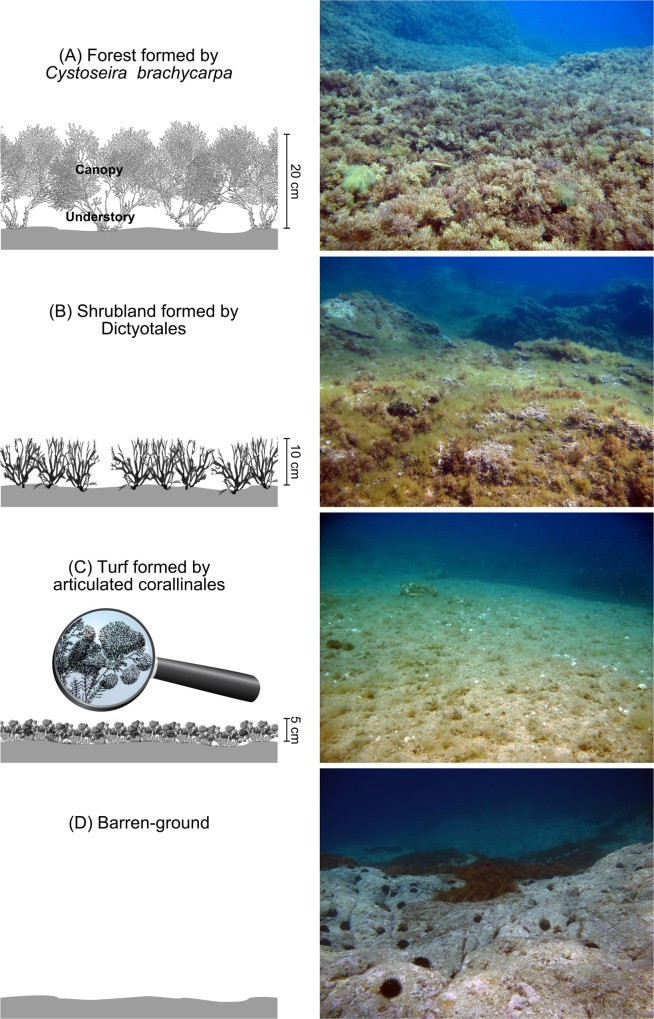
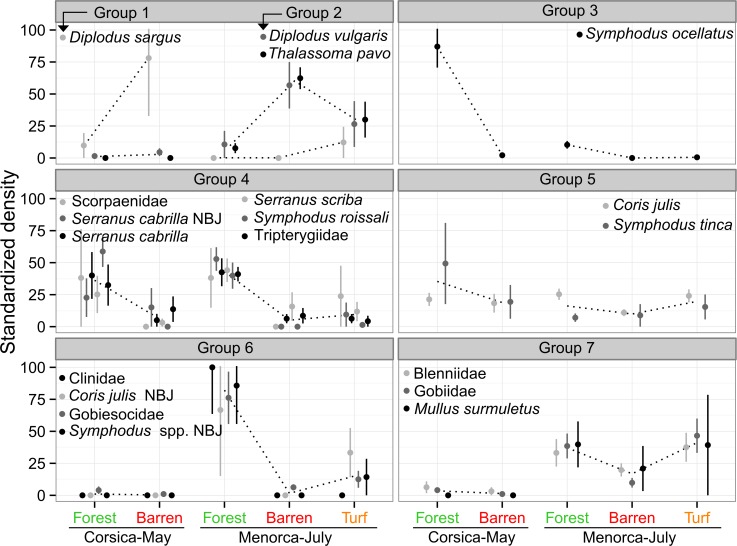
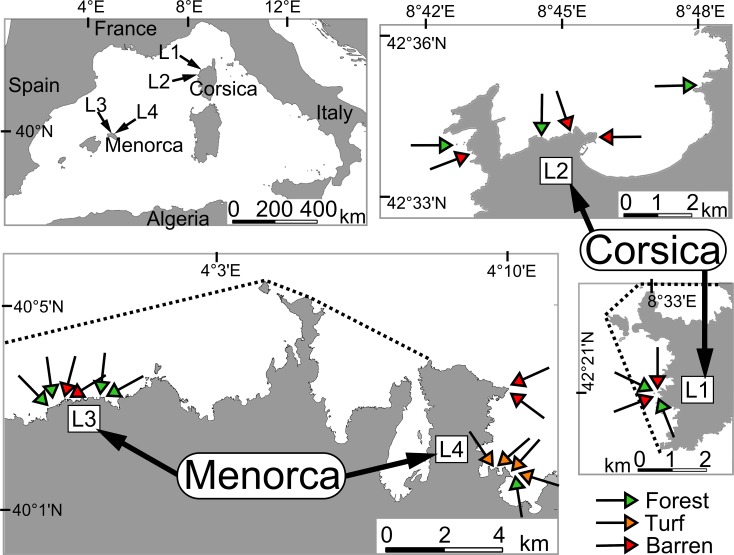
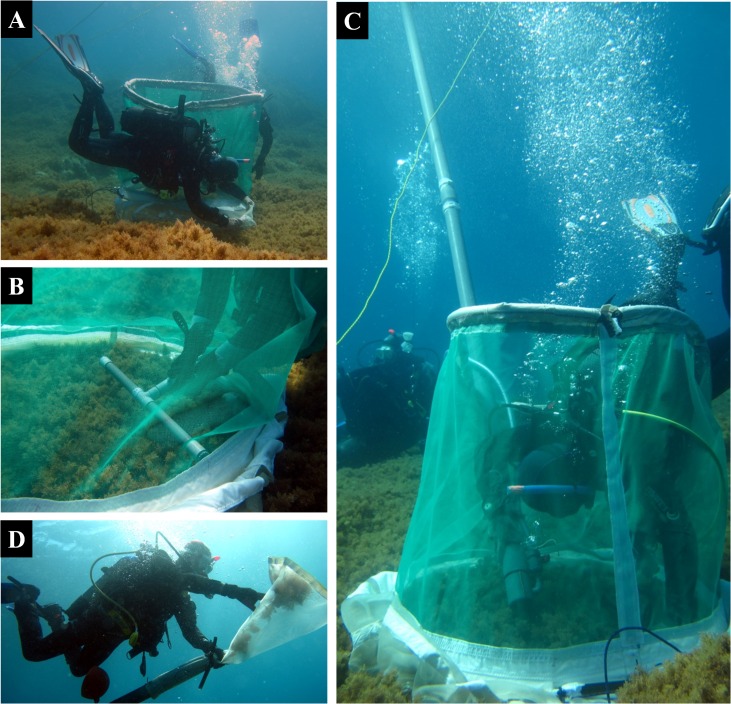
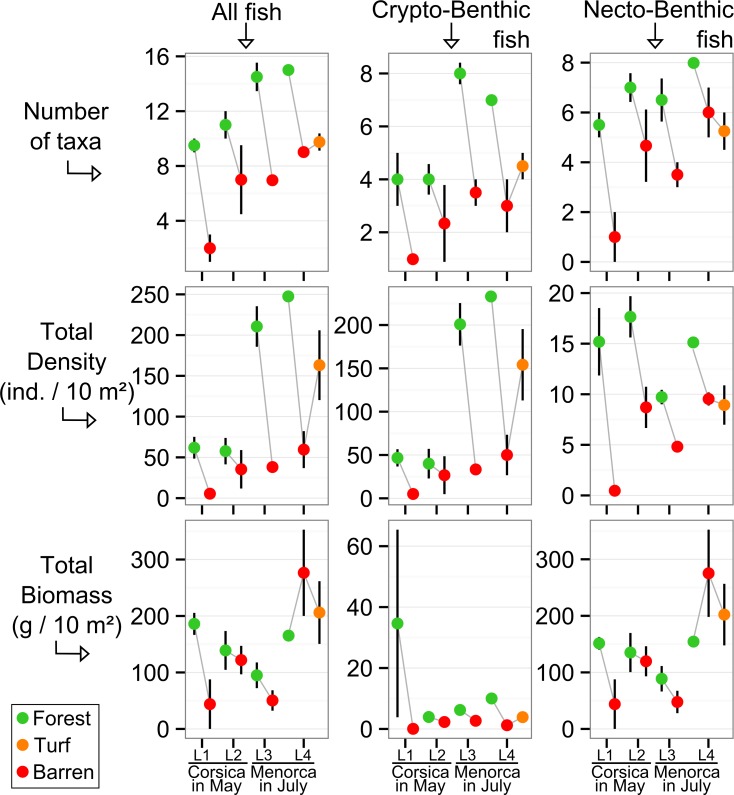
In Mediterranean subtidal rocky reefs, Cystoseira spp. (Phaeophyceae) form dense canopies up to 1 m high. Such habitats, called 'Cystoseira forests', are regressing across the entire Mediterranean Sea due to multiple anthropogenic stressors, as are other large brown algae forests worldwide. Cystoseira forests are being replaced by structurally less complex habitats, but little information is available regarding the potential difference in the structure and composition of fish assemblages between these habitats. To fill this void, we compared necto-benthic (NB) and crypto-benthic (CB) fish assemblage structures between Cystoseira forests and two habitats usually replacing the forests (turf and barren), in two sampling regions (Corsica and Menorca). We sampled NB fish using Underwater Visual Census (UVC) and CB fish using Enclosed Anaesthetic Station Vacuuming (EASV), since UVC is known to underestimate the diversity and density of the 'hard to spot' CB fish. We found that both taxonomic diversity and total density of NB and CB fish were highest in Cystoseira forests and lowest in barrens, while turfs, that could be sampled only at Menorca, showed intermediate values. Conversely, total biomass of NB and CB fish did not differ between habitats because the larger average size of fish in barrens (and turfs) compensated for their lower densities. The NB families Labridae and Serranidae, and the CB families Blenniidae, Cliniidae, Gobiidae, Trypterigiidae and Scorpaenidae, were more abundant in forests. The NB taxa Diplodus spp. and Thalassoma pavo were more abundant in barrens. Our study highlights the importance of using EASV for sampling CB fish, and shows that Cystoseira forests support rich and diversified fish assemblages. This evidence suggests that the ongoing loss of Cystoseira forests may impair coastal fish assemblages and related goods and services to humans, and stresses the need to implement strategies for the successful conservation and/or recovery of marine forests.
在地中海潮下带岩石礁中,囊藻属(褐藻门)形成了高达1米的密集冠层。这种被称为“囊藻森林”的栖息地,由于多种人为压力源,正在整个地中海范围内衰退,世界其他地方的大型褐藻森林亦是如此。囊藻森林正被结构较简单的栖息地所取代,但关于这些栖息地之间鱼类群落结构和组成的潜在差异,我们所知甚少。为填补这一空白,我们在两个采样区域(科西嘉岛和梅诺卡岛)比较了囊藻森林与通常取代森林的两种栖息地(草皮和裸地)之间的中层底栖(NB)和隐栖底栖(CB)鱼类群落结构。我们使用水下视觉普查(UVC)对NB鱼类进行采样,使用封闭麻醉站真空抽吸法(EASV)对CB鱼类进行采样,因为已知UVC会低估“难以发现”的CB鱼类的多样性和密度。我们发现,NB和CB鱼类的分类多样性和总密度在囊藻森林中最高,在裸地中最低,而仅在梅诺卡岛可以采样的草皮则呈现中间值。相反,NB和CB鱼类的总生物量在不同栖息地之间没有差异,因为裸地(和草皮)中鱼类较大的平均体型弥补了其较低的密度。NB科的隆头鱼科和鮨科,以及CB科的鳚科、颈鳍鱼科、虾虎鱼科、三鳍鳚科和鲉科,在森林中更为丰富。NB分类单元的笛鲷属和孔雀锦鱼在裸地中更为丰富。我们的研究强调了使用EASV对CB鱼类进行采样的重要性,并表明囊藻森林支持丰富多样的鱼类群落。这一证据表明,囊藻森林的持续丧失可能会损害沿海鱼类群落以及与人类相关的商品和服务,并强调需要实施相关策略,以成功保护和/或恢复海洋森林。